Servings 4
- Amount Per Serving
- % Daily Value *
- Total Fat 20g31%
- Saturated Fat 10g50%
- Sodium 420mg18%
- Total Carbohydrate 42g15%
- Dietary Fiber 2g8%
- Sugars 2g
- Protein 27g54%
* Percent Daily Values are based on a 2,000 calorie diet. Your daily value may be higher or lower depending on your calorie needs.
Note
Choosing the Right Bigoli
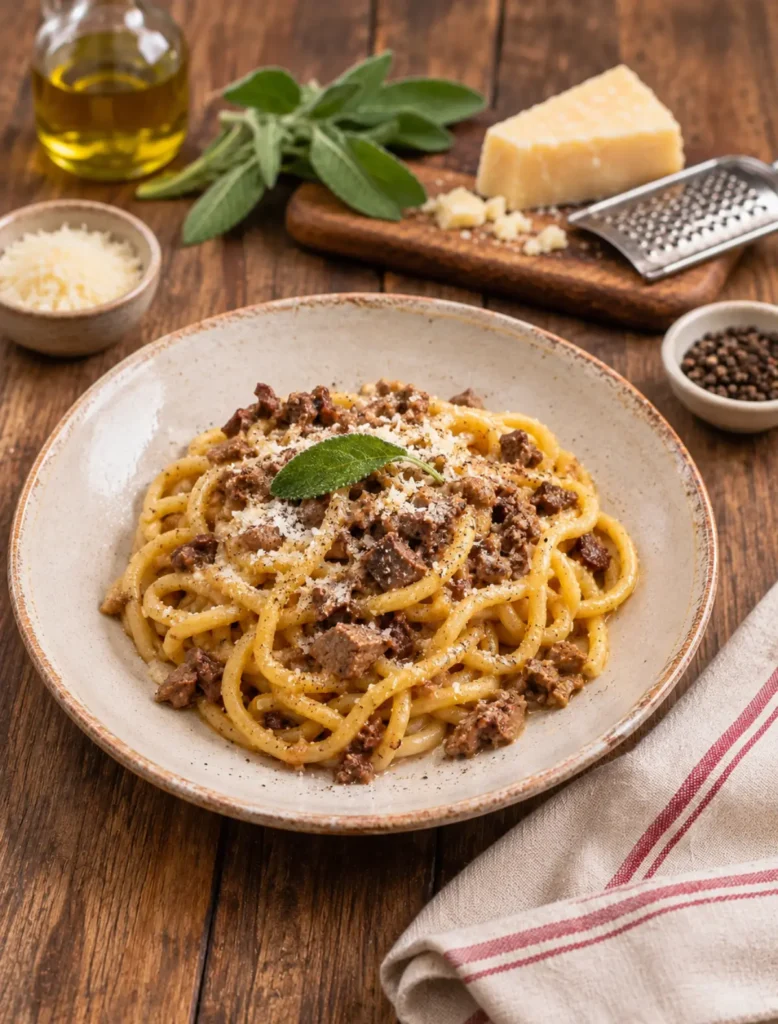
For this recipe, we prefer fresh egg-free bigoli, traditionally made with flour and water. If fresh bigoli are difficult to find, dried bigoli are a suitable alternative. Cooking times vary depending on the product, so follow the instructions on the package.
Choosing Chicken Giblets
For a balanced sauce, use a mixture of chicken livers, hearts and gizzards. You can buy them already cleaned or ask your butcher to prepare them. If purchasing them separately, try to include all three: the livers have a stronger flavour, while the hearts and gizzards provide a firmer texture.
Cooking the Giblets Safely
Chicken livers cook more quickly than hearts and gizzards, which is why they are added towards the end. The five-minute cooking time is only a guide. All the giblets must be fully cooked, reaching an internal temperature of 74°C (165°F) when checked with a food thermometer.
Storage
Bigoli coi rovinassi is best eaten immediately after cooking. Leftovers should be cooled promptly and refrigerated in an airtight container for 1–2 days. Reheat thoroughly, adding a little water if the sauce has become dry. Freezing the finished pasta dish is not recommended.
Keywords:
bigoli coi rovinassi, Venetian pasta with chicken giblets, Italian chicken liver pasta, bigoli pasta recipe, traditional Venetian pasta, pasta with chicken offal
Bigoli coi Rovinassi, a Traditional Dish from Padua
By 1931, bigoli coi rovinassi was already mentioned in the Guida gastronomica d'Italia, a gastronomic guide published by the Touring Club Italiano. In its section on Padua, the guide listed several ways of serving bigoli: with an anchovy and onion sauce, with chicken giblets or with goose.
At the time, Italian gastronomic guides paid close attention to the specialities of individual towns and provinces. Padua had its own dishes, as did Verona, Vicenza and Venice, each with recipes and customs rooted in local traditions.
Rovinassi, a Word from the Venetian Kitchen
The word rovinassi, also written rovinàzi, comes from the Venetian dialect and refers to the giblets of poultry. In households that raised chickens, the internal organs were also used in everyday cooking, often combined with rice or pasta.
In the Padua area, giblets also appear in risotto ricco alla padovana, a traditional local risotto. According to Turismo Padova, these ingredients were once known as menoaje, an older dialect word that has largely fallen out of use.
The Bigolaro and the Story of Bartolomeo Veronese
In the early seventeenth century, Bartolomeo Veronese, nicknamed Abbondanza, developed a mechanical system for producing different shapes of pasta. In 1602, he received a privilege for his invention in Vicenza. A document preserved in the State Archives of Padua records a further grant in January 1604.
The pasta press, known as the bigolaro, produced bigoli by forcing dough through a die. Operating it required considerable strength, particularly when working with firm dough. Over time, it became one of the most characteristic tools of Venetian pasta-making, used both by professional pasta makers and in home kitchens.