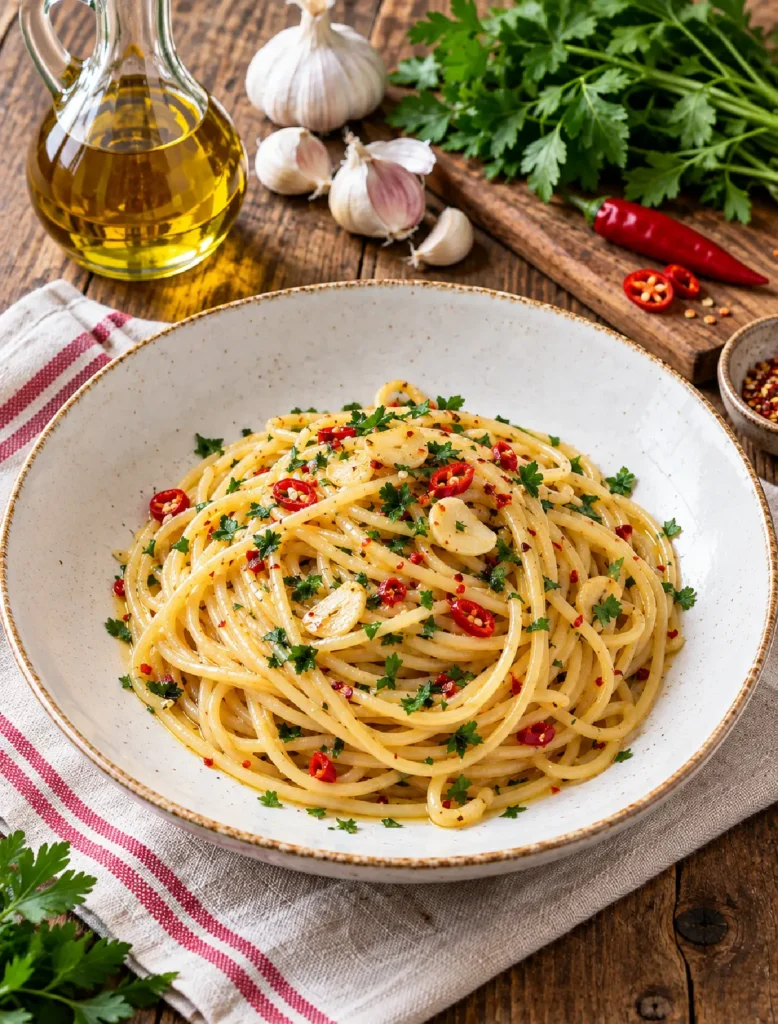
Servings 4
- Amount Per Serving
- % Daily Value *
- Total Fat 18.7g29%
- Saturated Fat 2.7g14%
- Sodium 300mg13%
- Total Carbohydrate 60.8g21%
- Dietary Fiber 2.7g11%
- Sugars 2.3g
- Protein 10.6g22%
* Percent Daily Values are based on a 2,000 calorie diet. Your daily value may be higher or lower depending on your calorie needs.
Note
The garlic should cook over low heat and take on just a little color. If it becomes too dark, it will give the oil a bitter flavor that carries through the entire dish. If you prefer a milder garlic flavor, leave the cloves whole or lightly crushed and remove them before adding the spaghetti.
The heat of a chili can vary considerably. With fresh chili, you can remove some of the seeds and inner membranes for a milder result. If using dried chili, add it directly to the oil with the garlic and adjust the amount according to its heat.
The parsley is optional. If you choose to use it, add it after turning off the heat so that it stays fresh rather than cooking in the oil.
With so few ingredients, the quality of the extra virgin olive oil is easy to taste. Choose a good one with a balanced flavor that is not excessively bitter or peppery, since there is no sauce here to mask it.
Add the pasta cooking water a little at a time. You only need enough to finish the spaghetti briefly in the pan and distribute the dressing evenly. There is no need to create a thick or particularly creamy sauce.
Aglio, Olio e Peperoncino is best served immediately. As it sits, the pasta continues to absorb the dressing and quickly loses the texture it had when first served. If you have leftovers, keep them in a sealed container in the refrigerator and eat them the following day, bearing in mind that the texture will be different.
Keywords:
aglio olio e peperoncino, spaghetti aglio olio e peperoncino, garlic olive oil pasta, spaghetti with garlic and olive oil, Neapolitan pasta
In nineteenth-century Naples, vermicelli with garlic and oil were already being eaten, and the preparation also appears in Ippolito Cavalcanti's Cucina teorico-pratica, published in 1837. Chili was not essential to the version described at the time. It would later become one of the dish's most recognizable ingredients.
This pasta also has a strong tradition in Puglia, where even its name changes from one area to another. In Bari it can be found as aglie e uglie, while in Salento it is known as spaghetti aju oju. Its presence is far from marginal: in 2026, Spaghetti aglio e olio entered Puglia's list of PAT (Traditional Agri-Food Products), in a version that also includes chili. Move over to Lazio, and the same dish is firmly established in everyday cooking, particularly in Rome.
Today, this dish is prepared throughout Italy, often without anyone even looking at a recipe. It is the pasta people make when it is late, the refrigerator is almost empty, and nobody feels like making anything complicated.