
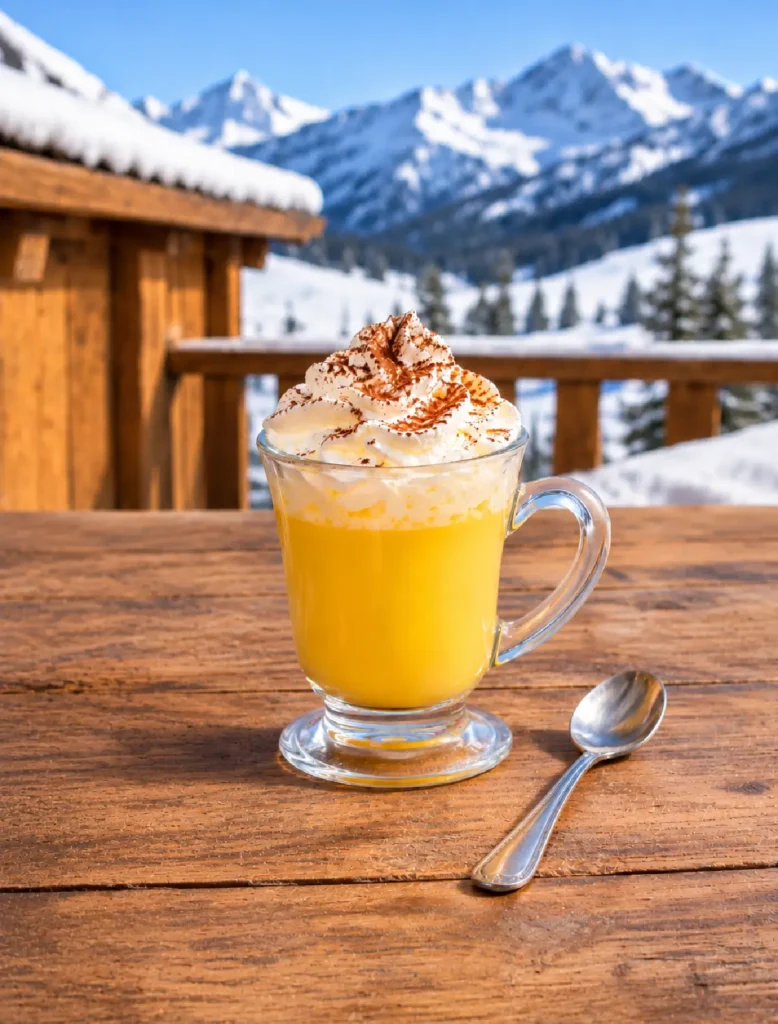
We prepare Bombardino using the original Livigno-style combination of equal parts egg liqueur and Scotch whisky, gently heated and topped with whipped cream and an optional dusting of cocoa powder.
Pour the cold whipping cream into a bowl and beat it with an electric mixer until soft but stable peaks form. Keep it refrigerated while we prepare the Bombardino. If using ready-made aerosol whipped cream, skip this step.
Pour the Vov and Scotch whisky into a small, heavy-bottomed saucepan. Heat over very low heat, stirring gently to combine the two liqueurs. The mixture should become hot without ever reaching a boil.
Remove the saucepan from the heat and immediately pour the Bombardino into a heat-resistant glass, leaving enough room for the whipped cream.
Spoon the whipped cream over the drink or pipe it on using a piping bag. If using aerosol whipped cream, dispense it directly onto the Bombardino just before serving. Dust lightly with unsweetened cocoa powder, if desired, and serve immediately while the drink is still hot.
Our recipe follows the combination of Vov and Scotch whisky traditionally attributed to Aldo Del Bò. Today, Bombardino is also commonly prepared with brandy, usually with a higher proportion of egg liqueur. For a milder variation, use 90 ml (3 fl oz) of Vov and 30 ml (1 fl oz) of brandy, keeping the same amount of whipped cream.
Vov is the Italian egg liqueur associated with the history of Bombardino, but it can be replaced with another creamy egg liqueur. The sweetness and consistency may vary depending on the product. Advocaat, commonly available in several European countries, is one possible alternative.
Heat the mixture gently and never let it boil. Excessive heat can affect the texture of the egg liqueur and diminish the whisky's aroma. If using a kitchen thermometer, aim for approximately 55–60°C (131–140°F).
Bombardino is best enjoyed immediately after preparation. Freshly whipped cream can be kept covered in the refrigerator for a few hours, but we recommend heating the liqueurs only when ready to serve. If using aerosol whipped cream, add it at the last moment, as it tends to lose its volume quickly.
With 60 ml (2 fl oz) of Scotch whisky and the same amount of Vov, this traditional-style Bombardino is considerably stronger than many modern versions. For a smaller serving, reduce both quantities while keeping the same proportions.
In 1972, the Mottolino ski facilities in Livigno, in the Italian Alps, were managed by Aldo Del Bò, a man from Genoa, a former Alpine troops officer and an enthusiast of Scotch whisky. The mountain refuge already served hot Vov, an Italian egg liqueur familiar to skiers. Del Bò came up with the idea of adding whisky, creating a mixture that soon began attracting customers at Mottolino.
Erich Bruno Ciapponi, who was managing the refuge at the time, later recalled those early days. In a 2017 interview, he said he had been the first to serve the drink created by Del Bò. Among the most regular customers were ski instructors, who had just ten minutes between lessons to stop at the bar. Back then, nobody was asking for a Bombardino. They simply ordered hot Vov with whisky.
The name reportedly emerged during a meeting of Italian ski resort directors held in Livigno. After lunch, Del Bò offered the guests a taste of the new drink from Mottolino. According to the story, one of them was so struck by its strength that he exclaimed, "Accidenti! È una bombarda!", roughly meaning "Good heavens! It's a bomb!"
The expression caught on, and the name Bombardino, literally "little bomb", began spreading through the bars of Livigno. Ciapponi, who attended the meeting, said many years later that he could no longer remember who had spoken those words, although he still clearly recalled the gathering and the first tastings.
Erich Ciapponi had known hot egg liqueur long before arriving at Mottolino. As a teenager, around the age of fifteen, he used to ski on the Parsenn slopes near Davos, Switzerland. At the mountain refuges, he was served a drink called Snowball, made with egg liqueur and plenty of milk to reduce its alcoholic strength.
In the early days at Livigno, ski instructors also had a habit of adding cold milk to their mixture of Vov and whisky. This allowed them to drink it more quickly during their short breaks between lessons. The whipped cream now closely associated with Bombardino became popular later.
The history of Vov begins in Padua in 1845, at the pastry shop of Gian Battista Pezziol. Making nougat required large quantities of egg whites, leaving more yolks than the shop could use in its other preparations. Pezziol decided to combine them with sugar, Marsala wine and alcohol, producing a liqueur he named Vov, from the Venetian word vovi, meaning eggs.
The product became successful beyond the Veneto region. In 1856, it received recognition from the Austrian imperial court, and in 1869 Pezziol was awarded a silver medal at the Provincial Exhibition of Padua.
During the Second World War, the liqueur was also supplied to Italian troops. For this purpose, it was marketed under the name VAV2, an abbreviation of Vino Alimento Vigoroso, meaning "Invigorating Food Wine", and packaged in containers that were easier to transport than traditional glass bottles.
The new drink initially spread to other establishments in Livigno. An important role was played by Gaspare Mango, bartender at Tea del Vidal, an après-ski venue in the Mottolino area that also operated as a nightclub at the time.
In the early 1970s, Mango presented Bombardino as a non-competitive entry at an event organised in the Aosta Valley by AIBES, the Italian Association of Bartenders and Supporters. It was an opportunity to introduce the Mottolino creation to professional bartenders beyond the mountain bars where it had originated.
Over the following years, Bombardino reached other Italian ski resorts and eventually spread across the Alps, becoming known in France, Switzerland and Austria.