Servings 4
- Amount Per Serving
- % Daily Value *
- Total Fat 31g48%
- Saturated Fat 15g75%
- Sodium 600mg25%
- Total Carbohydrate 22g8%
- Dietary Fiber 1g4%
- Sugars 2g
- Protein 65g130%
* Percent Daily Values are based on a 2,000 calorie diet. Your daily value may be higher or lower depending on your calorie needs.
Note
The quantity of breadcrumbs gives you enough room to coat the chops properly; you will not necessarily use all of them.
The same applies to the butter left in the pan. For this reason, the nutritional values are necessarily estimates and will vary according to how much breadcrumb coating adheres to the meat and how much butter is absorbed during cooking.
If your chops are particularly thick, do not increase the heat to speed up the cooking. Give them a little more time instead, keeping an eye on the color of the breadcrumb coating.
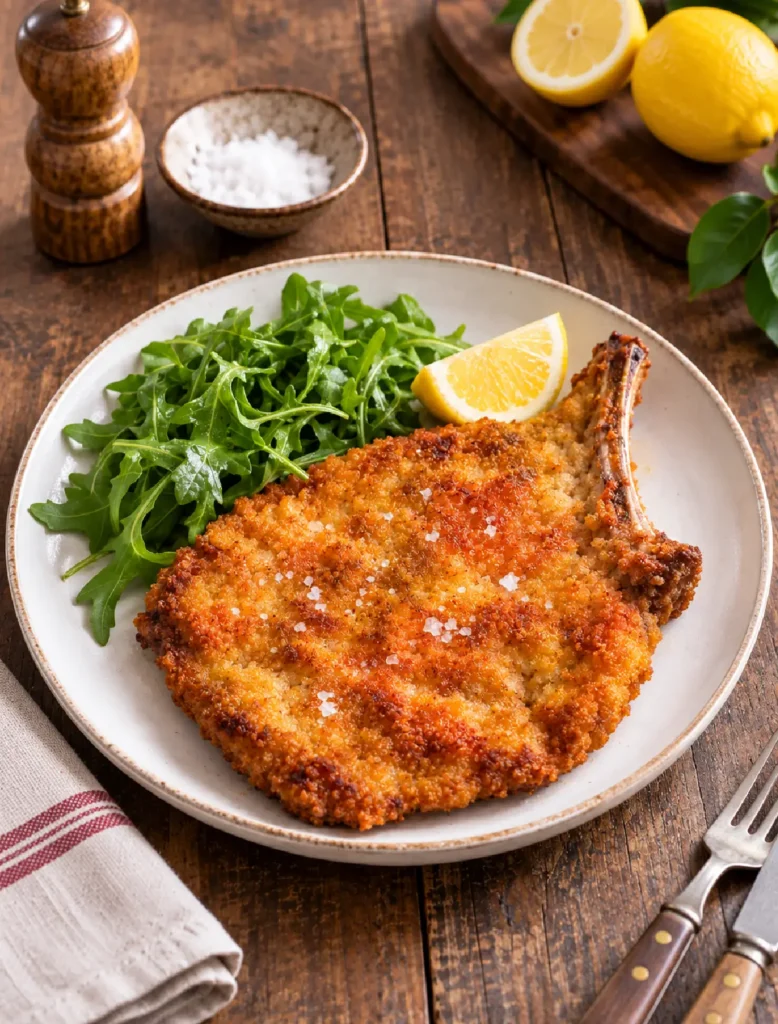
Season the cotoletta after cooking. If serving it with lemon, bring the wedges to the table without squeezing them over the breadcrumb coating beforehand.
Keywords:
Cotoletta alla Milanese, Milanese veal cutlet, Italian veal cutlet, breaded veal cutlet, bone-in veal cutlet
Mention the origins of Cotoletta alla Milanese and sooner or later the year 1134 appears. A document concerning a meal served to the canons of Sant'Ambrogio contains the expression lombolos cum panitio, later mentioned by Pietro Verri in his Storia di Milano. From those few Latin words came one of the most persistent stories surrounding the dish: that breaded meat was already being eaten in medieval Milan.
Those words, however, are not a recipe. The meaning of cum panitio does not tell us enough to reconstruct the dish with certainty, and identifying it directly with the cotoletta we know today goes further than the document itself allows.
In 1855, Giuseppe Sorbiatti left considerably less to decipher. His Gastronomia Moderna contains “costoline di vitello fritte alla milanese” — Milanese-style fried veal chops. Here the connection with the modern dish becomes much easier to recognize.
Then there is Radetzky. According to the famous story, Austrian field marshal Josef Radetzky discovered cotoletta while in Lombardy and helped introduce the recipe to Vienna, where it would eventually become associated with Wiener Schnitzel. It is an excellent story: Milan, the Austrian Empire, a field marshal and a recipe crossing the Alps. As historical evidence, though, it is far less convincing. Preparations related to Schnitzel were already documented in Vienna before the recipe was supposedly carried there by Radetzky.
The rivalry has lasted rather better than the story meant to explain it. Cotoletta alla Milanese and Wiener Schnitzel are still constantly compared, even though both have long since become recognizable dishes within their respective culinary traditions.
One date is much easier to pin down: 2008. That was the year the Municipality of Milan officially recognized Cotoletta alla Milanese as a De.Co. (Denominazione Comunale), confirming its place among the dishes associated with Milan's culinary heritage.