
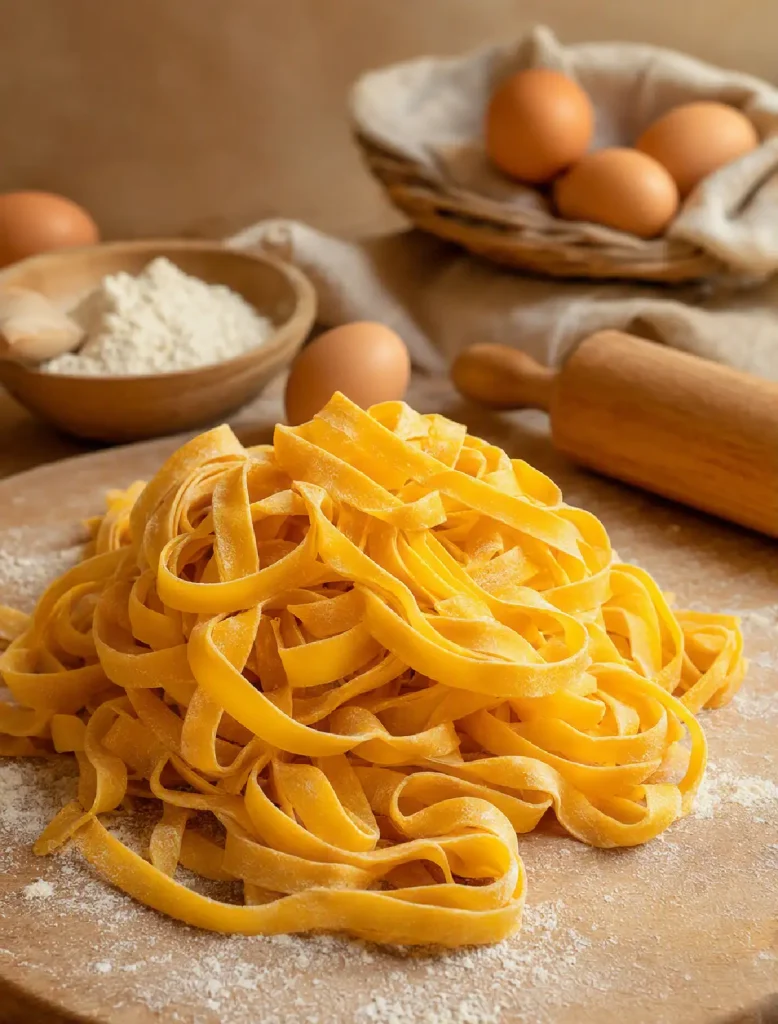
Flour and eggs are all you need to make a smooth, elastic and slightly porous dough that can be rolled to the desired thickness and used as the base for many types of fresh pasta.
Place the 400 g of 00 flour on a wooden pasta board or clean work surface and make a wide well in the centre. Crack the 4 eggs, about 220 g total without shells, directly into the well.
If you want to use it, add a pinch of fine salt. You can also leave it out and simply season the cooking water instead.
Beat the eggs with a fork, gradually drawing small amounts of flour from the inside edges of the well into the eggs.
Continue until the mixture in the centre begins to thicken. Then gradually incorporate the remaining flour, using a bench scraper if needed, until you have a rough dough that can be worked with your hands.
Knead the dough firmly with your hands, pushing it forwards with the heel of your palm, folding it back and repeating the movement for about 8-10 minutes.
The finished dough should be smooth, firm and elastic. If it feels quite stiff at first, keep kneading before adding any extra liquid. It will usually become softer and easier to work as you continue.
If the dough remains very dry and develops cracks that do not disappear, lightly dampen your hands with water and continue kneading. Avoid pouring a large amount of water directly onto the dough.
Shape the dough into a ball and wrap it tightly in cling film, or cover it with an upturned bowl so the surface does not dry out.
Leave it to rest for 30 minutes at room temperature. This allows the dough to relax, making it much easier to roll out.
Divide the dough into 4 portions. Take one portion and keep the others well covered while you work, as fresh pasta dough can dry out quickly when exposed to air.
Flatten the first portion slightly with your hands. You can now choose whether to roll the pasta using a pasta machine or traditionally by hand with a rolling pin.
Pass the dough through the rollers at their widest setting. Fold the sheet back onto itself and pass it through again. Repeat this 3-4 times, until the dough becomes smooth and even.
Then begin reducing the roller setting one step at a time, passing the pasta through each time until you reach the thickness required for the type of pasta you are making.
Dust with extra flour only when necessary to prevent sticking. Using too much can gradually make the pasta dry.
If you prefer the traditional method, lightly dust your work surface and rolling pin with flour. Work with one portion of dough at a time, rolling from the centre outwards.
Turn the pasta sheet frequently as you roll it, checking that it does not stick to the work surface. Continue until you have an even sheet at the appropriate thickness for the pasta you want to make.
Once the pasta has reached the correct thickness, your fresh egg pasta is ready to cut or use.
You can cut it into fettuccine, tagliatelle or other types of pasta, or leave the sheets whole for lasagne and filled pasta.
If you are making fettuccine for Fettuccine Alfredo, cut the pasta sheets into even ribbons and gently separate them with your hands. Dust them very lightly with flour and arrange them loosely on the work surface until ready to cook.
Resting the dough is important. Once kneaded, leave it to rest for at least 30 minutes, well covered. This allows the gluten to relax, making the dough easier to roll out without constantly springing back.
Never leave the dough uncovered while you work. Keep any portions you are not using wrapped in cling film or well covered, as fresh pasta dough can quickly dry out on the surface.
Use as little extra flour as possible when rolling. You only need enough to prevent the dough from sticking to the work surface, rolling pin or pasta machine. Too much flour can gradually make the pasta drier.
Fresh egg pasta cooks very quickly. The exact time depends on the type of pasta, its thickness and how much it has dried before cooking. Cook it in plenty of boiling salted water and check the texture by tasting it shortly before draining.
The whole, unrolled ball of dough can be refrigerated for 1-2 days, tightly wrapped in cling film to prevent it from drying out. For the best texture and ease of rolling, however, it is better to use it as soon as possible.
Once cut, keep the pasta lightly dusted with flour and well separated. If you plan to cook it shortly, you can leave it to air-dry for a while, making sure the pieces do not stick together.
To freeze fresh pasta, roll and cut it into your chosen type first. It is best not to freeze the whole ball of dough, as it may thaw unevenly and become difficult to roll. Instead, arrange the shaped pasta in a single layer on a lightly floured tray, keeping the pieces separate, and place it in the freezer. Once completely frozen, transfer it to freezer-safe bags.
Do not thaw frozen fresh pasta before cooking. Cook it straight from frozen in boiling salted water. It may need slightly longer than freshly made pasta.
If you want to dry fresh egg pasta completely for longer storage, you need suitable temperature, humidity and ventilation conditions. For normal home preparation, it is simpler and safer to use it fresh or freeze it.
Trying to identify a single birthplace for fresh egg pasta would oversimplify a much more complex history. Italian pasta developed over centuries through different ingredients, techniques and regional traditions, following different paths across the country.
There is evidence of pasta being eaten in Italy during the Middle Ages, but over time different traditions began to emerge. One important distinction developed between pasta intended for drying, closely associated with durum wheat semolina, and the many varieties of fresh pasta prepared to be eaten within a much shorter period.
The use of eggs in pasta dough became particularly widespread in the cuisines of central and northern Italy. The availability of soft wheat and a strong tradition of home cooking helped create a culture of fresh pasta that developed quite differently from the tradition associated with dried pasta.
For centuries, making fresh pasta was primarily a household activity. Recipes did not necessarily follow the precise quantities we use today: techniques and proportions were passed down within families and adjusted according to the ingredients available.
Over time, homemade production was joined by artisan pasta makers, delicatessens and specialist workshops. Refrigeration and modern preservation methods eventually made fresh pasta much easier to sell and distribute, taking it beyond the kitchens where generations had prepared and eaten it within a relatively short time.
Today, fresh and dried pasta coexist in Italian cooking, but they are not simply two versions of the same product. They have different ingredients, textures, cooking times and traditions.
Fresh egg pasta, however, still has a particularly strong connection with home and artisan cooking. Even when bought ready-made, it reflects a way of making pasta that was part of everyday life for generations of Italian families.