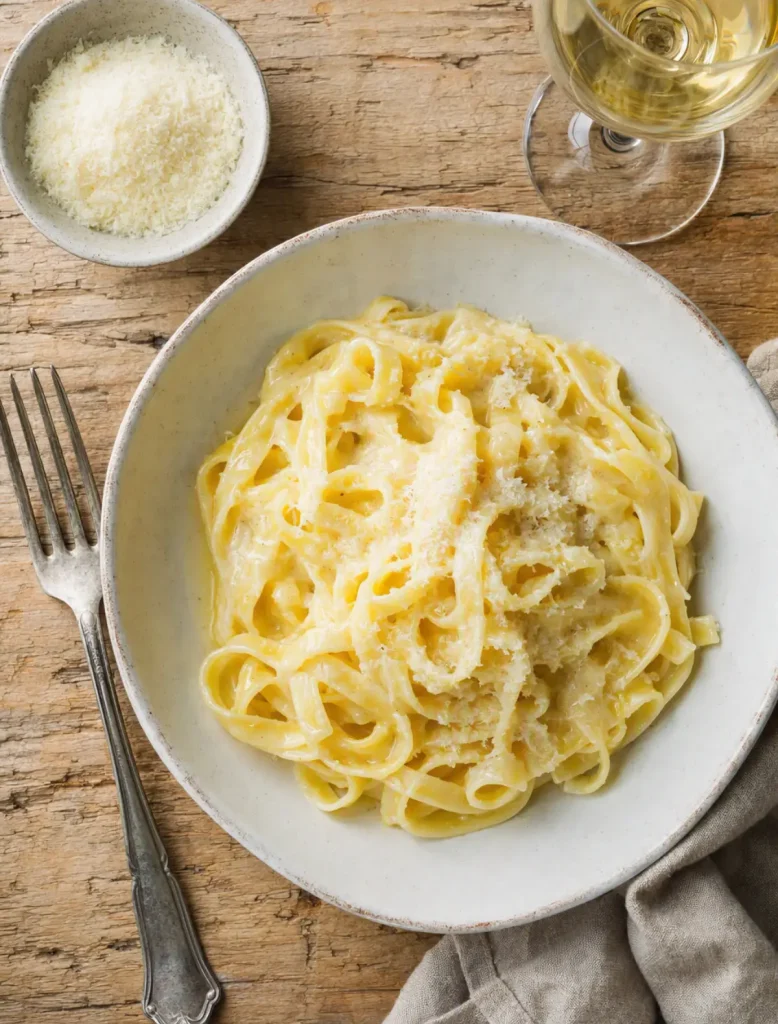
To make authentic Fettuccine Alfredo, you need just three ingredients: egg fettuccine, butter and Parmigiano Reggiano. If you want to make everything from scratch, you can also make your own fresh egg pasta at home and cut it into fettuccine. No cream and no separate sauce to prepare—the creamy coating comes together right as you toss the pasta.
The fettuccine are cooked until al dente, then combined with butter and very finely grated Parmigiano, along with a little of the starchy pasta water. The heat from the pasta melts the butter, while the cooking water helps the cheese blend smoothly into the sauce. A good toss does the rest, turning what might look like simple buttered pasta into something far creamier and more luxurious.
When everything comes together properly, the Parmigiano doesn’t clump and the butter doesn’t pool at the bottom of the pan. Instead, you get a smooth, silky sauce that coats every strand of fettuccine without weighing it down. The Parmigiano brings its characteristic savoury flavour, the butter adds richness and the egg pasta holds onto the sauce beautifully.
With only three ingredients, there isn’t much room to hide mistakes: good-quality ingredients and proper technique make all the difference.
And what about the cream? You won’t find it in the Roman recipe. Heavy cream belongs to the version that developed in the United States, along with popular additions such as chicken, prawns or broccoli. The original Roman Fettuccine Alfredo are much simpler: pasta, butter and Parmigiano. That’s it.
Fettuccine Alfredo: The Original Roman Recipe
Description
Egg fettuccine, butter and Parmigiano Reggiano tossed together until they form a smooth, silky coating. A three-ingredient Roman pasta recipe with one important difference from its American cousin: no cream.
Ingredienti
Instructions
How to Make Fettuccine Alfredo
-
Finely Grate the Parmigiano Reggiano 🧀
Finely grate the 200 g Parmigiano Reggiano DOP and set it aside. The finer the cheese is grated, the more easily it will melt into the sauce during tossing without forming lumps.
-
Cook the Fettuccine Until Al Dente 🍝
Bring a large pot of water to the boil. Salt it lightly, as Parmigiano Reggiano is already quite savoury, then cook the egg fettuccine until al dente. Fresh fettuccine will take only a few minutes; if using dried pasta, follow the cooking time on the packet.
Before draining, reserve at least 250 ml of the pasta cooking water. You'll need it to create the creamy sauce.
-
Prepare the Butter for Tossing 🧈
Place the 120 g room-temperature butter in a large pan with enough room to toss the fettuccine comfortably. Add 2–3 tablespoons of hot pasta water and allow the butter to soften and begin to melt.
Don't let it fry or brown. You simply want the butter to become soft and creamy.
-
Toss the Fettuccine with the Butter 🥄
Transfer the fettuccine to the pan while they are still slightly wet and toss gently with kitchen tongs, adding a little pasta water at a time.
Keep tossing until the butter evenly coats the pasta. Be particularly gentle if you're using fresh fettuccine, as the strands can break more easily.
-
Gradually Add the Parmigiano Reggiano 🧀
Take the pan off the heat and add the Parmigiano Reggiano a little at a time, continuously tossing the fettuccine.
Alternate the cheese with small amounts of hot pasta water whenever needed. The Parmigiano should gradually blend with the butter and starchy water, creating a creamy sauce without forming lumps.
-
Adjust the Creaminess of the Fettuccine Alfredo ✨
Continue tossing until you have a smooth, glossy and silky sauce that evenly coats the fettuccine.
If the sauce becomes too thick, add another tablespoon of pasta water at a time until you reach the right consistency. Taste and adjust the salt only at the end, if necessary.
-
Serve the Fettuccine Alfredo Immediately 🍽️
Divide the fettuccine between the plates as soon as you've finished tossing them and serve immediately.
Fettuccine Alfredo are at their best straight away. As they cool, the butter and Parmigiano quickly thicken and the sauce begins to lose its silky texture.
Nutrition Facts
Servings 4
- Amount Per Serving
- Calories 720kcal
- % Daily Value *
- Total Fat 41g64%
- Saturated Fat 26g130%
- Sodium 350mg15%
- Total Carbohydrate 60g20%
- Dietary Fiber 2.5g10%
- Sugars 2.5g
- Protein 28g57%
* Percent Daily Values are based on a 2,000 calorie diet. Your daily value may be higher or lower depending on your calorie needs.
Note
Start with quality ingredients: With only three ingredients, quality really matters. Choose a good-quality cultured butter and Parmigiano Reggiano DOP aged for at least 24 months. If you prefer a stronger, more pronounced flavour, you can use a 36-month aged Parmigiano instead.
Grate the Parmigiano as finely as possible: Grate it just before you need it, aiming for an almost powder-like texture. The finer the cheese, the more easily it will melt and blend into the sauce without forming lumps.
Always add the Parmigiano off the heat: When it's time to add the cheese, turn off the heat and move the pan away from the hob. If the pan is too hot, the Parmigiano can seize and form lumps instead of blending smoothly with the butter and pasta water.
Add the pasta water gradually: Don't pour it all in at once. Add the cooking water one tablespoon at a time, tossing continuously and watching the consistency. Stop when the sauce is fluid, glossy and coats the fettuccine beautifully.
Fettuccine and tagliatelle aren't quite the same: Although they look very similar, fettuccine are generally narrower than traditional Emilian tagliatelle. For this recipe, we're sticking with fettuccine.
Black pepper is optional: It isn't necessary in the original version we're making here. If you enjoy a little peppery contrast, however, you can grind some over the pasta just before serving.
Serve without delay: Fettuccine Alfredo don't like to wait. As the pasta cools, the butter and Parmigiano quickly thicken and that beautifully creamy texture begins to disappear. It's best to have everyone at the table before you finish tossing the pasta.