Note
Choosing the Right Flour
For gnocchi di malga, we can use Italian type 00 or type 0 wheat flour. Outside Italy, all-purpose flour is a practical alternative, preferably one that is finely milled.
Different flours absorb water differently, so the dough may need a slight adjustment. Start with the quantities listed and add only a little extra flour or water if necessary.
How to Check the Dough Consistency
The dough should remain soft and sticky but hold an irregular shape when scooped with a spoon. If it runs off immediately, it is too thin. If it forms a stiff mass that is difficult to work, it is too firm.
Make any adjustments gradually, using very small amounts of flour or water.
Alternatives to Aged Monte Veronese
Aged Monte Veronese is one of the characteristic ingredients of this traditional preparation. If it is unavailable, we can use another mature cow's milk cheese with a pronounced flavour, such as aged Asiago.
The result will differ from the traditional Lessinia recipe, but the cheese will still provide a rich, savoury finish.
For the hard grating cheese, Grana Padano is a suitable choice. Other aged hard cheeses can be used if necessary, although they will slightly change the flavour.
Variations on the Traditional Dressing
Some versions of gnocchi di malga include sage leaves cooked in the butter. Others use smoked ricotta, which adds a more pronounced flavour.
These variations are not part of the reference recipe used here, which follows the documented preparation associated with the PAT recognition.
How to Prevent Brown Butter from Burning
A light-coloured saucepan makes it easier to monitor the milk solids as they brown.
When they turn golden and the butter develops a toasted, nutty aroma, remove the pan from the heat. If the solids become very dark or smell acrid, the butter has burned and should be prepared again.
Making Ahead and Storage
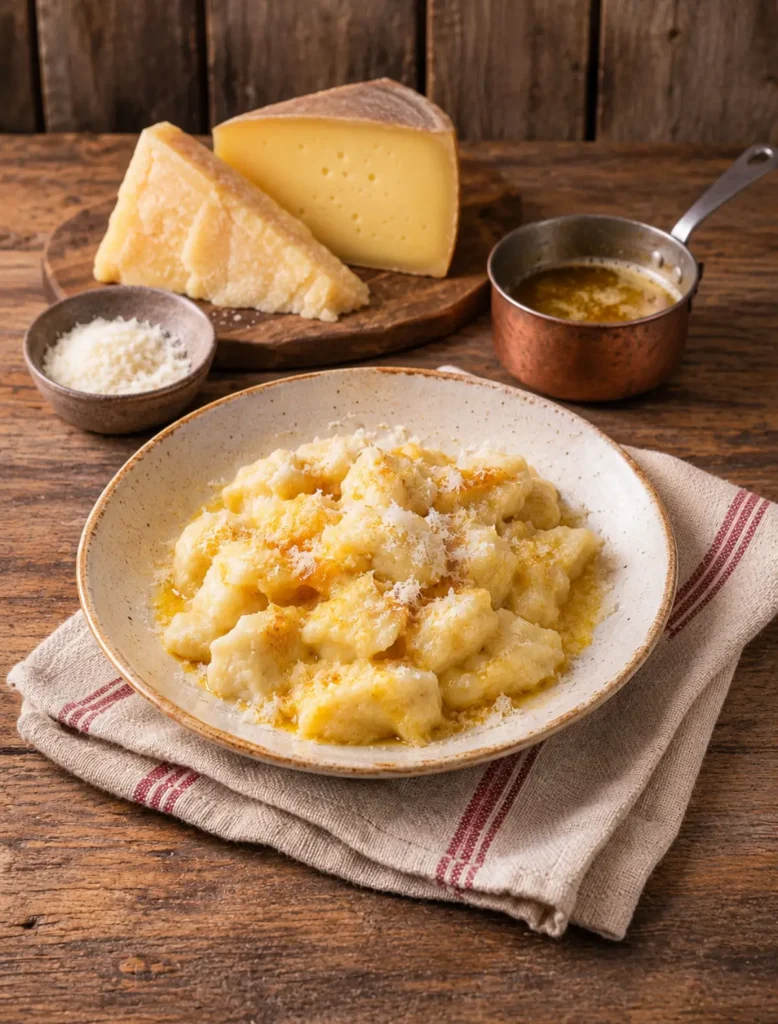
Gnocchi di malga are best served immediately, while the dumplings are hot and the butter and cheese are still soft.
We can grate the cheeses in advance and keep them refrigerated until needed. The dough is best prepared and cooked without a long resting period.
If any cooked and dressed dumplings remain, cool them promptly and refrigerate them in a sealed container for no longer than 1–2 days. Reheat thoroughly before serving, bearing in mind that the texture will be different from freshly prepared gnocchi.
Keywords:
gnocchi di malga, Italian flour dumplings, gnocchi della Lessinia, gnocchi sbatui, Italian dumpling recipe, flour gnocchi without potatoes, Venetian gnocchi, brown butter gnocchi, Monte Veronese cheese, traditional Italian mountain food
Gnocchi di Malga: A Story of Alpine Pastures, Forgotten Traditions and Village Festivals
For centuries, spending the summer in a mountain dairy meant leaving the village in spring and returning only when the pastures began to lose their grass. In Lessinia, the alpine grazing season generally lasted from May until the end of September. The dairy workers and herders travelled uphill with their cattle and enough provisions to spend months working away from home. Cattle farming in these mountains is documented from at least the sixteenth century, although the use of the high pastures goes back much further.
Daily life revolved around milking the cows and processing their milk. Inside the baìti, the stone buildings used for these activities, different rooms served specific purposes. The logo del late was where milk was collected and left to separate so the cream could rise, while the logo del fogo housed the hearth used for cheesemaking. Some buildings also contained binele, small sleeping spaces where the dairy workers could rest. The dumplings were prepared in this same environment, beside the fire used for the day's work.
Not everything produced in the mountains was eaten by the people who worked there. Ricotta, for example, was sometimes smoked to extend its shelf life and was often intended for sale. It was collected by the puinari, traders who helped connect the mountain dairies with markets in the surrounding villages. This helps explain why smoked ricotta, now found in some versions of gnocchi di malga, was not necessarily the most common everyday dressing.
During the twentieth century, life on the mountain pastures began to change. Better roads and the spread of motor vehicles made it easier to travel between the villages and the dairies without spending the entire season in the mountains. Fewer workers remained continuously on the pastures, and some dishes closely associated with that way of life gradually became less common. Gnocchi di malga also went through a period of declining popularity before returning to local tables through restaurants and community festivals.
In Erbezzo, the Festa degli Gnocchi di Malga has become one of the best-known events of the summer. Traditionally held on the second Sunday in August, it had reached its fortieth edition by 2024. Sant'Anna d'Alfaedo hosts the Palio degli Gnocchi della Lessinia, a culinary competition in which cooks representing different municipalities of the area prepare their versions of the dish. A jury tastes the entries and awards a prize to the one judged best. The competition gives neighbouring villages an opportunity to compare their interpretations of a recipe they all consider part of their heritage.
Documenting the history of these dumplings also required a collective effort. The Pro Loco of Sant'Anna d'Alfaedo, led by Marcella Marconi, gathered testimonies and historical documents to establish the continuity of the preparation over time. Among the sources consulted was Alti pascoli della Lessinia veronesi, published in 1991, with contributions by Paola Lanaro Sartori and Attilio Benetti on the history of alpine grazing and the food traditions of dairy workers. Another account appears in El gnoco e la gnoca, an article by Silvio Antolini published in 2002 in the cultural journal La Lessinia ieri, oggi e domani.
The research went beyond written records. Local cooks and restaurateurs worked together to define a shared version of the recipe, identifying its traditional elements and distinguishing them from variations introduced over the years. Their work helped document a preparation that had been passed down largely through hands-on experience.
Today, gnocchi di malga can be found in trattorias and mountain refuges throughout Lessinia, as well as at the summer food festivals held in its villages. In Erbezzo and Sant'Anna d'Alfaedo, they are still prepared in large quantities, served at communal tables and discussed by people who learned to make them at home. Everyone has their own habits, particularly when it comes to choosing the cheese or deciding exactly how thick the dough should be.