
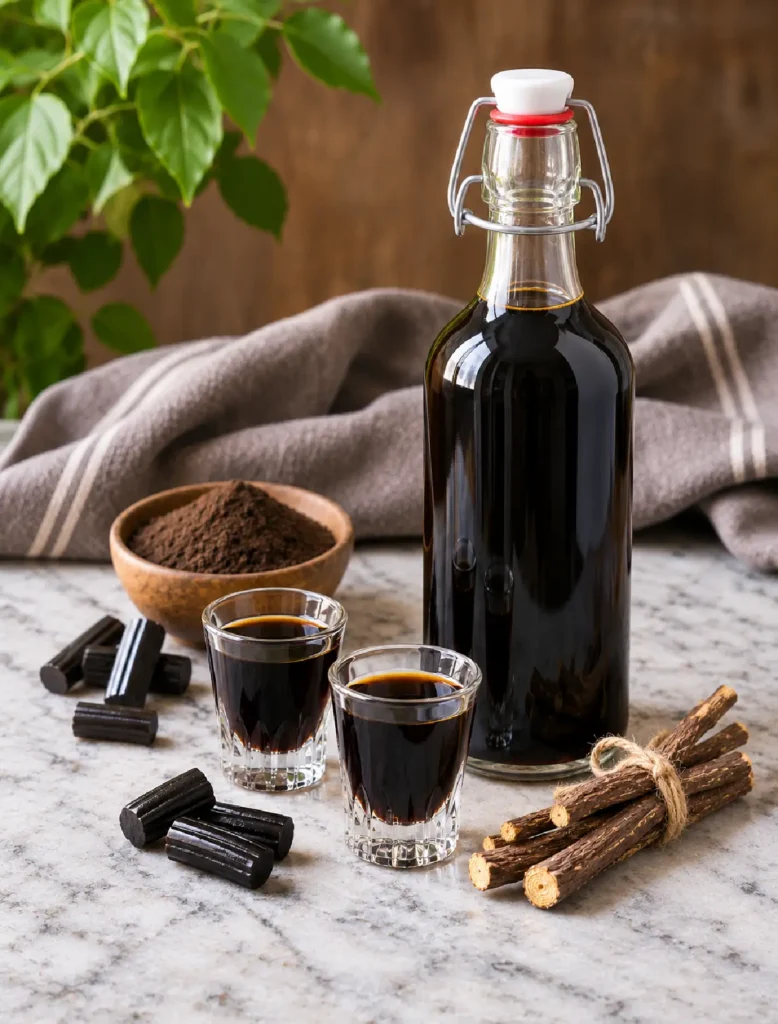
Italian licorice liqueur is a traditional Calabrian after-dinner drink with a dark color and an intense flavor. We make it with just four ingredients, without a lengthy infusion, creating a rich, full-bodied liqueur best served chilled in small glasses after a meal.
Pour 500 ml (16.9 US fl oz) of water into a heavy-bottomed saucepan and bring it to a boil. Reduce the heat, add 400 g (14.1 oz) of sugar, and stir until completely dissolved.
Gradually sift 70 g (2.5 oz) of pure licorice extract powder directly into the syrup, stirring continuously with a whisk. Keep the heat low and continue mixing, making sure to reach the bottom and sides of the saucepan. The licorice should dissolve without forming lumps. Once the mixture is smooth, avoid boiling it any longer than necessary.
Turn off the heat and leave the saucepan at room temperature, stirring occasionally. If any foam appears on the surface, gently remove it with a spoon. Wait until the syrup has cooled completely before continuing.
Pour 340 ml (11.5 US fl oz) of 95% ABV (190-proof) food-grade alcohol into the cold syrup and stir thoroughly. Check that the liqueur is smooth and uniform. Only if small lumps or residues remain, strain it through a fine-mesh sieve. Keep the alcohol away from open flames and heat sources throughout this step.
Using a funnel, pour the liqueur into clean, completely dry glass bottles. Leave a little space below the cap and seal tightly.
We can drink the liqueur immediately after preparing it, but resting it for one or two months allows the flavors to blend more fully. Store the bottles in a cool place away from direct light, gently shaking them occasionally to redistribute any sediment that may settle at the bottom.
Choose pure, food-grade licorice extract powder, without added sugar. Do not use ordinary dried, ground licorice root: it contains fibers and insoluble particles and will not behave in the same way when mixed into the syrup.
Italian licorice liqueur is best enjoyed chilled, served in small glasses after a meal. We can keep a bottle in the refrigerator before serving.
Keep the bottles tightly sealed in a cool place, protected from light and heat. Once opened, close them carefully after each use. For a homemade preparation, we cannot guarantee a specific shelf life without appropriate testing.
Small amounts of licorice sediment may appear during storage. Before serving, gently shake the bottle to redistribute them. If we notice any unusual changes in smell or appearance, we should avoid drinking the liqueur.
Licorice contains glycyrrhizin, a naturally occurring compound that, when consumed frequently or in large quantities, can increase blood pressure and affect potassium levels. People with high blood pressure or those taking certain medications should be particularly cautious about consuming licorice.
The history of licorice in Calabria began long before the liqueur became popular. The plant grows naturally in several parts of the region, particularly along the Ionian coast, where its roots were harvested and traded for centuries. During the eighteenth century, some landowning families began transforming this agricultural resource into a product intended for more distant markets.
In 1715, the Duke of Corigliano established one of the first Calabrian factories dedicated to licorice extraction. These facilities were known as conci, traditional licorice-processing workshops. Inside, the roots were processed with hot water to extract their juice, which was then concentrated into a dark, solid extract.
More conci were established in the Sibari area during the eighteenth century. The regional documentation on licorice liqueur mentions several families involved in the industry, including the Amarelli, Abenante, Labonia, and Castriota-Scanderbeg families. During the nineteenth century, Calabrian licorice production expanded beyond Italy, reaching European and American markets.
In Rossano, the Amarelli family was already trading licorice roots in the sixteenth century. In 1731, Fortunato Amarelli and his son Paolo Fortunato established a concio, transforming their commercial activity into a manufacturing business.
Over the centuries, the company had to adapt to changing markets and consumer habits. Among the curiosities preserved in the family archives is the Lealmair brand, an anagram of Amarelli used to market licorice abroad. The company also introduced a steam boiler, adopted computer technology as early as the 1980s, and launched its website in 1996.
Today, this history is preserved at the Giorgio Amarelli Licorice Museum, inaugurated in 2001 and housed in the family's historic building. The museum displays documents, photographs, agricultural tools, molds, and machinery used throughout different periods. Visitors can also see old packaging, illustrating how the presentation and marketing of licorice have changed over time.
Licorice was used in herbal preparations and elixirs long before modern liqueurs became widespread. It was often combined with other aromatic ingredients, including mint, anise, and bitter herbs. However, there is no documented date that can be identified as the invention of licorice liqueur.
A more recent chapter in its history involves Distilleria Caffo, based in Limbadi, Calabria. According to a company account published in 2009, Sebastiano Caffo developed the idea in 1995 of creating a liqueur in which Calabrian licorice would be the main ingredient rather than one component of an aromatic blend.
The idea reportedly emerged during a trade fair, while he was speaking with entrepreneurs involved in reviving the historic Zagarese licorice brand. At the time, the Italian liqueur market was showing considerable interest in limoncello, while licorice was generally combined with other flavorings.
That initiative led to the creation of Liquorice, a product made by extracting licorice root in hot water. The distillery claims to have pioneered the production of a liqueur made exclusively from Calabrian licorice. This account documents an important stage in the commercial history of the product, although the origins of licorice liqueur itself remain difficult to establish precisely.
The botanical name of licorice, Glycyrrhiza glabra, comes from Greek words referring to the sweetness of the root. This characteristic is primarily associated with glycyrrhizin, a naturally occurring compound found in the plant.
Calabrian licorice belongs to a local variety known as Cordara. The environmental conditions of the growing area contribute to its characteristics, and the production specifications for Liquirizia di Calabria DOP establish specific requirements, including those relating to glycyrrhizin content.
The European product specifications have been amended over time to recognize certain distinctive characteristics of Calabrian licorice, including its relatively low glycyrrhizin content compared with roots from some other growing regions.
The Liquirizia di Calabria DOP (Protected Designation of Origin) designation covers three forms of the product: fresh roots, dried roots, and licorice extract. Liqueurs made with these ingredients may highlight the qualities of Calabrian licorice, but they do not automatically qualify for the protected designation.
Licorice liqueur is included in Calabria's official list of Prodotti Agroalimentari Tradizionali (PAT), or Traditional Agri-Food Products, under code G-05. The regional documentation identifies production throughout Calabria and lists licorice extract, aromatic herbs, sugar, and alcohol among the ingredients.
The historical documentation cited by the regional authorities is preserved at Distilleria Caffo in Limbadi. The official description outlines the traditional production method without specifying exact quantities for a homemade recipe.
Different recipes therefore exist: some use only pure licorice extract, while others include additional aromatic ingredients. The PAT recognition documents this Calabrian tradition, which encompasses several variations of the liqueur.