
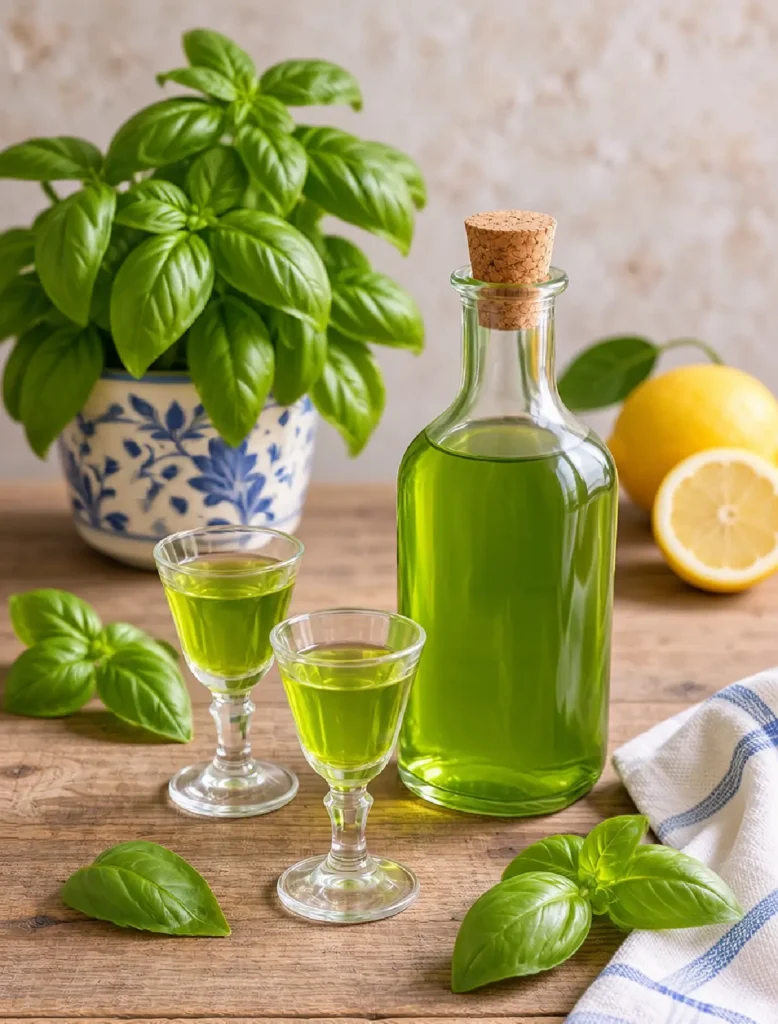
An Italian herbal liqueur made with fresh basil leaves, alcohol, water and sugar. After 20 days of infusion and a further resting period, we obtain approximately 1 litre (34 US fl oz) of fragrant basil liqueur, best served well chilled.
Remove 100 fresh basil leaves from their stems, choosing healthy leaves without damaged or discoloured areas. Rinse them gently under cold running water and dry them thoroughly, patting them with a clean kitchen towel or paper towels. Avoid crushing the leaves unnecessarily.
Place the leaves in a clean, dry glass jar with an airtight lid. Pour in 200 g (7.1 oz) of food-grade alcohol at 90–95% ABV, gently pressing the basil towards the bottom so that all the leaves remain submerged. Close the jar securely.
Keep the jar in a cool, dry place away from light. Leave the basil to infuse for 20 days, gently shaking the container once a day. During this time, the alcohol will gradually take on the colour and fragrance of the leaves.
Once the infusion period is complete, pour 400 g (14.1 oz) of water into a saucepan and add 600 g (21.2 oz) of granulated sugar. Heat over medium-low heat, stirring until the sugar has completely dissolved. There is no need to boil the syrup for an extended period. Remove from the heat and allow it to cool completely.
Strain the basil-infused alcohol through a fine-mesh sieve, removing the leaves. If necessary, strain it a second time through clean food-safe cheesecloth to remove smaller particles. Pour the filtered infusion into the completely cooled syrup and stir thoroughly until evenly combined.
Using a funnel, transfer the liqueur into thoroughly cleaned and dried glass bottles, preferably dark-coloured ones to protect it from light. Seal with closures suitable for alcoholic beverages and store the bottles in a cool, dark place.
Allow the liqueur to rest for at least 10 days before tasting, giving the flavours time to become more balanced. Before serving, place the bottle in the refrigerator for a few hours. Pour the chilled basil liqueur into small glasses, allowing approximately 50 ml (1.7 US fl oz) per serving.
Store the basil liqueur in clean, tightly sealed glass bottles away from light. We prefer to keep it refrigerated and recommend consuming it within approximately three months to enjoy the basil aroma at its best. This is a quality recommendation rather than a scientifically established safety shelf life. Always close the bottle securely after opening.
Choose fresh, fragrant basil with healthy, fleshy leaves, preferably grown without pesticide treatments. Basilico Genovese DOP (Genoese Basil PDO) is particularly suitable, but other sweet basil varieties also work well. Avoid yellowing, blackened or damaged leaves, which may affect the finished liqueur.
The colour of the liqueur depends partly on the freshness of the leaves and the storage conditions. To slow colour changes, protect both the infusion and the finished bottles from direct light and heat. Over time, the green may become less vivid or develop yellowish tones.
For a slightly citrusy version, add a few thin strips of unwaxed lemon zest during infusion, avoiding the white pith, which can introduce bitterness. Alternatively, add a few fresh mint leaves, taking care not to overpower the basil.
Serve the liqueur well chilled, straight from the refrigerator, preferably in small glasses that have been chilled beforehand. For a different aperitif, try combining a small amount with gin and freshly squeezed lemon juice, adjusting the proportions to taste.
Long before becoming one of the symbols of Ligurian cooking, basil travelled a considerable distance. Originating in Asia, particularly India, it was already known in the Mediterranean world in ancient times. Its name comes from the Greek basilikón, meaning "royal herb", which later passed into Latin as basilicum. Quite a grand name for a plant we now commonly grow in a small pot on the windowsill.
Over the centuries, basil has had a far more eventful history than its familiar green leaves might suggest. It has been cultivated as a culinary herb, used in traditional folk medicine and associated with beliefs that varied from one region to another. It was not always regarded simply as an ingredient for cooking.
To find basil in the history of homemade liqueurs, we need to look beyond the Genoese coastline, towards the villages of the Ligurian hinterland.
An ethnobotanical study conducted in the Val di Vara, in the province of La Spezia, recorded several traditional uses of the plant. In Varese Ligure, for example, liqueur made from basil leaves was traditionally consumed in small quantities as a digestif. The same study describes a rather unusual practice: while working in the fields, farmers would rub basil on their arms and necks in the belief that it helped keep insects away.
We also find evidence of basil liqueur in the Val Trebbia, preserved in a collection of recipes from the valleys around Genoa. These records are valuable because they offer a glimpse of local customs that might otherwise have left little written evidence. We do not know when the first bottle of basil liqueur was made, but we do know that the preparation was familiar in more than one part of inland Liguria.
There is another story that has nothing to do with liqueur, but reveals how deeply basil was embedded in the Italian imagination as early as the Middle Ages.
In the Decameron, written by Giovanni Boccaccio in the fourteenth century, we encounter the tragic story of Lisabetta of Messina. The young woman falls in love with Lorenzo, a man employed by her brothers, but they murder him to prevent the relationship. When Lisabetta discovers the truth, she retrieves her lover's head and hides it in a pot, covering it with soil and planting basil above it. From then on, she spends her days beside the plant, watering it with her tears.
The pot becomes a symbol of her love and grief. It is one of the most memorable images in the Decameron, so much so that the tale is also known as the story of Lisabetta and her pot of basil.