Note
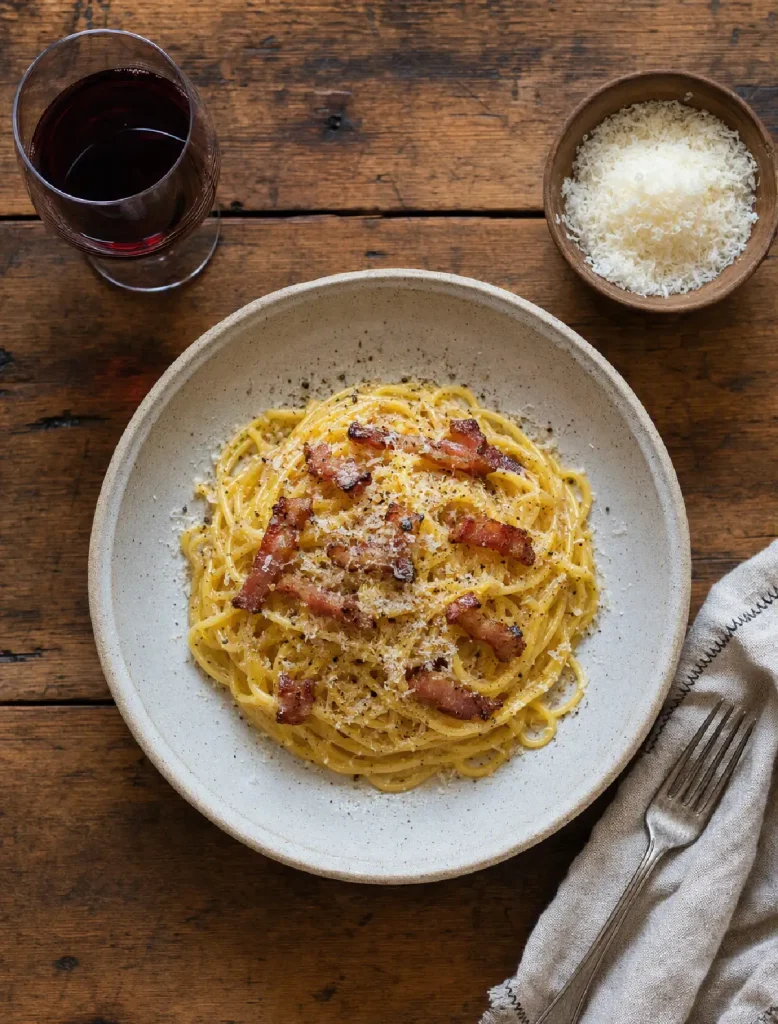
Choosing the pasta: spaghetti is one of the classic choices, but Carbonara also works beautifully with rigatoni or mezze maniche, whose shape catches both the sauce and the pieces of guanciale.
Bring the eggs to room temperature: if possible, take them out of the refrigerator 20-30 minutes before cooking. Eggs that aren't fridge-cold will combine more easily with the hot pasta.
Grate the Pecorino just before using it: finely grated fresh Pecorino blends more easily with the eggs and helps create a smooth sauce without lumps.
Pecorino and Parmigiano: if you prefer a slightly milder flavor, you can use half Pecorino Romano and half Parmigiano Reggiano. The more traditional Roman version, however, is made with Pecorino Romano.
Keywords:
Pasta alla Carbonara, Carbonara, Roman Carbonara, Carbonara recipe, traditional Carbonara, authentic Carbonara, Roman pasta, guanciale, Pecorino Romano
The History of Carbonara: Roman, Yes, but Since When?
Today, Carbonara is immediately associated with Rome, so much so that it's easy to imagine it being served in the city's trattorias for centuries. Go looking for its origins, though, and the trail quickly becomes murky. Most of the best-known theories take us back only as far as World War II.
One theory begins with Allied troops and their food supplies. Bacon and egg products met Italian pasta and cheese, and that combination may have produced an early version of the dish. Whether it actually happened that way is impossible to say, but a name from the same period frequently appears in accounts of Carbonara's origins.
Renato Gualandi, a young cook from Bologna, claimed that in 1944 he prepared a pasta dish for Allied troops gathered in Riccione using ingredients available to him, including bacon, cheese, and egg products. He later worked as a cook for Allied forces in Rome, a detail that inevitably tied his story even more closely to Carbonara.
The American theory doesn't explain everything. A dish known as cacio e ova, based on cheese and eggs, was already part of the food culture of areas between Lazio and Abruzzo. The charcoal workers of the Apennines spent long stretches in the woods producing charcoal, and their occupation has often been linked to the very name Carbonara. Another explanation points to the generous black pepper scattered over the pasta, supposedly resembling coal dust.
Head south to Naples and things become even less tidy. Nineteenth-century Neapolitan cookbooks already contain preparations in which eggs and cheese were used to finish certain dishes. Allied soldiers and their food supplies were also present in Naples during the war, providing enough material for yet another theory about where Carbonara might have begun, but not enough to settle the argument.
The First Carbonara Wasn't the One We Know Today
By 1954, at least we have something in print. La Cucina Italiana published one of the earliest documented Carbonara recipes, and its ingredients included pancetta, eggs, Gruyère, garlic, and black pepper.
Guanciale appears later. In 1960, Luigi Carnacina included it in his cookbook La grande cucina, but his recipe also contained cream. Cream didn't disappear immediately either: it continued to appear in different versions of Carbonara in the years that followed.
For decades, Carbonara was much less rigid than we tend to think of it today. Cookbooks and chefs' interpretations included ingredients that would probably raise a few eyebrows among modern-day purists: cream, garlic, Parmigiano, and even white wine.
It was especially from the 1990s onward that the stripped-back Carbonara we know today became increasingly established: pasta, guanciale, eggs, Pecorino Romano, and black pepper. The additions that had appeared in earlier decades gradually fell out of favor, while those five ingredients became the benchmark for Roman Carbonara.
The curious part is that the version now defended as though it had remained unchanged forever came after decades of much more flexible Carbonara recipes.
Cream may be the best example of all: today, mentioning it in Carbonara is enough to start an argument. For years, it appeared quite happily in cookbooks.