Servings 6
- Amount Per Serving
- % Daily Value *
- Total Fat 19g30%
- Saturated Fat 5g25%
- Sodium 570mg24%
- Total Carbohydrate 51g17%
- Dietary Fiber 12g48%
- Sugars 5g
- Protein 20g40%
* Percent Daily Values are based on a 2,000 calorie diet. Your daily value may be higher or lower depending on your calorie needs.
Note
Fresh or dried beans
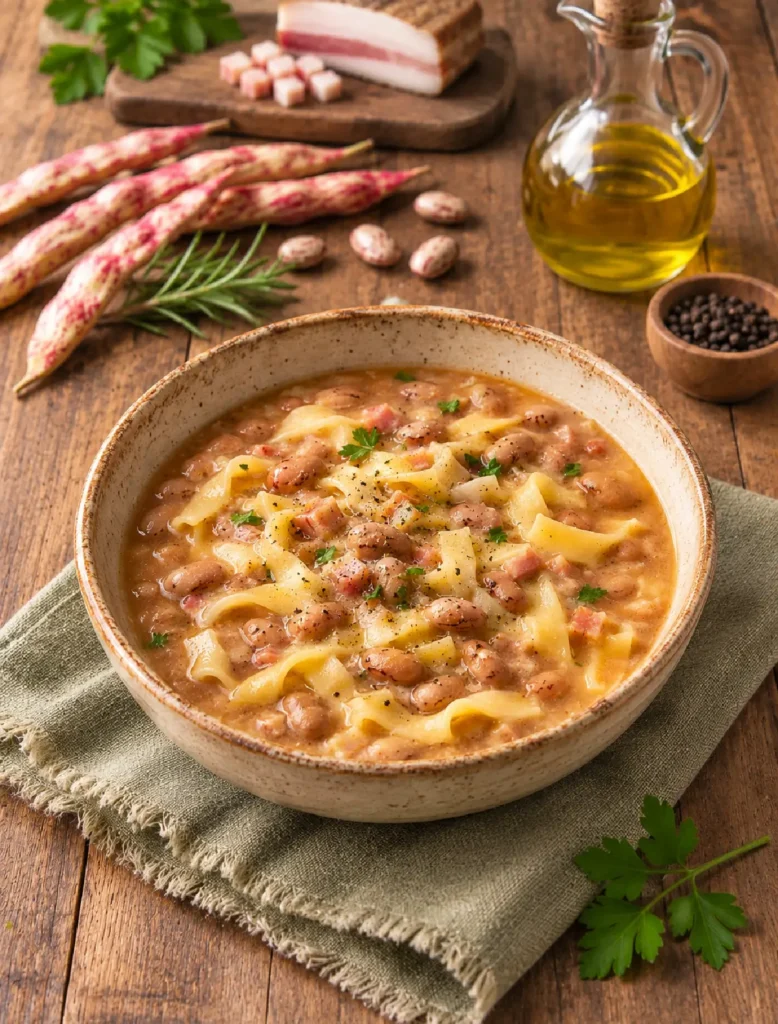
fresh beans are shelled directly from their pods and are still raw, so they do not need soaking. Dried beans should be soaked for approximately 12 hours. If Lamon beans are unavailable, ordinary borlotti beans (cranberry beans) are a suitable alternative.
Egg pasta
homemade pasta sheets can be cut into small irregular pieces or diamond shapes. Fresh egg tagliatelle, broken into shorter lengths, also work well. If using dried pasta, adjust the cooking time and make sure it is fully cooked before serving.
Potatoes and celery
both are optional in the traditional regional recipe. Potatoes help thicken the soup, while celery adds depth to the aromatic base.
Traditional seasoning
the regional recipe uses salted pancetta or lardo and mentions cured ham fat as a preferred choice for the soffritto. Some traditional versions also include strips of pork rind or a little raw butter added to the soup.
Consistency
pasta e fasioi should be creamy but not dry. If it becomes too thick while resting or reheating, stir in a little hot water.
Storage
cool the soup promptly and refrigerate in a sealed container within two hours of cooking. Preferably consume within 2 days, reheating thoroughly before serving.
Freezing
for the best texture, freeze the bean soup before adding the pasta. Thaw in the refrigerator, reheat, and finish the recipe with fresh pasta.
Keywords:
Venetian pasta and bean soup, pasta e fasioi, Italian pasta and beans, Venetian bean soup
History and Curiosities of Venetian Pasta e Fasioi
Around 1530, bean seeds reached the Belluno area through Pierio Valeriano, a humanist originally from Belluno who spent time at the court of Pope Clement VII. According to local tradition, the pope himself gave him the seeds. These beans had come from the Americas and were different from the species already known in Europe. The valleys at the foot of the Dolomites proved well suited to their cultivation.
In Lamon and the surrounding area, beans gradually became part of local farming and eating habits. They could be dried after harvest and stored throughout the winter, a particularly useful quality in rural households where food supplies depended on the seasons. Over time, farmers selected varieties suited to the local climate and passed down the knowledge needed to grow them.
Historical records show how firmly bean cultivation had become established in the area. By the eighteenth century, beans from the Feltre district were already known for their quality, while nineteenth-century Austrian cadastral records documented their cultivation in Lamon. Beans were not used only in soups: another local speciality was pendolon, a traditional Belluno dish made with potatoes and beans.
Beans even appear in seventeenth-century popular literature. In Bertoldo, by Giulio Cesare Croce, the main character is a clever peasant who earns a place at the court of King Alboin. Palace life, however, does not suit him. Accustomed to eating turnips and beans, Bertoldo cannot adapt to the refined food served at court and eventually dies. Croce uses this contrast to mock the habits of the nobility, while also offering a vivid glimpse of the everyday food of rural people at the time.
Pasta e fasioi belongs to the same rural culinary world, although no historical record identifies a precise birthplace or inventor of the dish. Pasta and bean preparations spread across several parts of northern Italy, acquiring local names and characteristics. Even within Veneto, the name changes from one area to another: expressions such as fasioi co le paste and fasioi co le tirache are documented in the Treviso area.
In 1996, Fagiolo di Lamon della Vallata Bellunese received Protected Geographical Indication (PGI) status. Its production specification recognises four traditional ecotypes: Spagnol, Spagnolit, Calonega, and Canalino, selected over generations. In Lamon, where an annual bean fair is held, local growers display their harvest and visitors can discover and taste regional specialities made with these beans.