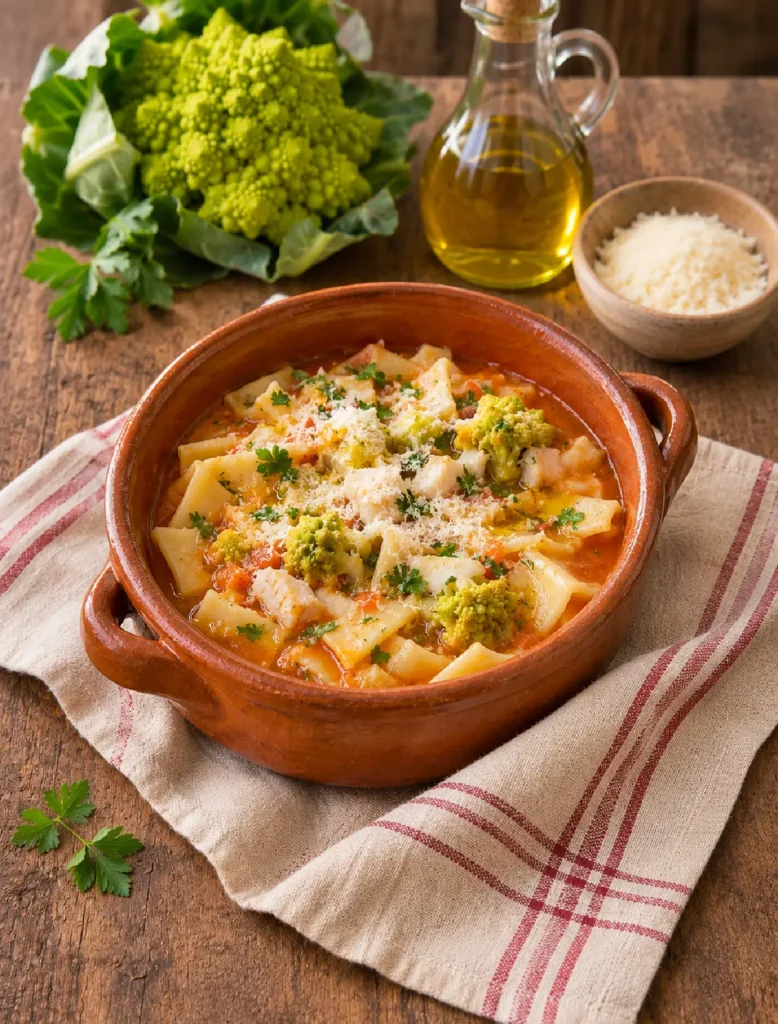
Servings 6
- Amount Per Serving
- % Daily Value *
- Total Fat 11g17%
- Saturated Fat 2.5g13%
- Sodium 650mg28%
- Total Carbohydrate 30g10%
- Dietary Fiber 4g16%
- Sugars 5g
- Protein 22g44%
* Percent Daily Values are based on a 2,000 calorie diet. Your daily value may be higher or lower depending on your calorie needs.
Note
Choosing the Skate
Skate is a type of ray traditionally used in Roman cooking. Ask your fishmonger to clean and skin it, keeping the cartilage for the stock. Most of the edible flesh comes from the wings.
In English-speaking countries, skate wings are often sold separately rather than as a whole fish. They can also be used for this recipe, provided the cartilage is retained for preparing the broth.
Getting the Right Soup Consistency
The finished soup should be brothy enough to eat with a spoon, but not watery. Add more hot stock while the maltagliati cook if the liquid reduces too much. Remember that the pasta will continue absorbing broth after cooking.
Alternatives to Maltagliati
Sora Lella's family recipe uses fresh maltagliati, irregularly shaped pieces of pasta traditionally made from rolled pasta dough.
If maltagliati are unavailable, use fresh egg pasta cut into uneven pieces. Broken spaghetti are another option and appear in many traditional Roman versions of this soup. Adjust the cooking time according to the pasta you choose.
If You Cannot Find Romanesco Broccoli
Romanesco broccoli has a distinctive pointed shape and a delicate, slightly nutty flavour.
If it is unavailable, ordinary green broccoli is a practical substitute and is widely available internationally. The flavour and texture will be slightly different, but the soup can still be prepared successfully.
For the traditional Roman version, Romanesco remains the preferred choice.
Resting and Storage
Renato Trabalza's version includes a resting period of at least 2 hours before cooking the pasta.
For food safety, cool the soup rapidly and refrigerate it during this period. Bring it back to a boil before adding the maltagliati.
Refrigerate leftovers promptly and preferably eat them within 24 hours, reheating thoroughly. Cooked pasta will continue to absorb the stock and soften, so storing the soup without the pasta is preferable whenever possible.
Keywords:
Italian skate fish soup, pasta and broccoli soup, Roman fish soup, skate broth, Romanesco broccoli soup, Sora Lella recipe
Skate Soup in Roman Culinary Tradition
Aldo Fabrizi loved cooking almost as much as theatre and cinema. During the 1970s, he published books of recipes written in verse, using the Roman dialect that had helped make him famous. Among the dishes that caught his attention was skate soup, a preparation he knew well and joked about finding impossible to stop eating after the first taste. His enthusiasm for cooking was shared by his sister Elena, better known as Sora Lella, who opened her restaurant on Rome's Tiber Island in 1959. Pasta and broccoli in skate broth became part of the family's cooking repertoire, particularly during the Christmas season.
Sora Lella was especially proud of this soup. Her grandson Renato Trabalza recalled one of her favourite jokes: she would say that the soup was so valuable you could take it to the Monte di Pietà, Rome's historic pawn institution, and receive its weight in gold. The comparison was amusing precisely because the dish belonged to everyday cooking, far removed from the expensive ingredients associated with wealthy households. The recipe remained on the restaurant's menu after her death, passed down to her children and grandchildren. It is still prepared during the colder months, using maltagliati instead of the broken spaghetti found in many other Roman versions.
The soup's association with Christmas meals reflects an older custom of observing meat-free days in the religious calendar. In papal Rome, dietary restrictions were followed particularly closely during Lent and influenced what families prepared at home. Pasta and broccoli in skate broth belongs to this culinary heritage, in which recipes survived through everyday family cooking rather than through written instructions or officially recorded cookbooks.
Another connection can be found in Roman Jewish cuisine, where a similar pasta and broccoli soup is prepared with cod broth. The choice of fish reflects Jewish dietary laws, which permit only fish with fins and scales. Skate does not meet these requirements and is therefore not considered kosher. Cod allowed Roman Jewish families to prepare a comparable soup while observing their religious traditions.