Note
If you want to get ahead, you can prepare the veal slices a few hours in advance. Pound them with a meat mallet and, if you want to protect them while working with them, place them between two sheets of parchment paper. Cover and refrigerate.
The flour, however, should be added shortly before cooking. Avoid flouring the saltimbocca in advance and leaving them in the refrigerator for several hours: moisture from the meat will cause the flour to absorb moisture, making it sticky and affecting the final result in the pan.
You can add the prosciutto and sage shortly before cooking, together with the flour.
One thing to watch is the butter. It should not turn brown: it should melt and form a light foam. If the bottom of the pan starts to burn, it’s better to stop, clean the pan, and start again.
Saltimbocca is definitely best when freshly cooked, but if you have leftovers, you can keep them refrigerated until the next day. To reheat them, use very low heat and add a splash of water to help keep the veal tender.
Keywords:
saltimbocca alla romana, Roman saltimbocca, saltimbocca alla romana recipe, Roman cuisine, Lazio cuisine, Roman main course, Roman recipes, veal with prosciutto and sage
Saltimbocca alla Romana: The Story (and Mystery) Behind a Dish That Wins You Over at First Bite
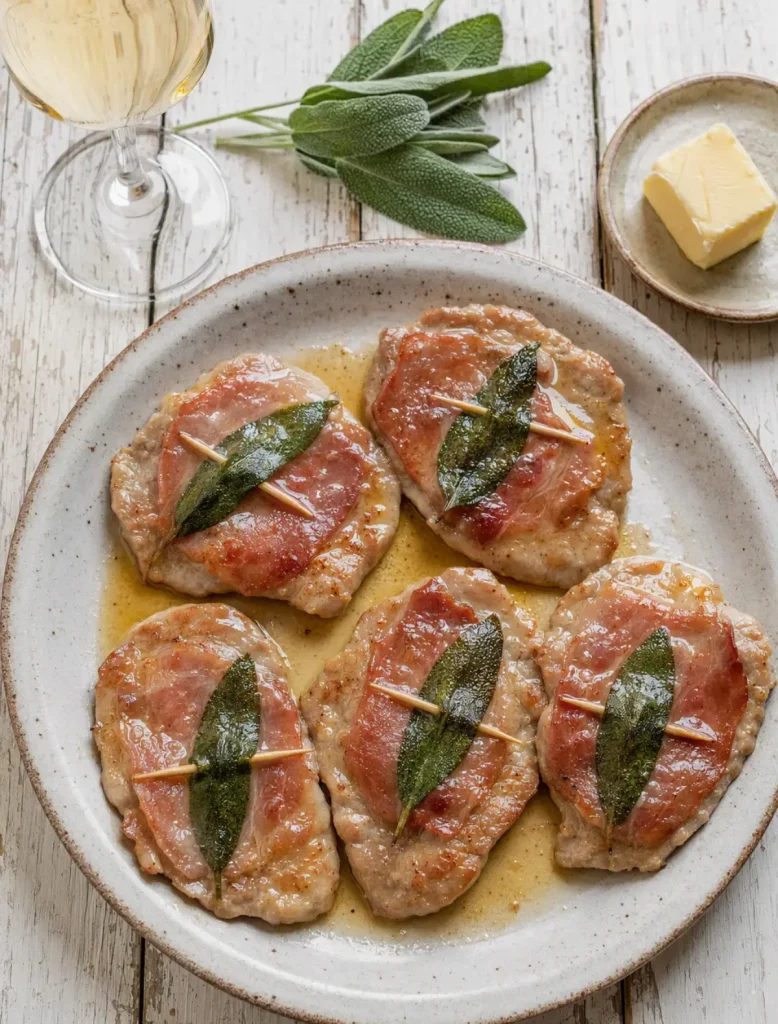
A thin slice of veal, a slice of prosciutto, and a sage leaf. Everything goes into a pan with butter, a splash of white wine, and within minutes, the saltimbocca are ready.
It’s one of those recipes that makes Italian cooking look wonderfully simple. Just a few ingredients, very little cooking time, and a result that really doesn’t need much introduction.
The name, after all, leaves little to the imagination. Saltimbocca comes from the dialect word saltimbocchi and suggests something so tempting that it practically jumps straight into your mouth. In this case, the name almost sounds like a description.
The veal needs to be thin because it cooks very quickly. The prosciutto brings a rich savouriness, the sage adds its aroma, and the butter, together with the white wine, picks up all the flavours left in the pan. That’s a big part of why stopping at just one can be difficult.
The curious part comes when you start looking into where they actually came from.
Today we know them as Saltimbocca alla Romana, but no one knows for certain where they were first created. One theory traces them back to Brescia in the 19th century, where combining meat, prosciutto, and sage was already common. The dish later became established in Rome, where it turned into a true classic of Roman cooking.
An important early reference comes from Pellegrino Artusi. In 1891, in La scienza in cucina e l’arte di mangiar bene (The Science of Cooking and the Art of Eating Well), he wrote about eating saltimbocca at the Roman trattoria Le Venete. He included the recipe in his famous cookbook, and from there the dish began to spread far beyond Rome.
Brescian or Roman, then? We may never have a definitive answer. But one thing is pretty clear: in Rome, saltimbocca found a home.
And perhaps, given the name, it was inevitable.