Note
If you want to get ahead, you can prepare the veal slices a few hours in advance. Pound them with a meat mallet and, if you want to protect them while working with them, place them between two sheets of parchment paper. Cover and refrigerate.
The flour, however, should be added shortly before cooking. Avoid flouring the saltimbocca in advance and leaving them in the refrigerator for several hours: moisture from the meat will cause the flour to absorb moisture, making it sticky and affecting the final result in the pan.
You can add the prosciutto and sage shortly before cooking, together with the flour.
One thing to watch is the butter. It should not turn brown: it should melt and form a light foam. If the bottom of the pan starts to burn, it’s better to stop, clean the pan, and start again.
Saltimbocca is definitely best when freshly cooked, but if you have leftovers, you can keep them refrigerated until the next day. To reheat them, use very low heat and add a splash of water to help keep the veal tender.
Keywords:
saltimbocca alla romana, Roman saltimbocca, saltimbocca alla romana recipe, Roman cuisine, Lazio cuisine, Roman main course, Roman recipes, veal with prosciutto and sage
Saltimbocca alla Romana: History and Origins
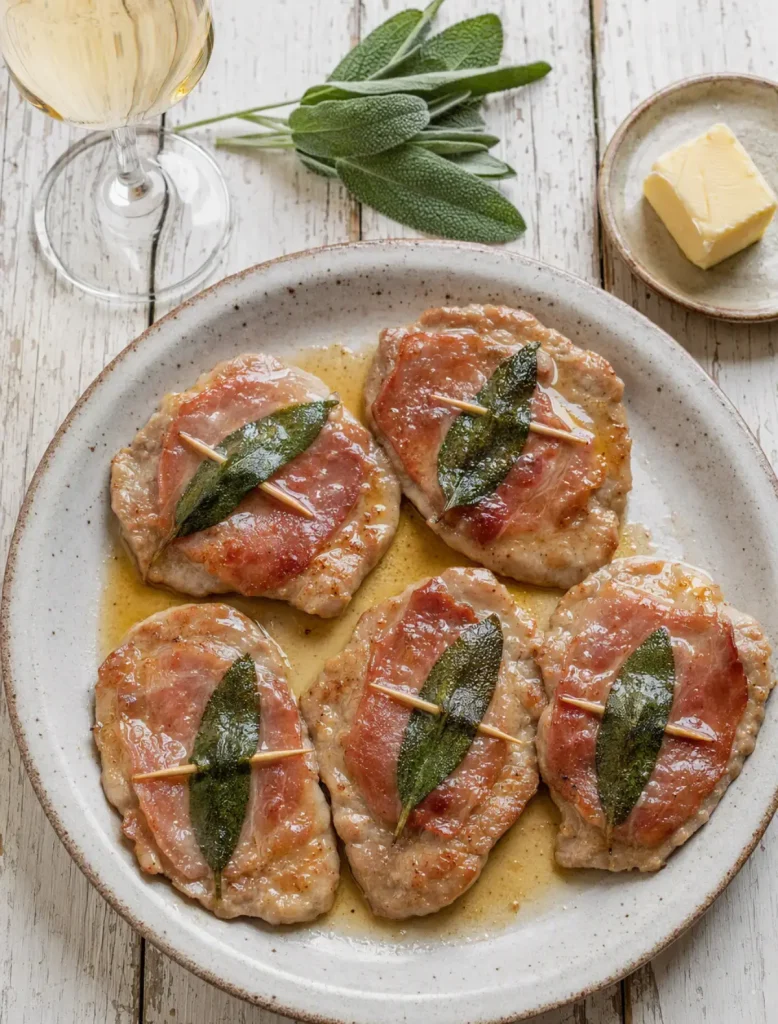
A thin slice of veal, a slice of prosciutto, and a sage leaf. Everything goes into a pan with butter, a splash of white wine, and within minutes, the saltimbocca are ready.
It is an essential preparation built around just a few ingredients and a very short cooking time.
The name, after all, leaves little to the imagination. Saltimbocca comes from the dialect word saltimbocchi and suggests something so tempting that it practically jumps straight into your mouth. In this case, the name almost sounds like a description.
The veal needs to be thin because it cooks very quickly. The prosciutto adds savouriness, the sage its distinctive aroma, while the butter and white wine pick up the flavours from the meat and form a short, savoury pan sauce.
The more interesting question arises when trying to trace the dish's origins.
Today we know them as Saltimbocca alla Romana, but their exact origin is not documented with certainty. Some sources suggest a possible Brescian origin, a theory also mentioned by Treccani, while the dish's connection with Rome by the end of the nineteenth century is much better documented.
One of the most important historical accounts comes from Pellegrino Artusi. In May 1899, during a stay in Rome, he tasted saltimbocca at the trattoria Le Venete, in Via di Campo Marzio. In a letter dated 12 June of that year, he wrote that he had been hearing about the dish for some time and had finally found it the previous month at that trattoria.
Artusi later included the preparation in La scienza in cucina e l'arte di mangiar bene (Science in the Kitchen and the Art of Eating Well) as recipe no. 222, under the name “Saltimbocca alla romana.” His description already contains the fundamental elements of the dish: veal, sage, prosciutto, and a quick cooking in butter.
Based on the available sources, it is therefore not possible to attribute the creation of saltimbocca with certainty to either Brescia or Rome. What can be documented is that by the end of the nineteenth century they were already known and served in Rome, and that Artusi helped establish in Italian gastronomic literature the name by which the dish is still known today: Saltimbocca alla Romana.