Spread the Cream and Cross the Second Layer 🍰
Cover the first layer of ladyfingers with about half of the mascarpone cream, spreading it evenly.
Quickly dip the remaining ladyfingers in the coffee and arrange them over the cream perpendicular to the first layer. Arranging the second layer crosswise adds stability and helps create clean, neat slices when serving.
6 Finish with the Cream and Refrigerate ❄️
Spread all the remaining mascarpone cream over the top and gently level the surface with a spatula.
Cover the dish and refrigerate for at least 10 hours. During this time, the cream firms up, moisture spreads through the ladyfingers and the two layers become more stable. You can easily prepare the Tiramisu the day before and refrigerate it overnight.
7 Dust with Cocoa and Serve the Tiramisu 🍫
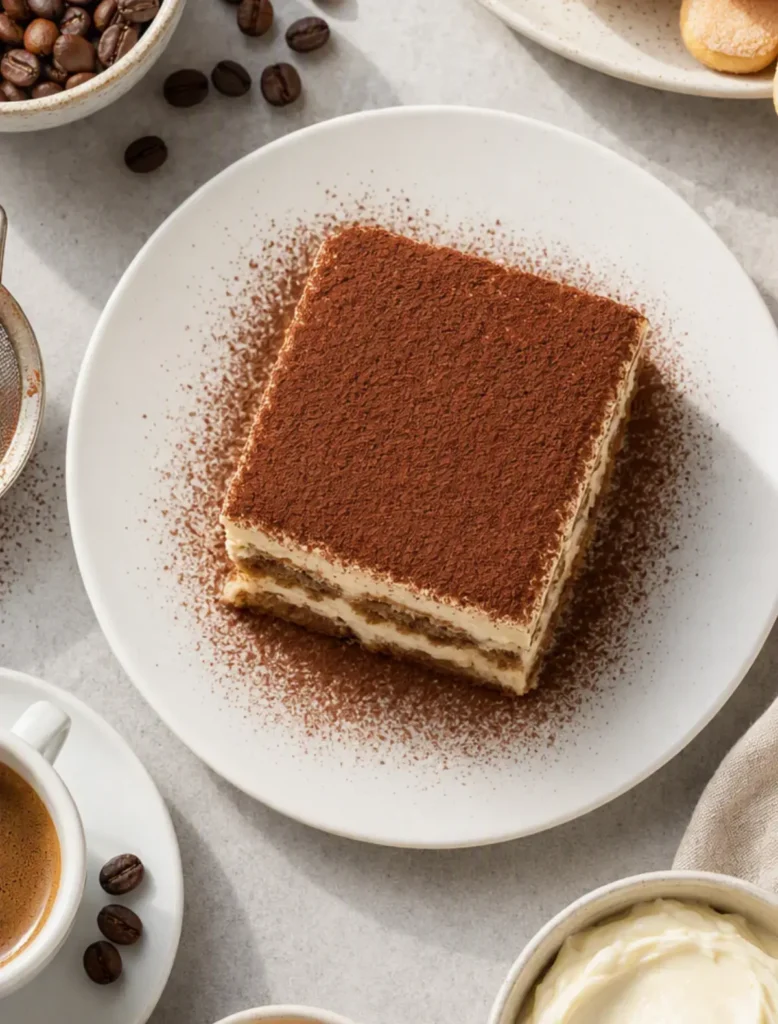
Take the Tiramisu out of the refrigerator shortly before serving and sift an even layer of unsweetened cocoa powder over the surface.
Adding the cocoa just before serving helps keep it dry and clearly visible over the cream. Slice the Tiramisu while still cold and serve directly from the dish.
Servings 8
- Amount Per Serving
- % Daily Value *
- Total Fat 25.9g40%
- Saturated Fat 15.6g78%
- Sodium 73mg4%
- Total Carbohydrate 42.1g15%
- Dietary Fiber 1g4%
- Sugars 29.4g
- Protein 7.4g15%
* Percent Daily Values are based on a 2,000 calorie diet. Your daily value may be higher or lower depending on your calorie needs.
Note
When to Use Pasteurized Egg Yolks
The traditional preparation uses raw egg yolks. To reduce the risk associated with consuming raw eggs, you can use pasteurized egg yolks; for these quantities, use about 80 g pasteurized egg yolk. This is particularly recommended when serving Tiramisu to young children, pregnant women, older adults, or people with weakened immune systems.
How to Keep the Mascarpone Cream Stable
Once the mascarpone has been added, mix it only until the cream is smooth and uniform. Mixing it longer than necessary can affect its consistency.
How Long to Dip the Ladyfingers
Give the ladyfingers only a quick dip in the coffee. They will continue absorbing moisture during the 10-hour rest, so there is no need to soak them completely during assembly. Too much coffee at this stage can make it harder to achieve clean, defined layers.
Why the Coffee Should Be Cold
Prepare the coffee ahead of time and use it only once it has cooled completely. A moka pot gives the concentrated coffee traditionally used for this recipe, but strong espresso works well too if you don't have one. No sugar or alcohol is added, allowing the coffee to provide a clean contrast to the rich mascarpone cream.
The 10-Hour Rest
Tiramisu needs at least 10 hours in the refrigerator. During this time, the cream firms up and moisture spreads evenly through the ladyfingers. Making the dessert the night before is an easy way to give it the full resting time.
When to Add the Cocoa
Sift the unsweetened cocoa powder over the Tiramisu shortly before serving. This keeps the cocoa dry and even on the surface instead of allowing it to absorb moisture during the long refrigerator rest.
The Traditional Shape and the 8 × 8 Inch Dish
The traditional presentation associated with Le Beccherie is round. To recreate it, place a 20–22 cm (8–9 inch) pastry ring directly on a serving plate and assemble the Tiramisu inside it, building the two layers of ladyfingers and mascarpone cream. After the refrigerator rest, carefully lift the ring straight up, then finish the surface with unsweetened cocoa powder.
For an easier home preparation, use a 20 × 20 cm (8 × 8 inch) square dish, with sides at least 5–6 cm (2–2½ inches) high. The 8 × 8 inch square dish is a convenient and widely available size.
How to Store Tiramisu
Keep the Tiramisu covered in the refrigerator and consume it within 2 days, keeping it properly chilled at all times.
Keywords:
traditional Tiramisu, original Tiramisu recipe, Treviso Tiramisu, Le Beccherie Tiramisu, Tiramisu with mascarpone, Tiramisu with ladyfingers, Tiramisu without cream, Tiramisu without egg whites
A More Recent History Than You Might Expect
Behind traditional Tiramisu lies a much more recent—and debated—history than you might imagine. Treviso and Le Beccherie played a central role in the spread of the modern recipe, while documents discovered in Friuli-Venezia Giulia have added new pieces to the story of its origins.
Read the full story of Tiramisu, its origins and the myths surrounding this Italian classic.