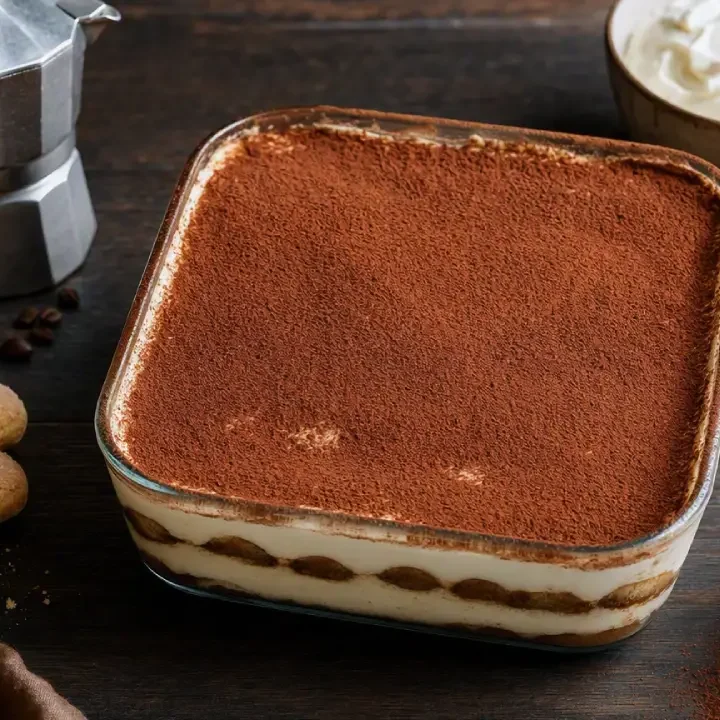
Tiramisu feels as though it has always been part of Italian cuisine. Ladyfingers, coffee, mascarpone and cocoa are such a familiar combination that it would be easy to imagine the dessert appearing in nineteenth-century cookbooks alongside zuppa inglese and other classics of Italian home baking. Yet a look through the cookbooks of the period tells a very different story: Tiramisu is absent from the major nineteenth-century works, and even those published during the first half of the twentieth century contain no recognisable dessert by that name. The Sabatini Coletti Italian dictionary dates the first recorded use of the term in the Italian language to 1980.
Its geographical origins are also more complicated than the best-known version of the story suggests. Treviso is closely associated with the recipe that spread throughout Italy and abroad from the 1970s onward, but earlier documents have been preserved in Friuli-Venezia Giulia, referring to names and preparations that cannot be overlooked when tracing the dessert’s history. Rather than pointing to one undisputed date and place of birth, the evidence reveals a story centred on northeastern Italy during the twentieth century, reconstructed through old menus, restaurant bills, cookbooks and testimonies collected after Tiramisu had already begun to gain widespread recognition.
Before Tiramisu: Biscuits, Creams and Layered Desserts
The idea of layering biscuits with cream did not begin with Tiramisu. Italian and European pastry traditions already included desserts built around a similar principle. Zuppa inglese layered sponge cake or biscuits soaked in liqueur with custard; charlotte paired ladyfingers with creamy fillings; while Dolce Torino, which also appears in the work of Pellegrino Artusi, combined biscuits with a rich mixture of butter, egg yolks, sugar and chocolate.
These are very different desserts, but they help explain the culinary background from which Tiramisu emerged. Layers, biscuits and creams were already well established in pastry making. What was still missing was the combination of mascarpone and coffee that would become one of the defining characteristics of the new dessert. Cocoa would provide its contrasting bitterness, while ladyfingers offered a porous structure capable of absorbing the coffee without completely disappearing beneath the cream.
Treviso, Le Beccherie and Sbatudin
In the Treviso version of the story, the trail leads to Le Beccherie, the restaurant run by the Campeol family. Between the late 1960s and early 1970s, Alba Campeol and pastry chef Roberto “Loly” Linguanotto became associated with the preparation of the Tiramisu that would eventually become its best-known form.
Its cream is often linked to sbatudin, a traditional Venetian home preparation made by vigorously beating egg yolk and sugar until pale and creamy. It was not originally a restaurant dessert. In Venetian households, it was a simple, nourishing preparation that was also eaten as a restorative food. Adding mascarpone made the mixture richer and more substantial; ladyfingers dipped in coffee provided the layers, while unsweetened cocoa completed the dessert.
The version associated with Le Beccherie is also notably restrained in its choice of ingredients. It contains no cream or alcohol, and the mascarpone mixture is not lightened with whipped egg whites, which would later become common in many homemade versions. Egg yolks, sugar and mascarpone are all that is needed to make the cream.
Why Is It Called Tiramisu?
The name has unmistakably Venetian roots. Tiramesù or tireme su became Tiramisu in standard Italian while retaining the original meaning of “pick me up” or “lift me up”—a fitting name for a rich combination of eggs, sugar and mascarpone paired with coffee.
Sbatudin itself was traditionally eaten as an energy-giving food, which makes the name even easier to understand within the context of Venetian home cooking. Its literal meaning, however, also gave rise to a much more provocative story that eventually became almost inseparable from the mythology surrounding the dessert.
According to legend, an ancestor of Tiramisu was served in a brothel in Treviso’s historic centre, where the madam supposedly offered customers an energising preparation before they left, encouraging them to “pick themselves up.” The same story is sometimes used to explain the supposed aphrodisiac reputation of the dessert. It has become enormously popular, but there is not enough documentary evidence to treat it as an established episode in Treviso’s culinary history.
From the “Duke’s Soup” to Cavour: The More Imaginative Origin Stories
Tiramisu’s fame has also inspired claims of much older origins. One of the best known takes the story back to seventeenth-century Siena, where a dessert known as “zuppa del duca,” or “the Duke’s soup,” was supposedly prepared for a visit by Cosimo III de’ Medici, Grand Duke of Tuscany. According to the story, the dessert survived and gradually evolved into modern Tiramisu.
There are some very practical problems with this account. Mascarpone, a highly perishable dairy product traditionally produced in northern Italy, would have been difficult to transport and preserve in seventeenth-century Tuscany. A preparation based on raw eggs would also have presented obvious storage challenges. More importantly, the major historical cookbooks provide no sequence of recipes that would allow us to trace a convincing evolution from the supposed Sienese dessert to modern Tiramisu.
A similar problem surrounds the story that a pastry chef in Turin created an energising dessert for Camillo Benso, Count of Cavour, during the Italian Risorgimento. Once again, the story has survived without documentation strong enough to substantiate it. The evidence that has genuinely changed the discussion about Tiramisu’s origins comes from a much more recent period—and from Friuli-Venezia Giulia.
Friuli-Venezia Giulia and the Earliest Traces of the Name
In Pieris, near Gorizia, the history of Tiramisu intersects with that of chef Mario Cosolo. The preparation that would eventually become Coppa Vetturino is traced back to 1935; in 1939, Cosolo brought it to his family’s restaurant, Al Vetturino, and in 1947 the dessert took on the dialect name “Tirime su”. A photograph from 1950 already documents the use of this name at the restaurant.
Coppa Vetturino was, however, very different from modern Tiramisu. It consisted of a layer of chocolate mousse and one of zabaglione mousse, separated by sponge cake soaked in liqueurs. This difference in ingredients makes the dessert particularly significant to the history of the name, rather than as a direct predecessor of the recipe we know today as Tiramisu.
Mascarpone and coffee, meanwhile, appear in another Friulian story, this time in Tolmezzo, in the Carnia area.
At the Albergo Roma, Norma Pielli is said to have reworked Dolce Torino during the 1950s, replacing butter with mascarpone and Alchermes liqueur with coffee. This preparation is accompanied by documents carrying specific dates: a restaurant bill from 1959 lists two servings of “tirami su”, while the name appears again on menus from dinners held at the same hotel in 1963 and 1965.
These documents predate the preparation associated with Le Beccherie, generally placed between the late 1960s and early 1970s. For this reason, the once-common statement that Tiramisu was simply “invented in Treviso in 1970” now requires some qualification: Tolmezzo preserves documented references that predate the Treviso evidence, both to the name and to a preparation that already included mascarpone and coffee.
How Treviso Became Central to the Modern Tiramisu Recipe
The documentary evidence from Treviso becomes more substantial in the early 1980s. In 1981, food and wine writer Giuseppe Maffioli wrote about Tiramisu in the magazine Vin Veneto, connecting it with Le Beccherie and Treviso’s culinary scene between the late 1960s and early 1970s.
Maffioli associated it with the Central European tradition of spoon desserts and described a sweet that was already spreading rapidly throughout Veneto and the rest of Italy. In 1983, Giovanni Capnist included a preparation resembling Tiramisu in I dolci del Veneto, although the dessert was not yet presented under the name that would eventually become known around the world.
During this period, the recipe began to circulate much more widely. It moved from restaurants into home kitchens and, inevitably, started to change along the way. Proportions varied, some cooks folded in whipped egg whites, while others added alcohol. Tiramisu was becoming part of family recipe collections at the same time that people were beginning to document the stories surrounding its origins.
The Registered Treviso Recipe
The desire to preserve the version associated with Le Beccherie eventually led to an important step. In 2010, the Treviso delegation of the Italian Academy of Cuisine (Accademia Italiana della Cucina) compiled a booklet documenting the history of Tirame su and its traditional preparation, formally depositing it through a notarised document.
The recipe is remarkably simple. For approximately 6–8 servings, it calls for 300 g mascarpone, 3 egg yolks, sugar in the proportion of one and a half tablespoons per egg yolk, ladyfingers, lightly sweetened coffee and unsweetened cocoa powder. The egg yolks are beaten with the sugar and then combined with the mascarpone. The cream is layered with ladyfingers dipped in coffee and finished with cocoa.
The registered version contains no whipped cream, alcohol or whipped egg whites. The document therefore preserves the Treviso preparation associated with Le Beccherie without settling the broader question of where Tiramisu originated: the 1959 Tolmezzo bill and the other earlier documents remain part of the same historical record.
Tiramisu in Italian Home Kitchens
Anyone who grew up with a family Tiramisu recipe may only partly recognise the Treviso version. Whipped egg whites have long been used in many homemade recipes to make the mascarpone cream lighter and airier. Other versions use whipped cream, while Marsala and rum became common additions in later interpretations.
Over time, even the meaning of the word Tiramisu has broadened. Pistachio, strawberry, lemon, chocolate and berry versions have produced desserts that retain the familiar layered construction while moving progressively further away from the classic preparation. Some still use mascarpone and ladyfingers; others preserve little more than the alternating layers of biscuits and cream.
In the Le Beccherie recipe, however, the flavour is built around just a few contrasts: the richness of mascarpone, the coffee absorbed by the ladyfingers and the bitterness of cocoa on top. It is this simplicity that defines the Treviso version, where just a handful of ingredients are enough to give Tiramisu its distinctive character.
From Treviso and Tolmezzo to Restaurants Around the World
From the 1980s onward, Tiramisu spread rapidly. It appeared in Italian restaurants beyond the northeast of the country and soon crossed national borders. The name travelled with the recipe, and there was little need to translate it: tiramisu simply entered restaurant menus around the world.
Within just a few decades, the dessert achieved a level of international recognition that many regional specialities had taken centuries to build. International interpretations multiplied, often changing the cream, biscuits and flavourings while leaving the name instantly recognisable.
Placing the dates side by side helps put this history into perspective: 1959, the Tolmezzo bill; the 1960s and 1970s, the preparation associated with Le Beccherie; 1981, Maffioli’s written account; followed by cookbooks and international expansion. Alongside these are the earlier Friulian references connected with Coppa Vetturino and the name Tirime su. There is no need for Renaissance courts or centuries-old genealogies: almost all of the documentable history of Tiramisu belongs to the twentieth century.
The Traditional Tiramisu Recipe
The recipe presented here follows the traditional Treviso version associated with Le Beccherie and formally registered in 2010. The mascarpone cream is made with egg yolks, sugar and mascarpone, without whipped cream or whipped egg whites.