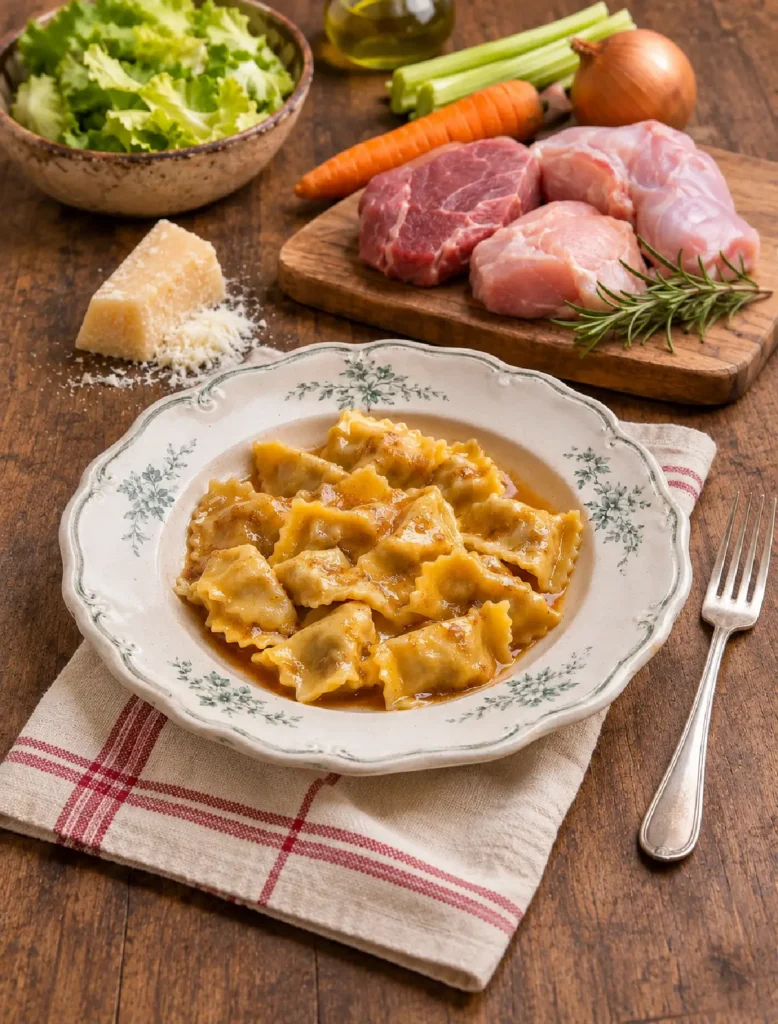
Prepare the Roast Meat Sauce 🍯
Strain the reserved meat cooking juices through a fine sieve into a small saucepan.
If any browned cooking juices remain in the original pan, add a little hot water or stock and gently scrape the bottom with a wooden spoon. Add this liquid to the reserved juices.
Remove any excess fat and simmer gently for a few minutes until the sauce becomes flavourful and slightly reduced.
If necessary, add a little hot water to adjust the consistency.
11 Cook the Agnolotti 🍝
Bring a large pot of salted water to a boil.
Carefully add the agnolotti and cook for approximately 3–4 minutes, keeping the water at a gentle boil to prevent them from opening.
Taste one to check that the pasta is cooked but still has a little firmness.
Remove the agnolotti carefully with a slotted spoon.
12 Dress and Serve 🍽️
Transfer the agnolotti to a pan containing the warm roast meat sauce. Gently move the pan to coat the pasta without breaking it.
If necessary, add a tablespoon of pasta cooking water to loosen the sauce.
Divide the agnolotti between serving plates and serve immediately, spooning over any remaining sauce.
Servings 4
- Amount Per Serving
- % Daily Value *
- Total Fat 19g30%
- Saturated Fat 6g30%
- Sodium 430mg18%
- Total Carbohydrate 49g17%
- Dietary Fiber 3g12%
- Sugars 3g
- Protein 32g64%
* Percent Daily Values are based on a 2,000 calorie diet. Your daily value may be higher or lower depending on your calorie needs.
Note
Filling consistency: the escarole must be thoroughly squeezed and the meat should not contain too much liquid. An overly wet filling makes the agnolotti difficult to seal and may cause them to open during cooking.
Choosing the meat: veal chuck is suitable for slow cooking. If unavailable, use veal shoulder suitable for braising or stewing. The exact name of the cut may vary between countries.
Pasta thickness: the dough should be very thin but elastic. If it starts tearing while being rolled out, let it rest for a few more minutes. If the edges become dry and difficult to seal, lightly moisten them with a fingertip dipped in water.
Roast meat sauce: use a saucepan that is not too wide and add water or stock gradually. Because the recipe uses relatively small quantities of meat, the cooking juices may be limited. Scrape up the browned bits from the pan and dilute the sauce slightly if necessary.
Preparing ahead: the filling can be prepared the day before. Cool it promptly and store it in a covered container in the refrigerator at 4°C (40°F) or below. Ideally, shape the agnolotti on the day you plan to cook them.
Storage: uncooked agnolotti can be frozen in a single layer on a tray, then transferred to freezer-safe bags. Cook directly from frozen, increasing the cooking time as needed. Avoid leaving fresh pasta filled with meat and eggs at room temperature for extended periods.
Keywords:
agnolotti del plin, Piedmontese stuffed pasta, Langhe agnolotti, Italian meat ravioli, homemade stuffed pasta, roast meat sauce
Agnolotti del Plin, a Tradition of Family Gatherings and Celebrations
In the Langhe, agnolotti were not something people prepared every day. They were made for Christmas, Carnival, weddings and other occasions when the family gathered around the table. Preparing enough for everyone took time, and it was often a job shared by several people.
The history of this stuffed pasta goes back further than one might expect. In 1846, the Turin chef Francesco Chapusot published a cookbook which, according to documentation from the Piedmont Regional Government, included a preparation that can be associated with plin. This does not prove that they originated at that particular time, but it suggests that their culinary roots extend back at least to the nineteenth century.
In rural Piedmont, there was a custom that reveals how closely agnolotti were connected to community life. During Carnival, groups of young people travelled between farmhouses collecting food and offerings from local families. Among the dishes that might be served were raviòle al plin. This tradition has been documented by the anthropologist Gianpaolo Fassino, who has studied the history and customs surrounding this regional speciality.
Agnolotti also had a more everyday side. Leftover roast meat could be finely chopped and turned into a pasta filling. Rural families made the most of whatever food was available, but it would be misleading to suggest that plin were simply a dish invented to use up leftovers. For important family meals, the meat was often cooked specifically for the filling, and every household had its own way of preparing it.
Recipes varied from one home to another. Quantities were judged through experience, and methods were passed down through generations without necessarily being written down. The Guida gastronomica d'Italia, published by the Touring Club Italiano in 1931, also shows how firmly agnolotti had become established in Piedmontese cooking for special occasions.
For a long time, plin remained a speciality associated mainly with the Langhe. During the twentieth century, particularly in its second half, they gradually became more widely known, appearing in restaurants and fresh pasta shops beyond their area of origin. Today, they are included in Piedmont's list of Traditional Agri-Food Products (PAT), a recognition of the preparation's longstanding connection with the region and its culinary customs.