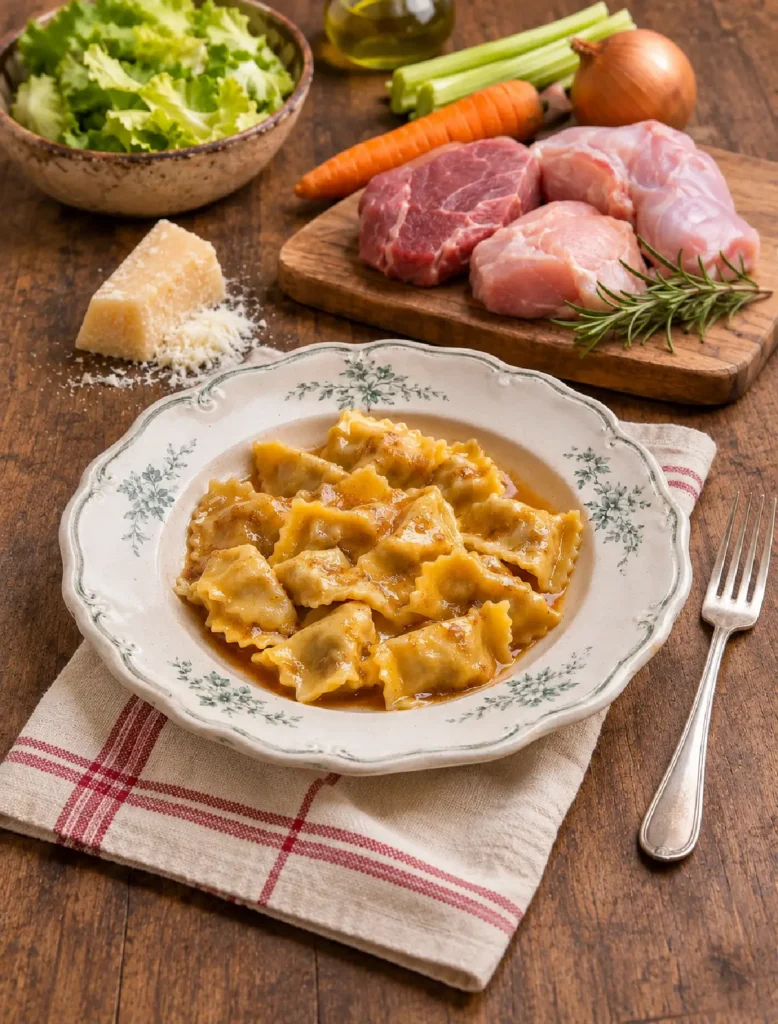
Agnolotti del Plin are small stuffed pasta parcels from the Langhe area of Piedmont, in northern Italy. Their name comes from the Piedmontese word plin, meaning a pinch, referring to the way the pasta is pressed between each little mound of filling. This simple gesture gives the agnolotti their distinctive shape, with a slight fold where the dough is pinched together.
The most challenging part isn’t necessarily making the filling, but enclosing it in a very thin sheet of pasta. Small portions of meat filling are placed along the dough, which is then folded over and pinched between them, taking care not to trap any air. A fluted pastry wheel is used to separate the individual agnolotti. It takes patience, especially the first few times, when judging the right distance between each portion of filling can be surprisingly tricky.
For our filling, we’ve chosen to follow the Alte Langhe recipe published by the Piedmont Regional Government. It uses three meats, veal, pork and rabbit, slowly cooked with vegetables and aromatic herbs. Once cooled, the meat is finely chopped and combined with escarole, Parmigiano Reggiano and an egg. The preparation takes time, particularly while the meat cooks, but much of the work can be done in advance.
In the Langhe, agnolotti del plin are often served with sugo d’arrosto, a sauce made from the juices left after cooking the meat. There’s also a rather unusual local custom known as al tovagliolo, in which the agnolotti are served without any sauce, laid out on a cloth napkin. This allows the flavour of the filling and the delicate pasta to be appreciated without anything else.
Agnolotti del Plin Piedmontese Meat Ravioli
Description
Delicate egg pasta filled with slow-cooked veal, pork, rabbit and escarole. Each tiny parcel is sealed with the characteristic plin pinch and served with a sauce made from the meat's cooking juices.
Ingredients
For the Filling and Meat Cooking
For the Fresh Pasta
Instructions
How to Make Agnolotti del Plin
-
Cook the Escarole 🥬
Wash the escarole thoroughly, remove any damaged leaves and cook it in lightly salted boiling water for about 5–7 minutes, until tender. Drain, leave to cool and squeeze thoroughly to remove excess water. Chop finely and set aside.
-
Prepare the Vegetables and Brown the Meat 🍖
Finely chop the onion, carrot and celery. Cut the pork, veal chuck and rabbit meat into pieces approximately 4–5 cm (1.5–2 inches) long.
Heat a little extra virgin olive oil in a heavy-bottomed saucepan or casserole. Add the chopped vegetables, garlic, rosemary and bay leaves, and cook gently for a few minutes.
Add the three meats and brown them on all sides, stirring occasionally. Season with salt and black pepper.
-
Slowly Cook the Meat 🍲
Reduce the heat, cover the saucepan and cook gently for approximately 2 hours.
Check occasionally and add a little hot water or meat stock whenever the cooking juices begin to dry out. The meat should become very tender without losing too much moisture.
Once cooked, leave it to cool slightly.
-
Prepare the Filling 🥣
Remove the meat and vegetables from the saucepan, discarding the rosemary, bay leaves and garlic. Reserve the cooking juices for the sauce.
Pass the meat, cooked vegetables and escarole through a meat grinder, or chop them finely in a food processor without turning them into a smooth paste.
Transfer the mixture to a bowl, add the egg and grated Parmigiano Reggiano, and mix thoroughly.
The filling should be soft and evenly combined, but firm enough to hold its shape. Taste and adjust the seasoning with salt and black pepper if necessary.
-
Prepare the Fresh Pasta 🥚
Place the flour on a clean work surface and make a well in the centre. Crack the two whole eggs into the well, add the egg yolk and beat lightly with a fork, gradually incorporating the flour.
Knead by hand for approximately 10 minutes, until the dough becomes smooth, firm and elastic. If it feels too dry, add a very small amount of water at a time.
Shape the dough into a ball, cover with plastic wrap or an overturned bowl, and leave to rest for 30 minutes at room temperature.
-
Roll Out the Pasta 📏
Divide the dough into 3–4 portions, keeping the unused pieces covered.
Flatten one portion and pass it through a pasta machine, starting at the widest setting and gradually reducing the thickness until you obtain a very thin sheet that is still strong enough to hold the filling.
If you don't have a pasta machine, use a rolling pin on a lightly floured work surface. Roll the dough from the centre outwards until it is thin and evenly stretched.
Cut the pasta into strips approximately 6–7 cm (2.5–2.75 inches) wide. Work with one strip at a time to prevent the dough from drying out.
-
Arrange the Filling 🥄
Using a piping bag or a teaspoon, place small portions of filling, roughly the size of a hazelnut, along the lower half of each pasta strip.
Space the portions approximately 1–2 cm (0.5–0.75 inches) apart, leaving enough pasta along the edge to fold over the filling.
-
Shape the Agnolotti with the Plin Pinch 🤏
Fold the lower edge of the pasta over the filling and press gently to seal it, pushing out any trapped air.
Using your thumb and index finger, pinch the pasta firmly between each portion of filling, making sure the two layers adhere.
With a fluted pastry wheel, trim away the excess pasta along the edge and separate the individual agnolotti by cutting between the pinches.
Continue until all the dough and filling have been used.
-
Let the Agnolotti Rest ⏳
Arrange the agnolotti on a lightly floured tray, leaving space between them so they do not touch or overlap.
Leave them to rest in a cool place for approximately 2 hours, following the regional preparation, while protecting them from excessive drying.
For such a long resting period, particularly in a warm kitchen, keep the filled pasta in the refrigerator.
-
Prepare the Roast Meat Sauce 🍯
Strain the reserved meat cooking juices through a fine sieve into a small saucepan.
If any browned cooking juices remain in the original pan, add a little hot water or stock and gently scrape the bottom with a wooden spoon. Add this liquid to the reserved juices.
Remove any excess fat and simmer gently for a few minutes until the sauce becomes flavourful and slightly reduced.
If necessary, add a little hot water to adjust the consistency.
-
Cook the Agnolotti 🍝
Bring a large pot of salted water to a boil.
Carefully add the agnolotti and cook for approximately 3–4 minutes, keeping the water at a gentle boil to prevent them from opening.
Taste one to check that the pasta is cooked but still has a little firmness.
Remove the agnolotti carefully with a slotted spoon.
-
Dress and Serve 🍽️
Transfer the agnolotti to a pan containing the warm roast meat sauce. Gently move the pan to coat the pasta without breaking it.
If necessary, add a tablespoon of pasta cooking water to loosen the sauce.
Divide the agnolotti between serving plates and serve immediately, spooning over any remaining sauce.
Nutrition Facts
Servings 4
- Amount Per Serving
- Calories 500kcal
- % Daily Value *
- Total Fat 19g30%
- Saturated Fat 6g30%
- Sodium 430mg18%
- Total Carbohydrate 49g17%
- Dietary Fiber 3g12%
- Sugars 3g
- Protein 32g64%
* Percent Daily Values are based on a 2,000 calorie diet. Your daily value may be higher or lower depending on your calorie needs.
Note
Filling consistency: the escarole must be thoroughly squeezed and the meat should not contain too much liquid. An overly wet filling makes the agnolotti difficult to seal and may cause them to open during cooking.
Choosing the meat: veal chuck is suitable for slow cooking. If unavailable, use veal shoulder suitable for braising or stewing. The exact name of the cut may vary between countries.
Pasta thickness: the dough should be very thin but elastic. If it starts tearing while being rolled out, let it rest for a few more minutes. If the edges become dry and difficult to seal, lightly moisten them with a fingertip dipped in water.
Roast meat sauce: use a saucepan that is not too wide and add water or stock gradually. Because the recipe uses relatively small quantities of meat, the cooking juices may be limited. Scrape up the browned bits from the pan and dilute the sauce slightly if necessary.
Preparing ahead: the filling can be prepared the day before. Cool it promptly and store it in a covered container in the refrigerator at 4°C (40°F) or below. Ideally, shape the agnolotti on the day you plan to cook them.
Storage: uncooked agnolotti can be frozen in a single layer on a tray, then transferred to freezer-safe bags. Cook directly from frozen, increasing the cooking time as needed. Avoid leaving fresh pasta filled with meat and eggs at room temperature for extended periods.