How Did Stockfish Arrive in Venice?
To understand how stockfish became part of Venetian cooking, we need to go back to the days of the Venetian Republic, when merchant ships travelled across Europe in search of new goods to trade.
One of the most interesting stories involves Pietro Querini, a Venetian merchant who was shipwrecked in 1432 while sailing towards Flanders. After a series of misfortunes, he and several surviving crew members were welcomed by the inhabitants of the Lofoten Islands in Norway. There, Querini discovered a fish preserved by drying it in the cold open air, without using salt: stockfish.
Querini described what he had seen in his account of the journey. Exactly who first thought of whipping stockfish with oil is another matter. The precise origins of Baccalà Mantecato aren't documented, although we know that stockfish found its place in Venetian cooking partly because it could be stored for long periods.
Baccalà or Stockfish? The Name Can Be Confusing
Order baccalà in Veneto and you might be served a dish made with stockfish. That's not a mistake: in this part of Italy, the word baccalà is traditionally used for dried cod as well.
The difference lies in how the fish is preserved. Salt cod is cured with salt, while stockfish is dried in the open air without salt.
Traditional Venetian Baccalà Mantecato is made with stockfish, either purchased already soaked or rehydrated in water for several days before cooking.
What Makes It So Creamy?
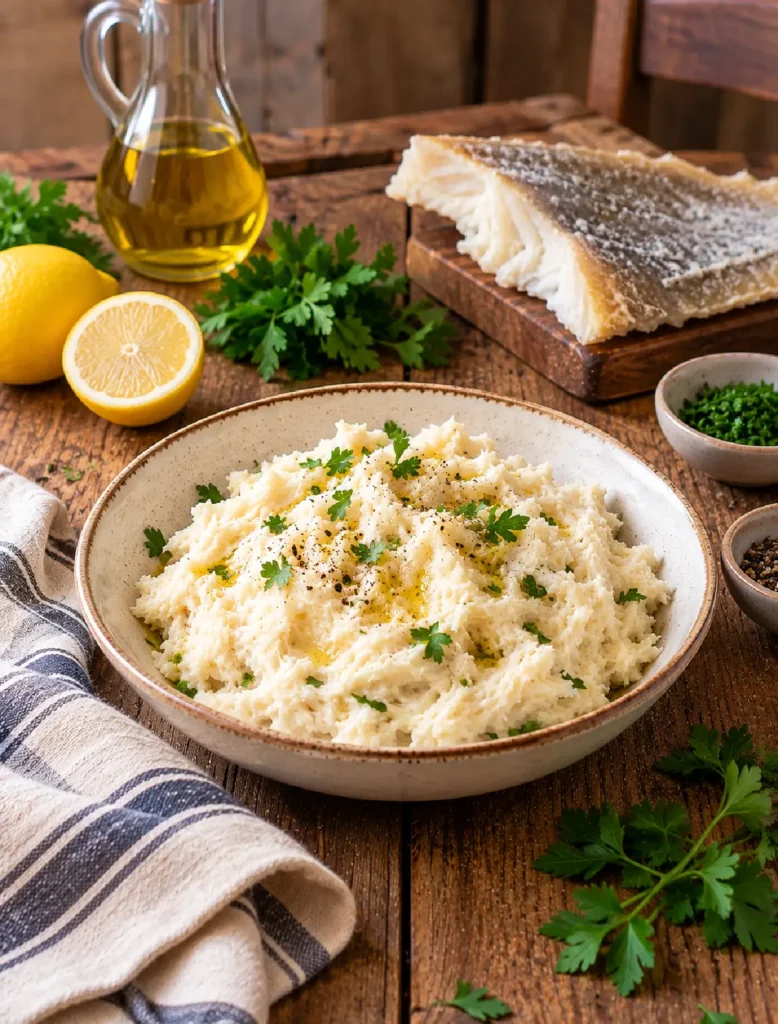
The most interesting part of the preparation begins once the fish has been cooked. The stockfish is worked for several minutes, adding the oil a little at a time, until its texture changes and it becomes pale, light and creamy.
Traditionally, this was done by hand with a wooden spoon. It takes patience, particularly because the oil needs to be incorporated gradually without separating from the fish. A stand mixer can achieve the same result with less effort.
The mixture shouldn't be completely smooth like a mousse: a few small flakes of stockfish should still be noticeable. There's no need for cream or butter. If the mixture becomes too thick, simply add a little of the water used to cook the fish.
In Venice's Bacari, with Cicchetti and Polenta
In Venice, Baccalà Mantecato is a familiar sight in bacari, the small traditional wine bars where people stop for an ombra, a small glass of wine, and a few cicchetti, the bite-sized snacks typical of Venice. It's served on toasted bread, although grilled polenta is perhaps its most characteristic accompaniment.
It's also a dish that works well for festive meals, particularly on Christmas Eve and New Year's Eve. Venetian Baccalà Mantecato is recognized as one of Veneto's PAT (Traditional Agri-food Products), a designation for foods with a long-established regional tradition.
What About Baccalà alla Vicentina?
The names are similar and both dishes start with the same ingredient, but one look at the finished preparations shows just how different they are.
Baccalà Mantecato is a creamy mixture of stockfish and oil, usually served as an appetizer. Baccalà alla Vicentina, on the other hand, is slowly cooked with onions, milk and oil. The fish remains in tender pieces surrounded by its sauce and is generally served as a main course.
Polenta accompanies both dishes, but with Baccalà alla Vicentina it's usually soft, while Baccalà Mantecato is often served with grilled slices.