Note
Choosing the Right Duck Meat
For this ragù, we can use boneless duck leg meat, which stays tender during the long cooking process. Duck breast is another option, although its leaner texture requires more attention to prevent it from drying out. Remove the skin before chopping the meat in either case.
Alternatives to Bigoli Pasta
If bigoli are unavailable, spaghetti alla chitarra or thick spaghetti are suitable substitutes. Their texture will be slightly different, but both work well with a meat ragù. Outside Italy, bigoli can sometimes be found in specialist Italian food shops.
Choosing the Wine
Recioto adds a sweet, fruity note to the ragù. If it is unavailable, we can use a smooth, slightly sweet red wine, as indicated in the ingredient list. Avoid highly tannic wines, which may develop a bitter edge as the sauce reduces.
Stock and Ragù Consistency
Use a meat stock that is not overly salty, as the liquid reduces during cooking and its flavours become more concentrated. There is no need to add all 400 g (13.5 fl oz) of stock at once. Pour it in gradually, keeping the duck moist without completely submerging the meat.
Storage
We can prepare the duck ragù in advance and keep it refrigerated in a sealed container for up to 2 days, after cooling it promptly. Reheat thoroughly before serving, adding a little stock if necessary.
The ragù can also be frozen separately from the pasta for approximately 2–3 months in suitable airtight containers. Thaw it in the refrigerator before reheating. Bigoli already mixed with the sauce are best enjoyed freshly prepared.
Keywords:
bigoli with duck ragù, duck ragu pasta, Venetian duck pasta, Italian duck pasta recipe, slow cooked duck ragu, bigoli pasta, traditional Venetian pasta
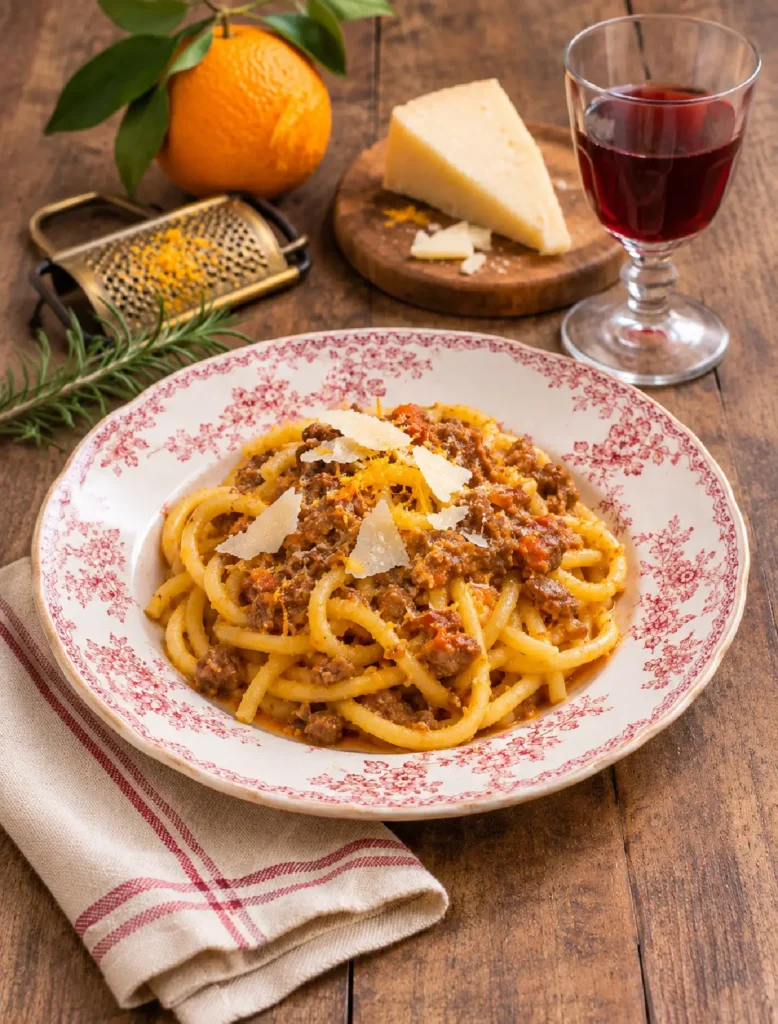
Bigoli with Duck Ragù: A Story Between Padua and Vicenza
On 26 January 1604, in Padua, Bartolomio Veronese, known by the nickname Abbondanza, obtained an official privilege to use a machine of his own invention for making pasta. The manuscript, preserved in the State Archives of Padua and brought to renewed scholarly attention in 2026, mentions bigoli alongside lasagne, menudelli and macaroni. The machine made it possible to produce considerably more pasta than by hand, using a press that forced the dough through specially shaped dies.
The connection between bigoli and duck takes us to the northern part of the province of Vicenza, particularly the towns of Thiene and Zanè. Here, the dish is known as bigoli co' l'arna, with arna meaning duck in the local Venetian dialect. It was traditionally associated with the Feast of Our Lady of the Rosary, celebrated on 7 October. The feast recalls the Battle of Lepanto in 1571, when the fleet of the Holy League defeated the Ottoman fleet. In local tradition, the commemoration became intertwined with the food customs of farming families. An old saying, still remembered in the Vicenza area, goes: “Arna lessa e bigolo tondo a Rosario contenta il mondo”, roughly meaning that boiled duck and round bigoli make everyone happy on the Feast of the Rosary.
The older preparation differed considerably from the duck ragù familiar today. The duck was boiled, and its broth was used to cook the bigoli. The giblets, prepared with butter and sage, provided the sauce, while the meat could be served separately as a main course. Over time, versions also developed in which the duck meat was minced or chopped by hand and cooked directly in the sauce.
In Thiene, one establishment that helped establish the dish's reputation was the Albergo Roma, run by Vera Signorini. Bigoli with duck appeared on its menu during the autumn and winter months, from October through January. When the establishment closed at the end of 1989, Signorini passed some of her recipes to Mario Calgaro, a researcher of Vicenza's culinary traditions. Among them was her recipe for bigoli with duck, which Calgaro would use many years later in his research into the area's food history.
A few kilometres away, Zanè helped preserve the tradition through a food festival that began in October 1972. The first event took place in the parish courtyard, using pasta presses and cooking pots lent by local families. The nuns from the nursery school prepared the duck ragù, and six ducks were used to serve 250 portions of bigoli. What began as a modest community initiative grew into one of the area's best-known gastronomic events. In 2012, the municipality awarded bigoli co' l'arna di Zanè its De.Co. designation (Denominazione Comunale), a municipal recognition intended to protect and promote local food traditions.
On 30 June 2026, the Alto Vicentino Delegation of the Italian Academy of Cuisine formally deposited a historical recipe for bigoli con l'arna with notary Nicola Voltan in Thiene, together with research conducted by Mario Calgaro. The document describes a preparation involving Muscovy duck, cooking broth, giblets and traditionally pressed bigoli, drawing attention to the version handed down through the trattorias of northern Vicenza.