Note
Choosing the bigoli
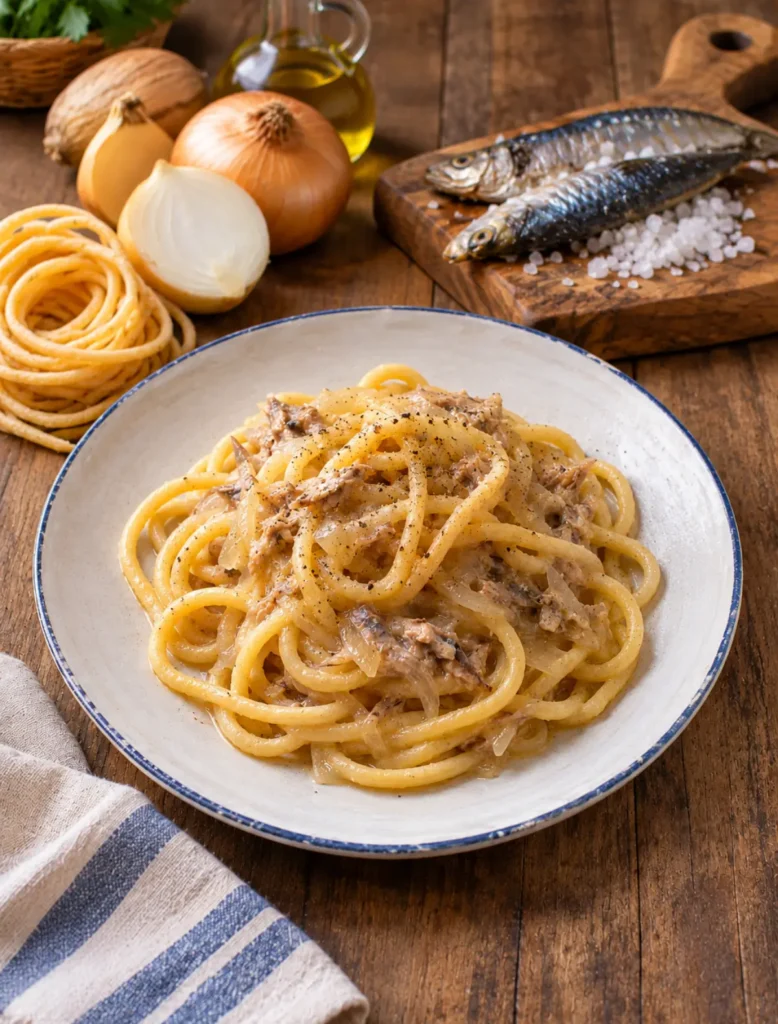
We can use either fresh or dried bigoli for this recipe. If bigoli are unavailable, thick spaghetti alla chitarra make a reasonable substitute, although the texture will be slightly different.
White onions
White onions from Chioggia are particularly associated with the local culinary tradition. Ordinary white onions are a suitable alternative and are widely available outside Italy.
Salt-cured sardines
These are the traditional ingredient used in the recipe we have chosen to follow. If they are difficult to find, salt-cured anchovies can be substituted, adjusting the quantity according to their size and saltiness. Anchovy fillets packed in oil are another convenient option, although they produce a slightly different flavour.
Sauce consistency
If the onions become too dry during cooking, add a little hot water at a time. There is no need to blend the sauce. The onions should soften gradually until they combine with the fish to form a smooth, cohesive mixture.
Salt and cheese
Always taste the sauce before adding salt, as the sardines are already salty. Grated cheese is not traditionally added to Bigoli in Salsa.
Storage
Bigoli in Salsa is best enjoyed immediately after preparation. The sauce can be stored separately in an airtight container in the refrigerator for 1–2 days, provided it is cooled promptly after cooking. Reheat it thoroughly, adding a little water to restore its consistency. For the best result, cook the pasta just before serving.
Keywords:
bigoli in salsa, sardine pasta, Venetian pasta with sardines, pasta with sardines and onions, traditional Venetian pasta
The Bigolaro and a Document from 1604
On 26 January 1604, in Padua, Bartolomio Veronese, known by the nickname Abbondanza, was granted a public privilege for a machine designed to produce pasta. The concession gave him the right to exploit his invention, a press capable of shaping dough through specially designed dies.
For many years, this episode was known mainly through accounts of Veneto's culinary history. In January 2026, however, an original manuscript dated 26 January 1604 was presented at the State Archives of Padua. The document describes a device capable of producing several types of pasta, including bigoli, menudelli, lasagne and macaroni.
The press made it possible to produce quantities of pasta that would have been difficult to achieve through manual preparation alone. This technology gave rise to the bigolaro, a tool that would eventually become familiar in many Venetian kitchens. To operate it, a fairly firm dough was placed inside a cylinder and compressed against a metal die. Long strands of pasta emerged through the holes, ready to be cut to the desired length.
Bigoli Were Already Well Known in the Eighteenth Century
One historical reference comes from literature. In 1747, Giuseppe Pichi published a Venetian-language version of the stories of Bertoldo, Bertoldino and Cacasenno in Padua. In the verses dedicated to Verona, the city's inhabitants are described as enthusiastic eaters of bigoli.
The name itself may have roots in the local dialect. One widely repeated explanation connects it to bigàt, meaning caterpillar, because of the pasta's elongated shape. Another theory traces it to the Latin bombyx, meaning silkworm. The exact origin of the word remains uncertain.
The Possible Jewish Origins of Bigoli in Salsa
According to a tradition discussed by writers specialising in Jewish cuisine, Bigoli in Salsa may have originated within Venice's Jewish community. The theory appears, for example, in the writings of Benedetta Jasmine Guetta on Italian Jewish cooking and in a publication devoted to the culinary history of the Venetian Ghetto.
However, surviving historical documents do not establish with certainty that the dish was invented by the Jewish community.
The Venetian Ghetto, established in 1516, became home to Jewish families from different parts of Italy and other Mediterranean territories. Their food traditions contributed to the development of a distinctive cuisine that brought together dishes from several backgrounds. Pasta with onions and preserved fish is sometimes associated with this culinary heritage, although it is difficult to establish when the recipe first appeared in its present form.
Bigoli Mori and Other Regional Variations
Bigoli have not always been made with the same type of flour. Alongside versions prepared with refined wheat flour, there are bigoli mori, darker varieties traditionally made with wholemeal flour or mixtures of different grains.
The dough also varies according to local customs. Some versions use only flour and water, while others include eggs, which give the pasta a richer texture and a yellow colour.
In the province of Vicenza, bigoli are often served with duck ragù. Around Bassano del Grappa, this preparation is also known as bigoli co' l'arna, with arna meaning duck in the local dialect. The pasta retains its characteristic long, thick shape, traditionally formed using a press, and is noticeably thicker than ordinary spaghetti.