Note
Storage
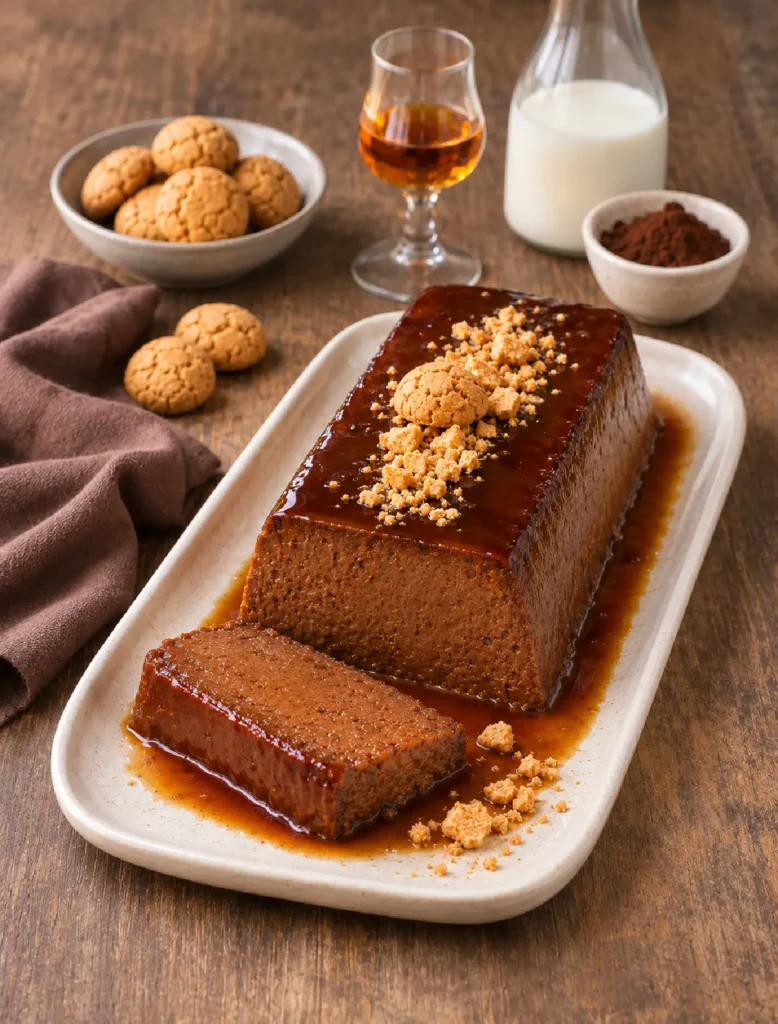
Bonèt can be stored in the refrigerator for 2–3 days, well covered with plastic wrap or in an airtight container. If possible, leave it in its mould until you are ready to serve, as this makes it easier to protect and helps it retain its shape.
Freezing is not recommended, as the custard may lose some of its texture and release liquid after thawing.
Choosing the Right Mould
For these quantities, we recommend a loaf pan approximately 20 × 10 cm (8 × 4 inches), deep enough to hold at least 1 litre (33.8 US fl oz). Alternatively, use 6 individual pudding moulds with a capacity of approximately 150–180 ml (5.1–6.1 US fl oz) each.
Metal moulds conduct heat more quickly than oven-safe ceramic or glass moulds. Baking times may therefore vary even when using the same quantity of custard.
How to Avoid Bubbles and Small Holes
If your Bonèt has many small holes when sliced, the baking temperature may have been too high or the mixture may have been whisked too vigorously. Mix the eggs without incorporating too much air and make sure the water bath does not boil vigorously.
A few small irregularities are normal, especially because of the crushed amaretti.
If the Bonèt Remains Too Liquid
A Bonèt that does not set may simply need a few more minutes in the oven. Before removing it, check that the edges are firm and the centre has only a slight wobble.
Remember that the custard will still be soft when it comes out of the oven. It will become firmer as it cools and rests in the refrigerator.
How to Avoid Lumps
Sift the cocoa powder before adding it to the eggs. If small lumps remain in the mixture, you can briefly use an immersion blender, taking care not to incorporate too much air.
Choose crisp, dry amaretti biscuits rather than soft amaretti for this recipe. They are easier to crush and distribute more evenly throughout the custard.
Avoiding Bitter Caramel
The caramel should turn amber, but not black. If the sugar burns, it develops a bitter flavour that will also affect the finished dessert. In that case, it is better to make a fresh batch rather than use the burnt caramel.
Alternatives to Rum
If you prefer not to use rum, you can replace it with 2 tablespoons of cooled espresso coffee for a more pronounced coffee flavour. Alternatively, you can omit the alcohol.
The traditional recipe used as our reference contains rum.
Keywords:
Italian chocolate amaretti custard, Bonèt, Bonet, Bunet, Piedmontese dessert, Italian chocolate custard, amaretti pudding, traditional Italian desserts
A Hat That Gave Its Name to a Dessert
In 1830, Casimiro Zalli recorded an unusual pastry-making utensil in his Piedmontese dictionary: a tin-lined copper vessel shaped rather like a cap. It was called a bonèt, the Piedmontese word for a hat or cap. In 1859, Vittorio di Sant'Albino also recorded the expression bonèt ëd cusin-a, literally a "kitchen cap", referring to a similarly shaped mould.
The dessert's name is generally thought to come from these traditional moulds. The Piedmontese word is also related to the French bonnet, as linguist Riccardo Regis explains in his research on the relationship between Italian and regional dialects.
Another explanation survives in the Langhe area. According to local tradition, the dessert was named after a hat because it was served at the end of a meal, just as guests were getting ready to put on their hats before leaving. This second interpretation belongs to popular tradition, whereas nineteenth-century dictionaries provide documentary evidence of the name used for the moulds.
When Bonèt Was Not Yet a Dessert
An anonymous Piedmontese cookbook from the early nineteenth century, entitled Polizia e cucina, contains a preparation called Bonèt that might surprise us today. It was described as a cold dish served between courses, following the custom of tramessi, intermediate dishes presented during elaborate formal meals.
The recipe included milk, six egg yolks, sugar, melted chocolate, bitter almond and, optionally, coffee. The mixture was slowly thickened in a saucepan and then left to cool. It was not yet the caramel-coated custard familiar on Piedmontese tables today.
In 1846, Francesco Chapusot, chef to the British ambassador in Turin, described a preparation closer to the modern version, cooked in a water bath in a caramel-lined mould. A few years later, in 1854, Giovanni Vialardi, head chef and pastry chef at the Savoy court, published a set chocolate custard enriched with chopped hazelnuts.
From Turin's Kitchens to Homes in the Langhe
For a long time, preparations such as Bonèt were mainly associated with meals served in aristocratic and wealthy middle-class households. Their spread into rural Piedmont is generally placed between the late nineteenth century and the early decades of the twentieth century.
One historical account highlights the role of young women who left their villages to work as domestic servants in Turin. When they returned to the Langhe, Asti and Monferrato areas, they brought recipes and cooking techniques learned in city kitchens. Bonèt gradually became part of the repertoire of desserts prepared for weddings, celebrations and other family occasions.
During the twentieth century, traditional restaurants and trattorias in the Langhe also helped popularise it, until it became one of Piedmont's most recognisable desserts.
White Bonèt and Regional Variations
Alongside the dark version, there is also bonèt bianco, sometimes called bonèt alla monferrina, made without cocoa. It is often described as an older form of the dessert, although it is difficult to establish exactly when it first appeared or to reconstruct a precise chronology of the different versions.
Regional documentation also records variations featuring Tonda Gentile hazelnuts from the Langhe, coffee or cognac instead of rum.
Bonèt is included in Piedmont's official list of Prodotti Agroalimentari Tradizionali (PAT), a designation recognising foods with a longstanding place in regional culinary traditions.