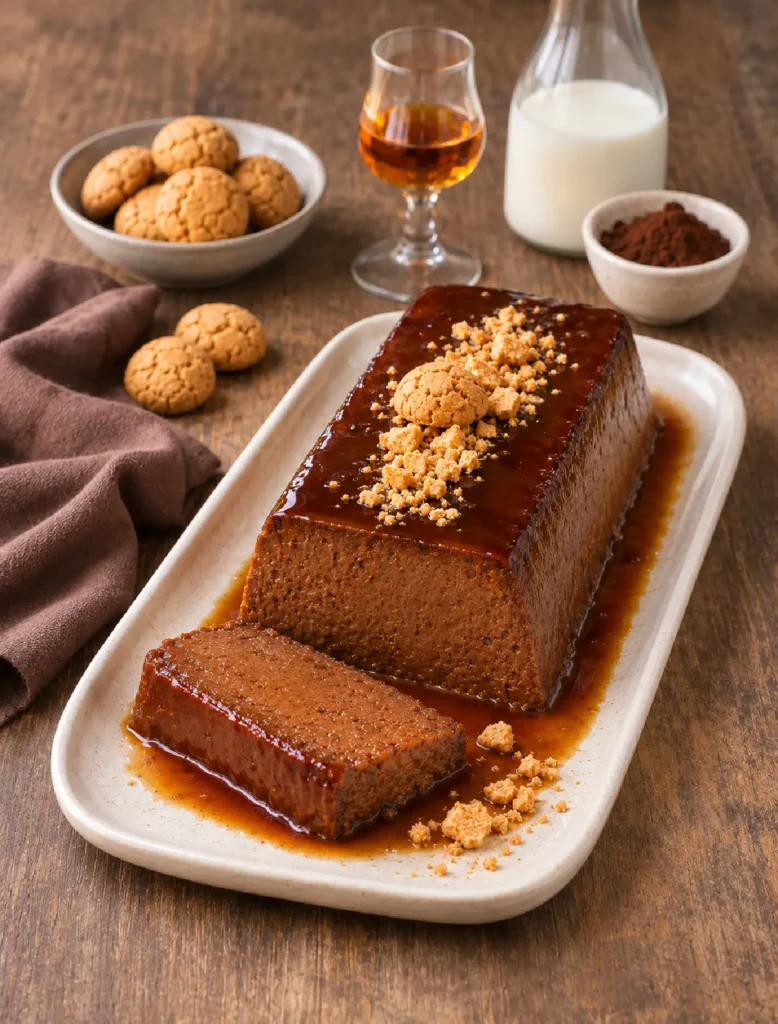
The trickiest moment comes when it’s time to remove the Bonèt from its mould. After a few hours in the refrigerator, we run a knife around the edges, place a plate over the mould and turn it upside down. If all has gone well, the custard slides out in one piece and the caramel collects around it. It’s tempting to cut a slice immediately, but it’s worth letting the dessert lose some of its refrigerator chill first.
Cocoa and amaretti both play an important part in this Piedmontese dessert. The cocoa gives it its dark colour and distinctive flavour, while the crushed amaretti add a slightly grainy texture, quite different from the smoothness of a crème caramel. Then there’s the rum, found in many traditional versions. In the Langhe and Monferrato areas of Piedmont, Bonèt has long been served at the end of a meal, often prepared several hours in advance.
For our version, we use milk, eggs, sugar, unsweetened cocoa powder, amaretti biscuits and rum, following the quantities of a documented traditional recipe. No thickening agents are needed: the eggs set the mixture as it cooks in a water bath. The main thing is to prevent it from cooking too quickly. The finished custard should remain soft but firm enough to slice without falling apart.
Bonèt Piedmontese Chocolate and Amaretti Custard
Description
We make Bonèt with milk, eggs, sugar, unsweetened cocoa powder, crisp amaretti biscuits and rum, using the quantities from a documented traditional recipe. After coating the mould with caramel, we combine the ingredients and gently bake the custard in a water bath. Once cooled and chilled, we turn it out and decorate it with amaretti.
Ingredients
For the Caramel
For the Bonèt
For Decoration
Instructions
How to Make Bonèt
-
Prepare the Caramel 🍯
Place 2 tablespoons of granulated sugar in a small, heavy-bottomed saucepan and add 1 teaspoon of water. Heat over medium-low heat without stirring with a spoon. As the sugar begins to melt, gently tilt the pan to distribute the heat. Once the caramel turns amber, remove it from the heat and immediately pour it into the bottom of a loaf pan. If you prefer individual portions, divide it among 6 small pudding moulds instead. Carefully tilt the pan or moulds to spread the caramel evenly, taking care not to burn yourself. Leave to cool.
-
Crush the Amaretti 🥣
Finely crush the 50 g of crisp amaretti biscuits using a food processor or by placing them in a food-safe bag and crushing them with a rolling pin. Set aside.
-
Mix the Eggs and Sugar 🥚
Crack the 4 eggs into a large bowl, add the 4 tablespoons of granulated sugar and mix with a hand whisk. Whisk only until the ingredients are combined, without beating the mixture until fluffy. Incorporating too much air can create bubbles during baking.
-
Add the Cocoa and Amaretti 🍫
Sift the 2 tablespoons of unsweetened cocoa powder directly into the bowl, stirring to remove any lumps. Add the crushed amaretti and 2 tablespoons of rum, then mix gently until combined.
-
Incorporate the Milk 🥛
Gradually pour in the 500 ml of whole milk, stirring gently until the mixture is fluid and fairly uniform. Don't worry if it looks very thin: the eggs will help it set during baking.
-
Pour the Mixture into the Mould 🍮
Give the mixture a brief stir, as the amaretti crumbs tend to settle at the bottom, then carefully pour it into the caramel-coated loaf pan using a ladle or a jug with a spout. If using individual pudding moulds, divide the mixture evenly among them, leaving a little space at the top.
-
Prepare the Water Bath 💧
Place the loaf pan, or the individual moulds, inside a larger, deep-sided baking dish. Carefully pour hot water into the outer dish until it reaches approximately halfway up the sides of the moulds, making sure no water gets into the custard mixture.
-
Bake the Bonèt Gently 🌡️
Carefully transfer the baking dish to a conventional oven preheated to 150°C (300°F). For a loaf pan, allow approximately 50–60 minutes. If making individual portions, begin checking after around 30 minutes, as smaller moulds generally require less time.
The water bath should remain hot without boiling vigorously. The Bonèt is ready when the edges are set and the centre has only a slight wobble when the mould is gently moved. If the centre is still very liquid, continue baking for a few more minutes and check again.
-
Cool and Chill ❄️
Carefully remove the mould or moulds from the water bath and allow them to cool completely at room temperature. Refrigerate for at least 3 hours, or preferably overnight, so the custard can firm up properly.
-
Unmould the Bonèt 🍽️
Carefully run a thin knife around the edges of the mould. If the caramel prevents the custard from releasing, briefly dip only the base of the mould into hot water for a few seconds. Place a serving plate with a slightly raised rim over the mould and turn it upside down in one confident movement. Slowly lift away the mould and allow the caramel to flow over the dessert. For individual portions, repeat with a small plate for each pudding.
-
Decorate and Serve 🍪
Finish the surface of the Bonèt with a few whole or lightly crushed amaretti biscuits, adding them just before serving. If you have prepared individual portions, you can place a small amaretto in the centre of each custard. Let the dessert stand outside the refrigerator for a few minutes before serving.
Nutrition Facts
Servings 6
- Amount Per Serving
- Calories 200kcal
- % Daily Value *
- Total Fat 7.5g12%
- Saturated Fat 3.5g18%
- Sodium 95mg4%
- Total Carbohydrate 25g9%
- Dietary Fiber 1g4%
- Sugars 22g
- Protein 7.5g15%
* Percent Daily Values are based on a 2,000 calorie diet. Your daily value may be higher or lower depending on your calorie needs.
Note
Storage
Bonèt can be stored in the refrigerator for 2–3 days, well covered with plastic wrap or in an airtight container. If possible, leave it in its mould until you are ready to serve, as this makes it easier to protect and helps it retain its shape.
Freezing is not recommended, as the custard may lose some of its texture and release liquid after thawing.
Choosing the Right Mould
For these quantities, we recommend a loaf pan approximately 20 × 10 cm (8 × 4 inches), deep enough to hold at least 1 litre (33.8 US fl oz). Alternatively, use 6 individual pudding moulds with a capacity of approximately 150–180 ml (5.1–6.1 US fl oz) each.
Metal moulds conduct heat more quickly than oven-safe ceramic or glass moulds. Baking times may therefore vary even when using the same quantity of custard.
How to Avoid Bubbles and Small Holes
If your Bonèt has many small holes when sliced, the baking temperature may have been too high or the mixture may have been whisked too vigorously. Mix the eggs without incorporating too much air and make sure the water bath does not boil vigorously.
A few small irregularities are normal, especially because of the crushed amaretti.
If the Bonèt Remains Too Liquid
A Bonèt that does not set may simply need a few more minutes in the oven. Before removing it, check that the edges are firm and the centre has only a slight wobble.
Remember that the custard will still be soft when it comes out of the oven. It will become firmer as it cools and rests in the refrigerator.
How to Avoid Lumps
Sift the cocoa powder before adding it to the eggs. If small lumps remain in the mixture, you can briefly use an immersion blender, taking care not to incorporate too much air.
Choose crisp, dry amaretti biscuits rather than soft amaretti for this recipe. They are easier to crush and distribute more evenly throughout the custard.
Avoiding Bitter Caramel
The caramel should turn amber, but not black. If the sugar burns, it develops a bitter flavour that will also affect the finished dessert. In that case, it is better to make a fresh batch rather than use the burnt caramel.
Alternatives to Rum
If you prefer not to use rum, you can replace it with 2 tablespoons of cooled espresso coffee for a more pronounced coffee flavour. Alternatively, you can omit the alcohol.
The traditional recipe used as our reference contains rum.