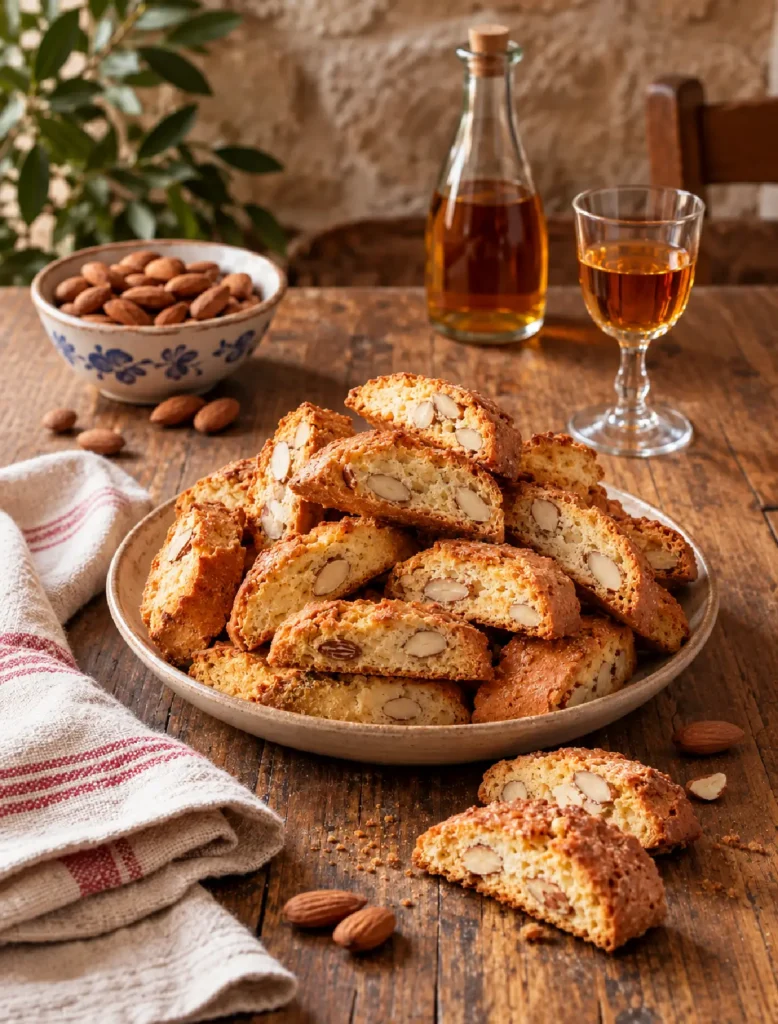
Cantucci Before Almonds
The history of cantucci begins long before the almond biscuits we know today. In a letter written before 1642, Galileo Galilei thanked someone for sending him four flasks of Greek wine and fifty cantucci. We do not know exactly what those cantucci looked or tasted like, but a few decades later we find an important clue.
In 1691, the third edition of the Vocabolario dell'Accademia della Crusca described a cantuccio as a sliced biscuit made with fine flour, sugar and egg white. Almonds were not mentioned. Francesco Redi also referred to cantucci in his seventeenth-century writings and letters: they were bought, given as gifts and sent from place to place at a time when the almond biscuit we recognize today had yet to take shape.
The name itself tells us something. Cantuccio is related to canto and can refer to the end piece of a loaf of bread, with plenty of crust and little crumb. The documentation associated with the IGP also mentions the Latin cantellus, meaning a piece or slice of bread. Either way, the name was not originally about almonds, but about something cut from a larger piece.
It is not until the nineteenth century that the story begins to resemble the cantucci we know today.
Prato, Antonio Mattei and Pellegrino Artusi
In 1858, Antonio Mattei opened his bakery in Via Ricasoli in Prato. He made bread, pasta and biscuits, and within a few years his specialities were appearing at some of the major exhibitions of the period. He received an award at the Italian Exhibition in Florence in 1861, followed by appearances in London, Paris and elsewhere, including an honourable mention in Paris in 1867.
It was in this setting that almond biscuits gained an important part of their reputation. Another familiar name in the history of Italian cooking also enters the story here: Pellegrino Artusi.
Mattei and Artusi knew each other. In Science in the Kitchen and the Art of Eating Well, Artusi remembers Mattei as a dear friend and recounts receiving recipes from him, including one for torta mantovana and another for a stiacciata. When Mattei died in 1885, Artusi left an affectionate portrait of a man he remembered for his skill, honesty and industrious character.
There is, however, a detail that makes the story less straightforward than it first appears. In nineteenth-century Prato, calling something a cantuccio did not automatically mean an almond biscuit. Mattei also produced anise-flavoured cantucci, while the almond biscuits that made his bakery famous were known as Biscotti di Prato.
That distinction helps explain a confusion that has survived to this day.
Are Cantucci Toscani and Biscotti di Prato the Same Thing?
Today, cantucci, cantuccini and Biscotti di Prato are often used almost interchangeably. Historically, however, the names followed different paths, and the codified recipes still preserve some differences.
The Tuscany Region lists Biscotti di Prato, also identified as Cantuccini di Prato, among its traditional food products. The documented formulation contains flour, sugar, eggs, whole almonds and a small quantity of pine nuts.
The specification for Cantuccini Toscani or Cantucci Toscani IGP, on the other hand, covers a tradition extending across the whole of Tuscany and sets out a different composition, which also includes butter, honey and a raising agent.
This does not mean that they belong to two completely separate traditions. Their histories have overlapped for so long that it is easy to understand why the names are now frequently treated as synonyms. Calling them exactly the same thing, however, would hide an interesting part of Prato's baking history.
Cantuccini Toscani / Cantucci Toscani was registered as an IGP in 2016, with a production area covering the entire region of Tuscany. This is the protected tradition we use as the reference for our recipe, while Biscotti di Prato retain an identity and history of their own.