Cantucci Toscani: Traditional Tuscan Almond Biscotti

Servings: 6 Total Time: 57 mins Difficulty: Beginner
Twice-baked Tuscan almond biscotti.

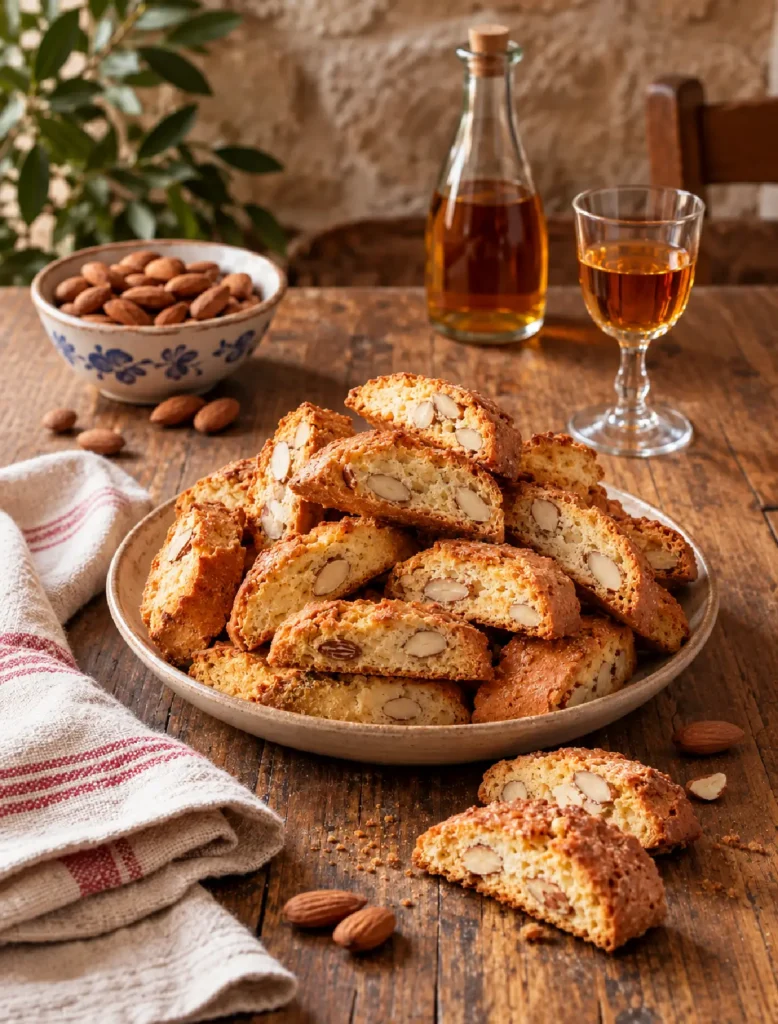
You can recognize Cantucci Toscani as soon as you cut into them: whole almonds, still in their skins, appear throughout the golden dough, while each slice takes on its characteristic elongated shape. Before becoming individual biscuits, however, cantucci go into the oven as long logs. They are sliced diagonally while still warm, then baked again until dry and crisp.

In Tuscany, they often arrive at the table with a glass of Vin Santo, especially at the end of a meal. Some people dip them into the wine, while others prefer them just as they are. Once cool, they keep well and stay crisp for a long time, so they are just as easy to enjoy away from the dinner table, perhaps with a coffee.

For this recipe, we take the Cantuccini Toscani IGP specification as our reference. The dough contains flour, sugar, eggs, unpeeled almonds, butter and honey. We shape it into logs, bake them, slice them and return the cantucci to the oven for their final bake. They should come out golden and crisp, with almonds running through every slice.
Traditional Cantucci Toscani Italian almond biscotti
0 Add to Favorites

Cantucci Toscani: Traditional Tuscan Almond Biscotti

Difficulty: Beginner Prep Time 20 mins Cook Time 32 mins Rest Time 5 mins Total Time 57 mins
Servings: 6 Calories: 103

Description

These Cantucci Toscani are traditional Tuscan almond biscotti made by baking the dough in logs, slicing it diagonally while still warm and baking the individual biscuits a second time until crisp. Our recipe is based on the composition specified for Cantuccini Toscani IGP.

Ingredients for about 30 Cantucci

Cooking Mode Disabled

Instructions

How to Make Cantucci Toscani

  1. Mix the eggs, sugar and honey 🍯

    Crack the two eggs into a bowl, add the sugar and wildflower honey, and mix with a spatula until evenly combined. There is no need to whip the eggs; simply mix the three ingredients together well.

  2. Add the flour, baking powder and butter 🥣

    Mix the flour and baking powder, then gradually add them to the egg, sugar and honey mixture. Add the softened butter and continue mixing until the dough comes together. When it becomes too firm for the spatula, finish working it briefly with your hands.

  3. Add the almonds 🌰

    Add the whole unpeeled almonds and work them into the dough until they are fairly evenly distributed. Transfer the dough to your work surface and divide it into two equal portions.

  4. Shape and bake the logs 🔥

    Shape each portion into a long, narrow log about 4 cm (1.6 in) wide and place them well apart on a baking tray lined with baking paper. Beat the egg yolk and brush it over the tops of the logs.

    Bake in a preheated conventional oven at 190°C (375°F) for about 20 minutes, until the logs are risen and golden. Remove them from the oven and leave them for about 5 minutes. They should cool slightly but remain soft enough to slice without breaking.

  5. Slice the cantucci diagonally 🔪

    Using a sharp knife, cut the logs slightly diagonally into cantucci about 1.5 cm (0.6 in) thick. Use firm movements without pressing down on the logs, particularly when the knife reaches an almond.

  6. Bake the cantucci a second time ♨️

    Arrange the cantucci on the baking tray with one cut side facing upwards. Reduce the conventional oven temperature to 160°C (320°F) and bake for another 10-12 minutes, until dry and lightly golden.

    Remove them from the oven and leave them to cool completely. They may still feel slightly soft when they first come out, but they will become crisper as they cool.

Nutrition Facts

Servings 6


Amount Per Serving
Calories 103kcal
% Daily Value *
Total Fat 3.9g6%
Saturated Fat 0.9g5%
Sodium 5mg1%
Total Carbohydrate 15g5%
Dietary Fiber 0.9g4%
Sugars 6.5g
Protein 2.6g6%

* Percent Daily Values are based on a 2,000 calorie diet. Your daily value may be higher or lower depending on your calorie needs.

Note

Slice the logs a few minutes after the first bake. If they are still very hot, they can lose their shape; if you allow them to cool completely, they become more difficult to slice without breaking.

Use whole unpeeled almonds and do not toast them beforehand. They will cook along with the dough during the two stages in the oven.

The second bake is mainly about drying the cantucci. If you prefer them crunchier, leave them in the oven for a few extra minutes, keeping an eye on them so they do not become too dark.

Allow the cantucci to cool completely before storing them. Once cold, keep them in a tightly closed container away from moisture to help them stay crisp.
Keywords: cantucci toscani, Tuscan cantucci, Italian almond biscotti, Tuscan almond biscotti, cantuccini toscani, biscuits
Rate this recipe

Cantucci Before Almonds

The history of cantucci begins long before the almond biscuits we know today. In a letter written before 1642, Galileo Galilei thanked someone for sending him four flasks of Greek wine and fifty cantucci. We do not know exactly what those cantucci looked or tasted like, but a few decades later we find an important clue.

In 1691, the third edition of the Vocabolario dell'Accademia della Crusca described a cantuccio as a sliced biscuit made with fine flour, sugar and egg white. Almonds were not mentioned. Francesco Redi also referred to cantucci in his seventeenth-century writings and letters: they were bought, given as gifts and sent from place to place at a time when the almond biscuit we recognize today had yet to take shape.

The name itself tells us something. Cantuccio is related to canto and can refer to the end piece of a loaf of bread, with plenty of crust and little crumb. The documentation associated with the IGP also mentions the Latin cantellus, meaning a piece or slice of bread. Either way, the name was not originally about almonds, but about something cut from a larger piece.

It is not until the nineteenth century that the story begins to resemble the cantucci we know today.

Prato, Antonio Mattei and Pellegrino Artusi

In 1858, Antonio Mattei opened his bakery in Via Ricasoli in Prato. He made bread, pasta and biscuits, and within a few years his specialities were appearing at some of the major exhibitions of the period. He received an award at the Italian Exhibition in Florence in 1861, followed by appearances in London, Paris and elsewhere, including an honourable mention in Paris in 1867.

It was in this setting that almond biscuits gained an important part of their reputation. Another familiar name in the history of Italian cooking also enters the story here: Pellegrino Artusi.

Mattei and Artusi knew each other. In Science in the Kitchen and the Art of Eating Well, Artusi remembers Mattei as a dear friend and recounts receiving recipes from him, including one for torta mantovana and another for a stiacciata. When Mattei died in 1885, Artusi left an affectionate portrait of a man he remembered for his skill, honesty and industrious character.

There is, however, a detail that makes the story less straightforward than it first appears. In nineteenth-century Prato, calling something a cantuccio did not automatically mean an almond biscuit. Mattei also produced anise-flavoured cantucci, while the almond biscuits that made his bakery famous were known as Biscotti di Prato.

That distinction helps explain a confusion that has survived to this day.

Are Cantucci Toscani and Biscotti di Prato the Same Thing?

Today, cantucci, cantuccini and Biscotti di Prato are often used almost interchangeably. Historically, however, the names followed different paths, and the codified recipes still preserve some differences.

The Tuscany Region lists Biscotti di Prato, also identified as Cantuccini di Prato, among its traditional food products. The documented formulation contains flour, sugar, eggs, whole almonds and a small quantity of pine nuts.

The specification for Cantuccini Toscani or Cantucci Toscani IGP, on the other hand, covers a tradition extending across the whole of Tuscany and sets out a different composition, which also includes butter, honey and a raising agent.

This does not mean that they belong to two completely separate traditions. Their histories have overlapped for so long that it is easy to understand why the names are now frequently treated as synonyms. Calling them exactly the same thing, however, would hide an interesting part of Prato's baking history.

Cantuccini Toscani / Cantucci Toscani was registered as an IGP in 2016, with a production area covering the entire region of Tuscany. This is the protected tradition we use as the reference for our recipe, while Biscotti di Prato retain an identity and history of their own.

Filed under
Rate this recipe
Add a question