Servings 4
- Amount Per Serving
- % Daily Value *
- Total Fat 10.2g16%
- Saturated Fat 1.5g8%
- Sodium 28mg2%
- Total Carbohydrate 25.6g9%
- Dietary Fiber 1.2g5%
- Sugars 0.5g
- Protein 3.2g7%
* Percent Daily Values are based on a 2,000 calorie diet. Your daily value may be higher or lower depending on your calorie needs.
Note
Choosing the Right Bread
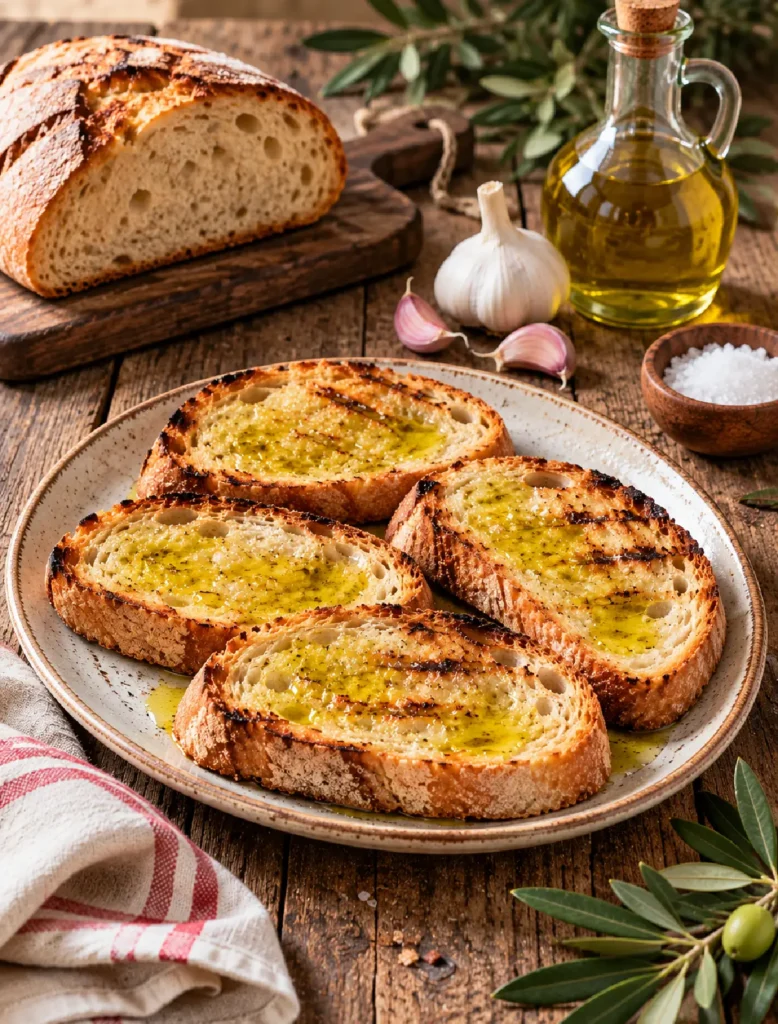
Traditional fettunta is made with unsalted Tuscan bread. If it's unavailable, use a rustic sourdough loaf with a substantial crust and a fairly firm crumb. Day-old bread also works well, provided it hasn't dried out completely.
If your bread already contains salt, reduce or omit the extra salt.
Toasting Without a Grill
You can toast the slices under the oven broiler or grill setting, watching closely and turning them as needed. The aim is a crisp surface without drying out the center.
How Much Garlic Should You Use?
The 2 garlic cloves are used to rub the four slices, not chopped or spread over the bread. The amount of garlic transferred depends on how firmly you rub.
Choosing the Olive Oil
Freshly pressed olive oil is especially good for fettunta, but it isn't essential. A good-quality extra virgin olive oil will work at any time of year.
Can Fettunta Be Made Ahead?
Fettunta is best prepared just before serving. Once dressed, the bread gradually absorbs the oil and loses some of its crispness.
Keywords:
fettunta toscana, fettunta recipe, Tuscan garlic bread, Tuscan bruschetta, Italian garlic toast, olive oil toast, Tuscan bread
A Slice of Bread with a Very Literal Name
Tuscans didn't make the name complicated: fettunta simply means "oiled slice." You may also see it written as fett'unta, while similar preparations elsewhere in Italy are often called bruschetta. That word comes from bruscare, a verb associated with toasting bread over heat.
Fettunta belongs to the cooking traditions of the Tuscan countryside, where farming families baked their own bread and kept it for several days. Stale bread was never much of a problem. It went into ribollita, pappa al pomodoro, and acquacotta, or was simply toasted over the fire.
Bread has a particularly important place in Tuscan cooking. Think of panzanella, where soaked bread becomes the main ingredient of a summer salad, or ribollita, whose hearty texture depends in part on the bread added to the soup.
The Olive Mills and the Harvest Season
To understand fettunta's place in Tuscan food culture, it helps to imagine a time when olive oil wasn't something you chose from dozens of bottles on a supermarket shelf. In olive-growing areas, the harvest marked a particular period of the year. Olives were taken to the mill, and families waited to see how much oil their crop would produce.
Tasting the newly pressed oil was a special occasion. It was a chance to see the results of the work in the fields, but also an opportunity to gather together. A slice of bread was enough to let everyone taste the oil without preparing anything elaborate.
That custom is still alive today. At festivals celebrating the new olive oil and events organized by Tuscan olive mills, fettunta often appears among the foods offered to visitors. Perhaps that's part of its appeal: it has made its way from farmhouse tables to modern tastings without becoming a complicated dish.
👉 Discover our recipe for Tuscan Ribollita, another dish in which bread plays an essential role.