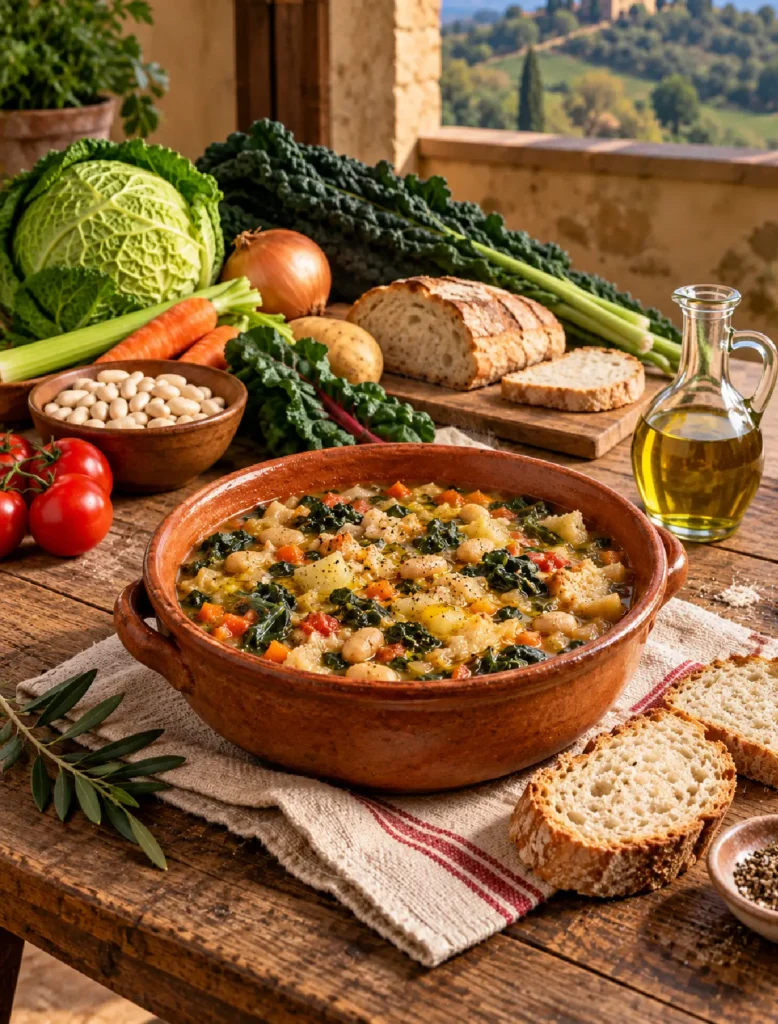
For our Tuscan Ribollita, we use the recipe registered in 2001 by the Florence Delegation of the Italian Academy of Cuisine as our reference. It starts with cannellini beans and a generous pot of vegetables: Tuscan kale, Savoy cabbage, Swiss chard, potatoes, tomatoes, onion, carrot and celery. We purée some of the beans with their cooking water and leave the rest whole.
Once the vegetables are ready, we alternate the soup with layers of stale Tuscan bread. The bread slowly absorbs the liquid, then we leave everything to rest until the following day. This is where the bread soup takes a different turn.
The next day, we put it back on the heat and let it boil again for about ten minutes. By then, the bread has broken down, the beans have thickened the soup and the vegetables have blended into the rest. That second boil is where Ribollita gets its name.
We serve it hot, finished with extra virgin olive oil and freshly ground black pepper.
Tuscan Ribollita: Traditional Bread, Bean and Kale Soup
Description
Tuscan Ribollita is made with stale Tuscan bread, cannellini beans, Tuscan kale, Savoy cabbage, Swiss chard and other vegetables. After resting overnight, it returns to the heat for the second cooking that gives the dish its name.
Ingredients
Instructions
How to Make Tuscan Ribollita
-
Soak the cannellini beans 🫘
The night before, place the cannellini beans in a large bowl and cover generously with cold water. Leave them to soak for 12 hours.
-
Cook the beans and save their cooking water 🥣
Drain and rinse the cannellini beans, transfer them to a pot and cover generously with cold water. Slowly bring to a boil, then cook gently for about 1 hour, or until tender.
Do not discard the cooking water: we will use it to make the Ribollita.
-
Prepare the vegetables 🔪
Peel the potatoes and cut them into pieces about 2 cm across. Prepare the Tuscan kale by removing the toughest parts of the central stems, then cut the leaves into strips.
Remove the tough core from the Savoy cabbage and cut the leaves into strips. Wash the Swiss chard, trim only the toughest ends of the stalks, then cut both the leaves and tender stalks into strips. Finally, slice the onions, carrots and celery.
-
Soften the vegetables for the base 🥕
Pour a little extra virgin olive oil into a large casserole. Add the onions, carrots and celery and cook gently until softened, without letting them brown.
Add the peeled tomatoes, breaking them up as needed, and stir.
-
Add the remaining vegetables 🥬
Add the Tuscan kale, Savoy cabbage, Swiss chard and potatoes. Stir well and let the vegetables begin to soften and reduce in volume.
-
Purée some of the cannellini beans 🫘
Take a little more than half of the beans and pass them through a food mill or sieve with some of their cooking water. Alternatively, use an immersion blender, adding a little cooking water to obtain a pourable purée.
Add the bean purée to the casserole and stir. Pour in enough additional bean cooking water to allow the vegetables to cook without drying out.
-
Slowly cook the soup 🍲
Cook over low heat for about 1 hour, stirring occasionally. If the soup becomes too dry during cooking, add a little of the reserved bean cooking water at a time.
Towards the end of cooking, add the remaining whole cannellini beans and season with salt and black pepper.
-
Layer the bread and soup 🍞
Arrange a layer of stale Tuscan bread in the bottom of a large serving bowl. Pour over half of the soup, add another layer of bread and finish with the remaining soup.
Leave it to cool slightly, then cover and refrigerate until the following day. As it rests, the bread will absorb the soup and become completely soft.
-
Boil it again the next day 🔥
The following day, transfer everything to a large casserole. Add a drizzle of extra virgin olive oil and heat slowly, stirring from the bottom to combine the softened bread with the vegetables and beans.
Once the Ribollita returns to a boil, cook for about 10 minutes, stirring occasionally to prevent it from sticking.
-
Serve the Ribollita 🫒
Spoon the Ribollita into bowls while still piping hot. Finish with a drizzle of extra virgin olive oil and freshly ground black pepper.
Nutrition Facts
Servings 6
- Amount Per Serving
- Calories 700kcal
- % Daily Value *
- Total Fat 15g24%
- Saturated Fat 2g10%
- Sodium 650mg28%
- Total Carbohydrate 115g39%
- Dietary Fiber 24g96%
- Sugars 16g
- Protein 29g58%
* Percent Daily Values are based on a 2,000 calorie diet. Your daily value may be higher or lower depending on your calorie needs.
Note
Ribollita takes time mainly because the cannellini beans need to soak and the soup needs to rest with the bread. Plan to start at least a day ahead. After soaking, cook the beans until tender but not falling apart and keep their cooking water: you will need it both to purée some of the beans and to adjust the consistency of the soup.
Stale, unsalted Tuscan bread is the traditional choice. If you cannot find it, use a rustic bread with a firm crumb, preferably low in salt and at least a couple of days old. Avoid sandwich bread, very soft rolls and enriched breads: once soaked, they will not give the Ribollita the same texture.
During the long cooking of the vegetables, add the bean cooking water gradually. Before the resting stage, the soup needs enough liquid for the bread to absorb, but it should not become brothy.
The following day, the Ribollita will be considerably thicker. Reheat it gently and stir frequently from the bottom. If it has become too dry, add a very small amount of hot water at a time. The finished Ribollita should remain thick, with the bread completely incorporated into the soup.
The registered recipe calls for a little more than half of the cannellini beans to be passed through a sieve. A food mill is a practical alternative; if you do not have one, an immersion blender also works. Add only enough cooking water to produce a pourable purée.