Servings 8
- Amount Per Serving
- % Daily Value *
- Total Fat 17.5g27%
- Saturated Fat 2.6g13%
- Sodium 600mg25%
- Total Carbohydrate 49g17%
- Dietary Fiber 3.5g15%
- Sugars 2.5g
- Protein 8g16%
* Percent Daily Values are based on a 2,000 calorie diet. Your daily value may be higher or lower depending on your calorie needs.
Note
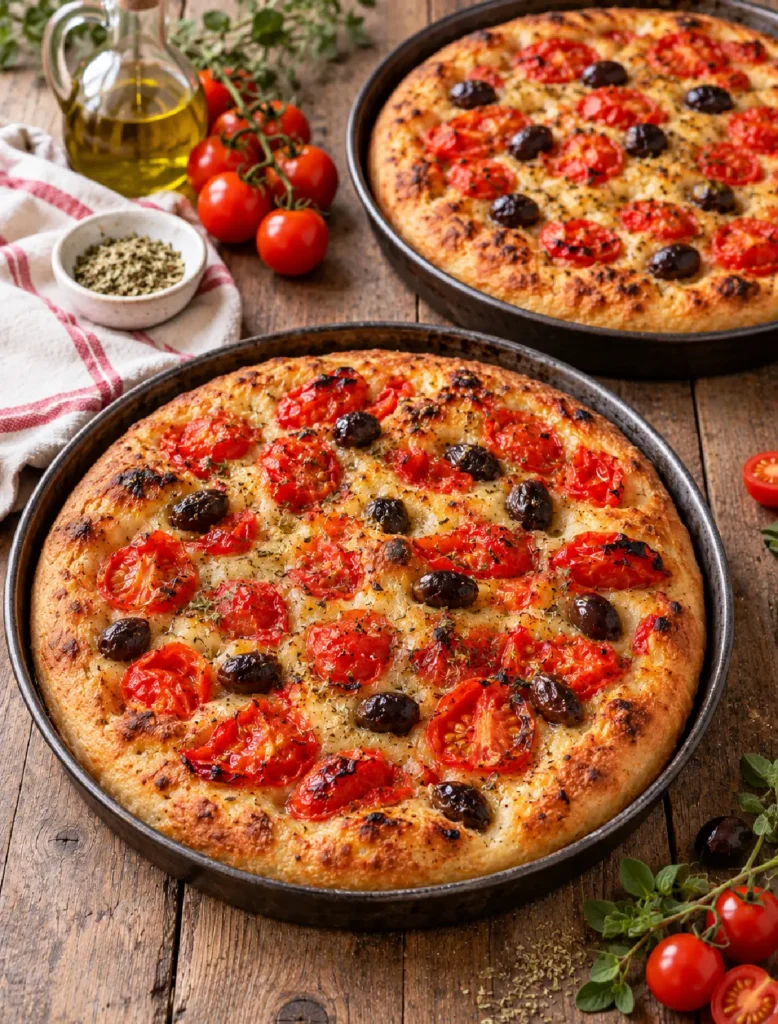
Choosing the pans: this recipe uses two 30 cm (12-inch) round baking pans, preferably made from steel or aluminium, with solid bases and raised sides. Avoid perforated pizza pans, as the olive oil needs to remain in contact with the dough during baking.
Dough consistency: the amount of water absorbed may vary depending on the flour and the moisture content of the potatoes. The dough should be soft but not completely liquid. If necessary, hold back a little of the water at first and add it gradually.
Rising times: the times given are based on a room temperature of approximately 24–26°C (75–79°F). At lower temperatures, the dough may need longer to rise. Always check how much it has increased in volume rather than relying solely on the clock.
Baresane olives: these are particularly suitable for Focaccia Barese. If they are unavailable, you can use other good-quality table olives, preferably whole and with their stones still inside. Make sure anyone eating the focaccia knows that the olives contain stones.
Baking: every oven behaves differently. If yours cannot reach 250°C (480°F), use the highest available conventional oven temperature and monitor the focaccia, as it may need a few extra minutes.
Storage: keep the focaccia in a sealed container once completely cool, for 1–2 days. To restore its crispness, warm it in the oven at 180°C (350°F) for a few minutes. You can also freeze it in individual portions.
Keywords:
focaccia barese, Italian focaccia, tomato focaccia, olive focaccia, potato focaccia, Bari focaccia, Italian bread recipe
In Bari, some bakeries have been making focaccia for generations. One of the best-known is Panificio Fiore, in Bari Vecchia, the city's historic old town. Its bakery has become a popular stop for visitors looking to try one of Bari's best-known specialities. But focaccia doesn't belong only to the famous bakeries. Every neighbourhood has its own places, and many locals have a favourite bakery they've been returning to for years.
Its connection with bread goes back a long way. According to a widely told account, focaccia was also made to check the temperature of wood-fired ovens before the loaves went in. Because it baked more quickly, it helped bakers judge whether the oven was hot enough.
One particular feature of Bari's bakeries is that focaccia is often sold by weight. You don't have to buy a whole one. You can simply ask for a piece and choose how much you'd like. It's a small detail that says a lot about the place focaccia holds in everyday life in the city, far removed from the idea of something reserved for special occasions.
And although you can now find it well beyond Puglia, in Bari focaccia is still, above all, something you buy from a bakery. The kind of thing everyone has their own favourite place for.