In Bari, focaccia is something you can pick up from a bakery and eat while walking through the streets, still warm and wrapped in paper. There’s no need to wait until lunch or dinner. You don’t even need cutlery. Just tear off a piece with your hands, trying not to lose the tomatoes that have softened into the dough during baking.
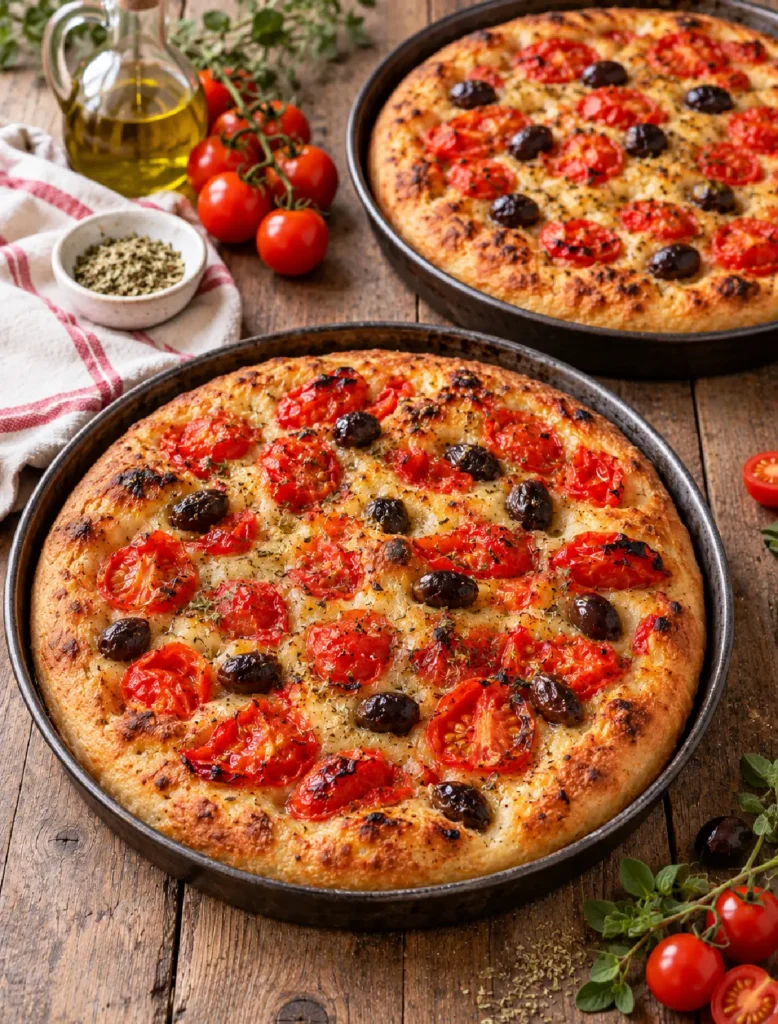
Focaccia Barese has a texture of its own. Beneath the surface, dotted with tomatoes, olives and oregano, the soft crumb contrasts with a crisp base, almost fried in the olive oil coating the pan. Boiled potato in the dough makes a difference too. It’s a characteristic ingredient in many versions from Bari and helps give the focaccia its particularly soft interior.
We make ours with wheat flour, finely milled durum wheat semolina and fresh yeast. The dough needs time to rise before being spread into the pans and topped with plenty of tomatoes. We break them open by hand directly over the dough, letting their juices fall onto the surface. Then come the olives, oregano and extra virgin olive oil.
The best moment to eat it? When it has cooled just enough for the base to retain its crunch. But in Bari, focaccia is eaten cold too, and quite often it doesn’t even make it to lunchtime.
Focaccia Barese with Tomatoes and Olives
Description
Focaccia Barese is made with type 0 wheat flour, finely milled durum wheat semolina, boiled potatoes and fresh yeast. Topped with cherry tomatoes, olives and oregano, it is baked in round pans until the base is crisp and the inside remains soft.
Ingredients for 2 round focaccias, each 30 cm (12 inches) in diameter
For the Dough
For the Pans
For the Topping
Instructions
How to Make Focaccia Barese
-
Boil the Potatoes 🥔
Wash the potatoes and boil them with their skins on until tender, usually 25–35 minutes, depending on their size. Drain, peel and mash them using a potato ricer. Weigh out 100 g (3.5 oz) of potato and leave it to cool before using.
-
Dissolve the Yeast 💧
Take 100 g of the 320 g of water and dissolve the 10 g of fresh yeast in it. Set aside the remaining 220 g of water.
-
Prepare the Dough 🥣
By hand: place the 300 g of type 0 wheat flour and 200 g of finely milled durum wheat semolina in a large bowl. Add the mashed potato and the water containing the dissolved yeast. Mix with a sturdy spoon, gradually incorporating the remaining 220 g of water.
Once the flours have absorbed the liquid, add the 10 g of salt and begin working the dough with one hand. Gradually add the 50 g of extra virgin olive oil, continuing to knead for about 8–10 minutes, repeatedly lifting and folding the dough over itself.
Using a stand mixer: place both flours, the mashed potato and the water containing the dissolved yeast in the mixer bowl. Fit the dough hook and start mixing on low speed, gradually adding the remaining 220 g of water.
Once the ingredients are combined, add the 10 g of salt, followed by the 50 g of extra virgin olive oil, a little at a time. Continue mixing on medium-low speed for about 6–8 minutes, until the dough becomes smooth and elastic.
With either method, the dough should remain soft and slightly sticky. Do not add extra flour to make it firmer. It will develop more structure during the following folds.
-
Fold the Dough 🙌
Transfer the dough to a work surface lightly moistened with water. With damp hands, gently stretch it out and fold all four edges towards the centre.
Cover and leave to rest for 15 minutes, then repeat the folds. Avoid adding flour, as the dough needs to remain soft.
-
Leave the Dough to Rise ⏳
Shape the dough into a ball, place it in a large bowl and cover. Leave to rise in a sheltered place, ideally at around 24–26°C (75–79°F), for approximately 2 hours, or until it has almost doubled in volume.
-
Stretch the Dough into the Pans 🫒
Divide the 40 g of extra virgin olive oil between two 30 cm (12-inch) round baking pans, using 20 g per pan.
Divide the risen dough into two equal portions and transfer one to each pan. Gently stretch the dough from the centre towards the edges using your fingertips, without pressing too firmly. If it springs back, leave it to rest for 5–10 minutes before continuing.
-
Add the Cherry Tomatoes 🍅
Wash the 400 g of cherry tomatoes and divide them between the two focaccias. Break them open by hand directly over the dough, allowing their juices to fall onto the surface. Gently press them into the dough with the cut sides facing down.
-
Finish the Topping 🫒
Distribute the 20 Baresane olives between the two focaccias, using 10 for each, and press them gently into the dough. Sprinkle with dried oregano and a little salt, then drizzle the 30 g of extra virgin olive oil over the surface, using 15 g per pan.
-
Leave to Rise in the Pans ⏳
Cover the focaccias without touching the toppings and leave them to rise for another 30–45 minutes, until the dough looks noticeably puffier and more relaxed.
-
Preheat the Oven 🔥
Preheat a conventional oven to 250°C (480°F) for at least 20–30 minutes, allowing it to reach the correct temperature before baking.
-
Bake the Focaccia 🍞
Place one pan at a time on a low oven shelf. Bake for approximately 15–20 minutes, checking the colour towards the end.
The focaccia is ready when the surface is golden brown, the tomatoes are roasted and the underside has developed a well-coloured crust. If necessary, move the pan to the middle shelf for the final few minutes to finish browning the top.
Repeat with the second focaccia.
-
Remove from the Oven and Serve 🍽️
eave the focaccia in the pan for a few minutes, then transfer it to a wire rack to prevent moisture from softening the base. Allow it to cool slightly before slicing and serving.
Nutrition Facts
Servings 8
- Amount Per Serving
- Calories 390kcal
- % Daily Value *
- Total Fat 17.5g27%
- Saturated Fat 2.6g13%
- Sodium 600mg25%
- Total Carbohydrate 49g17%
- Dietary Fiber 3.5g15%
- Sugars 2.5g
- Protein 8g16%
* Percent Daily Values are based on a 2,000 calorie diet. Your daily value may be higher or lower depending on your calorie needs.
Note
Choosing the pans: this recipe uses two 30 cm (12-inch) round baking pans, preferably made from steel or aluminium, with solid bases and raised sides. Avoid perforated pizza pans, as the olive oil needs to remain in contact with the dough during baking.
Dough consistency: the amount of water absorbed may vary depending on the flour and the moisture content of the potatoes. The dough should be soft but not completely liquid. If necessary, hold back a little of the water at first and add it gradually.
Rising times: the times given are based on a room temperature of approximately 24–26°C (75–79°F). At lower temperatures, the dough may need longer to rise. Always check how much it has increased in volume rather than relying solely on the clock.
Baresane olives: these are particularly suitable for Focaccia Barese. If they are unavailable, you can use other good-quality table olives, preferably whole and with their stones still inside. Make sure anyone eating the focaccia knows that the olives contain stones.
Baking: every oven behaves differently. If yours cannot reach 250°C (480°F), use the highest available conventional oven temperature and monitor the focaccia, as it may need a few extra minutes.
Storage: keep the focaccia in a sealed container once completely cool, for 1–2 days. To restore its crispness, warm it in the oven at 180°C (350°F) for a few minutes. You can also freeze it in individual portions.