Note
Storage
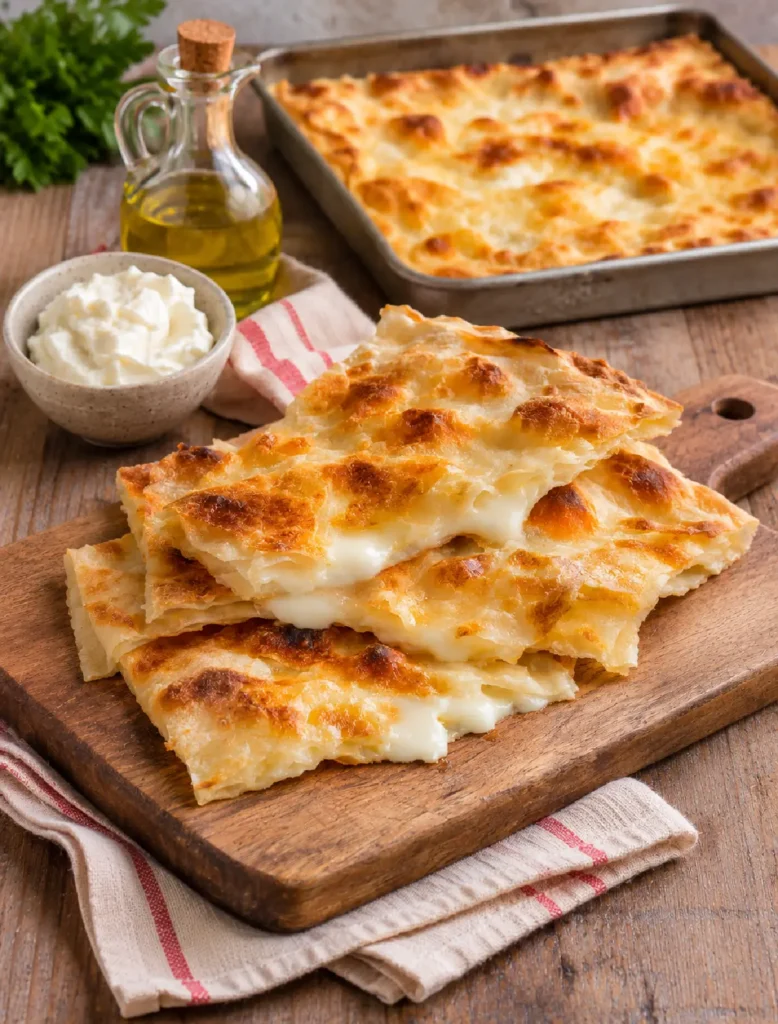
Focaccia di Recco is best enjoyed straight from the oven, while the pastry is still crisp. If there are leftovers, allow them to cool slightly and refrigerate in an airtight container for 1–2 days. Do not leave the focaccia at room temperature for more than 2 hours.
To reheat, place it in an oven preheated to 180–200°C (350–390°F) for a few minutes, until the cheese becomes creamy again and the pastry regains some of its crispness. Avoid the microwave, which tends to soften the pastry.
Freezing the baked focaccia is not recommended, as the cheese may release moisture when thawed and the pastry can lose its delicate texture.
Choosing the right cheese
Crescenza is the preferred cheese for this recipe. Fresh Italian stracchino is also suitable, provided it has a creamy consistency and is not excessively watery.
Avoid mozzarella and other stretched-curd cheeses. They behave differently when heated and do not produce the characteristic creamy filling of Focaccia di Recco.
If the crescenza has released a lot of whey in its packaging, leave it to drain in a sieve for a few minutes without pressing it. Excess moisture can make the bottom pastry soggy.
If the dough shrinks or tears
If the dough keeps shrinking as you stretch it, do not pull harder. Cover it and let it rest for another 10–15 minutes before continuing. This usually means the gluten has not relaxed sufficiently or the dough is still too resistant.
If the pastry tears easily, check that the dough has been kneaded thoroughly and that the flour is strong enough. Manitoba flour works particularly well because it produces an elastic dough that can be stretched very thinly.
Use only a little flour on the work surface. Too much flour can make the pastry drier and less delicate.
Getting the baking right
Make sure the oven has fully reached the required temperature before baking.
If the top browns too quickly while the bottom remains pale, try placing the tray on a lower rack next time.
Keep a close eye on the final minutes. The bottom should also be golden, while the upper pastry should not become excessively dry.
Keywords:
focaccia di Recco, Italian cheese focaccia, Ligurian cheese focaccia, cheese filled flatbread, Italian cheese flatbread, yeast free focaccia
From All Souls' Day Fritters to Focaccia di Recco
Some stories about the origins of Focaccia di Recco go all the way back to the Middle Ages. One of the best known links it to raids by Saracen pirates, when people living along the Ligurian coast supposedly fled inland, taking flour, olive oil and cheese with them. Another tradition claims that cheese-filled focaccia was served to crusaders departing for the Holy Land in 1189, near the Abbey of San Fruttuoso.
They are intriguing stories, but there is no documentary evidence strong enough to establish them as historical fact.
A different picture emerges from older customs associated with All Souls' Day. In research published by the Italian Academy of Cuisine, food historian Paolo Lingua traces the presence of small focaccias filled with fresh cheese in the Recco area to at least the mid-eighteenth century. They were fried and eaten with chickpea and vegetable soups.
These were not yet the oven-baked focaccia we know today. The tradition of making small fried cheese pastries, however, offers a more tangible historical connection than the medieval legends.
The Carriages Arriving from Genoa at Midnight
In the early twentieth century, some people travelled from Genoa specifically to eat cheese focaccia in Recco's taverns. And they did not always arrive at a reasonable hour.
Paolo Lingua describes groups of men and women who, after attending a theatre performance, would climb into carriages and make their way to Recco. By the time they reached the taverns, it could already be midnight.
The custom came to an end during the First World War. After the Second World War, as social life and transport along the Riviera recovered, visitors from Genoa began returning.
Manuelina and the Early Cheese Focaccia Taverns
In 1885, Emanuela Capurro, better known as Manuelina, opened a tavern in Recco. Cheese focaccia was already being prepared in local homes, but it was not until the early twentieth century that Manuelina began serving it to her customers. The speciality helped establish the tavern's reputation, attracting visitors from outside the town.
Another historic establishment is Da O Vittorio, whose origins date back to 1861. The building originally served as a coaching inn, where travellers could stop for a meal and some rest while their horses were looked after.
According to the Bisso family's recollections, Gio Buono Bisso purchased the business in the very year of Italian unification. Part of the payment was reportedly made in old gold coins and the remainder in the newly introduced Italian lira.
Aldo Fabrizi and His Escapes from a Diet
Aldo Fabrizi loved good food and made no secret of it. During one of his stays at the Colonia Arnaldi health retreat in Uscio, where he was following a weight-loss diet, he found ways to make the occasional exception.
Federico Bisso, whose family runs Da O Vittorio, told Identità Golose that the actor would sometimes travel down to Recco for cheese focaccia, escaping the retreat's dietary restrictions for an evening.
On one such occasion, according to the family's account, Fabrizi left a few humorous verses written on a napkin. The message was dedicated to the restaurant and the pleasure of being able to eat freely again.
The episode has not been independently verified, but the story has been preserved in the Bisso family's recollections.
A Festival That Began in 1955
The first Festa della Focaccia, or Focaccia Festival, was held in Recco in 1955. Since then, the event has grown to involve local bakers, restaurateurs and businesses throughout the town centre.
The day is traditionally divided between different specialities. Plain focaccia and onion focaccia are distributed in the morning, while the afternoon is dedicated to the famous cheese-filled version.
Tastings take place in the streets and squares of Recco, where local producers prepare and serve focaccia to visitors. Since 2007, the event has been coordinated by the Focaccia di Recco Consortium.
When Focaccia Reached the American Newspapers
In 1967, Focaccia di Recco appeared in the Daily American, an English-language newspaper published in Italy and aimed primarily at the American community.
The newspaper introduced the speciality to its readers with a particularly enthusiastic description: quite divine.
The quotation also appears in the official Protected Geographical Indication (PGI) specification for Focaccia di Recco col formaggio, alongside references to Italian restaurant guides that began featuring the speciality in subsequent years.
For a dish rooted in the kitchens and taverns of a small Ligurian town, finding itself described in English in an American newspaper was certainly something new. And judging by those two words, the journalist must have enjoyed it quite a bit.