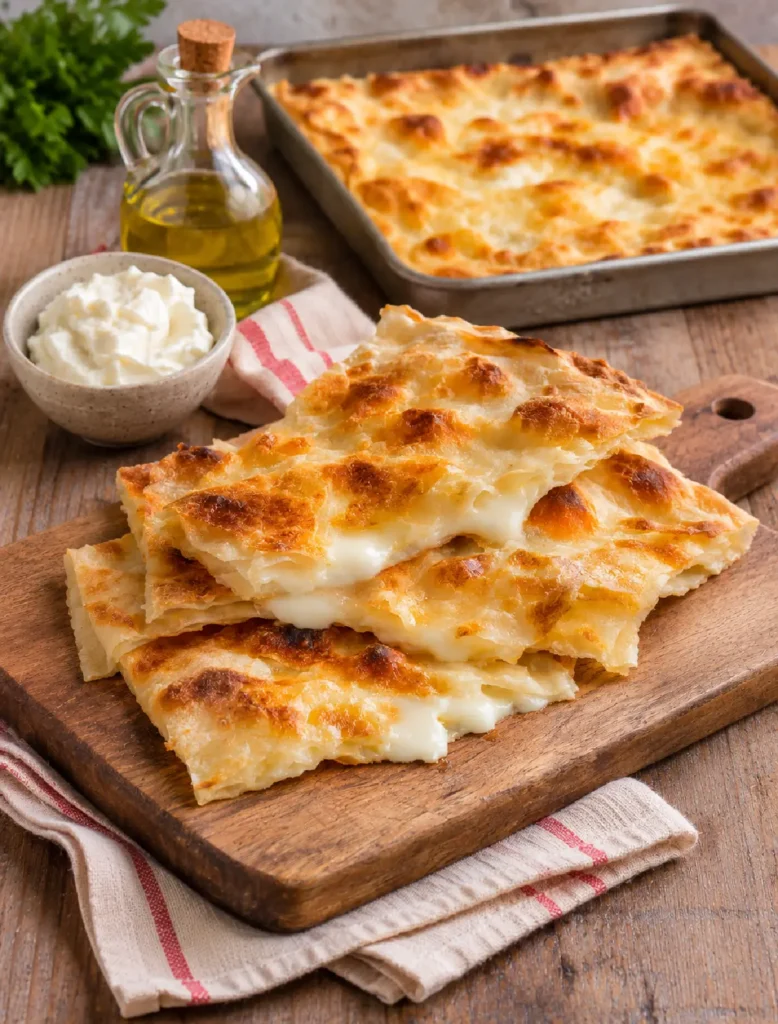
Focaccia di Recco is quite different from the thick, fluffy focaccia most people know. Its pastry is so thin that you can almost see the cheese beneath it, while the surface develops golden blisters and a few darker spots in the oven. In Recco, on the Ligurian coast, it is often served in rectangular slices, straight from the oven, with creamy cheese tucked between two delicate sheets of pastry.
The traditional speciality is protected by the European Protected Geographical Indication (PGI) designation, but we can recreate its defining characteristics in a home kitchen. We start with Manitoba flour, water, extra virgin olive oil and salt, without any yeast. After resting, the dough becomes elastic enough to stretch into an almost transparent sheet. We spread pieces of crescenza cheese over the base, cover them with another thin sheet and make small openings to allow steam to escape.
The main challenge at home is the baking. Professional ovens reach much higher temperatures and cook Focaccia di Recco in just a few minutes. We use a conventional oven heated to around 250°C (480°F), watching carefully as the pastry turns golden without becoming too dry and the cheese melts into a creamy filling.
Focaccia di Recco Italian Cheese Flatbread
Description
Two exceptionally thin sheets of yeast-free pastry enclose a generous filling of crescenza cheese. This homemade version of Focaccia di Recco is baked in a rectangular tray at a high temperature until golden and crisp.
Ingredients for one Focaccia di Recco, using a 30 × 40 cm (12 × 16 inch) baking tray.
For the dough
For the filling
For the baking tray
For the baking tray
Instructions
How to Make Focaccia di Recco
-
Prepare the dough 🥣
Place the Manitoba flour in a large bowl, add the water and begin mixing. Add the salt and 40 g of extra virgin olive oil, then knead for approximately 8–10 minutes, either by hand or using a stand mixer fitted with a dough hook, until the dough is smooth, soft and elastic.
-
Let the dough rest ⏳
Shape the dough into a ball, place it in a bowl and cover with a clean kitchen towel or plastic wrap. Leave it to rest at room temperature for 1 hour, away from draughts.
Knead it briefly again, then divide it into two portions, making one slightly larger for the base and the other smaller for the top. Shape both into balls, cover and leave to rest for another 5 minutes.
-
Stretch the first sheet 🙌
Lightly flour the work surface and roll out the larger piece of dough into a rectangle slightly bigger than the 30 × 40 cm baking tray.
Carefully lift the dough over the backs of your hands and gently stretch it, allowing its own weight to help thin it out. Aim for an even sheet less than 1 mm thick, taking care not to tear it.
-
Line the baking tray 🫒
Lightly grease a 30 × 40 cm rectangular baking tray with extra virgin olive oil. Carefully lay the first sheet of dough inside, making sure it covers the bottom completely and extends slightly beyond the edges.
-
Add the crescenza cheese 🧀
Break the 600 g of crescenza into walnut-sized pieces using your hands. Arrange them evenly across the pastry, leaving small gaps between the pieces and a narrow border around the edges.
-
Cover with the second sheet 🤲
Roll out the remaining dough, first with a rolling pin and then over the backs of your hands, until it is even thinner than the base and almost transparent.
Carefully drape it over the cheese, allowing the excess pastry to hang over the sides of the tray.
-
Seal the edges and make steam vents ✂️
Press around the edges to seal the two sheets together. Trim away the excess dough with a knife or by running a rolling pin along the rim of the tray.
Using your fingertips, gently pinch and open several small holes in the upper sheet, including over some of the cheese. These openings allow steam to escape during baking.
-
Prepare the topping 🫒
Mix the 25 g of water, 20 g of extra virgin olive oil and a pinch of salt in a small bowl.
Brush the mixture evenly over the surface of the focaccia, taking care not to close the steam vents.
-
Bake the focaccia 🔥
Preheat a conventional oven thoroughly to 250°C (480°F).
Place the tray on a lower-middle oven rack and bake for approximately 10 minutes, checking the colour during the final few minutes.
The focaccia is ready when the surface is golden with a few darker blisters and the cheese inside is hot and creamy.
-
Slice and serve 🍽️
Remove the focaccia from the oven, cut it into rectangular pieces and serve immediately, while the pastry is still crisp and the cheese is soft.
Nutrition Facts
Servings 6
- Amount Per Serving
- Calories 619kcal
- % Daily Value *
- Total Fat 36.1g56%
- Saturated Fat 19.8g99%
- Sodium 830mg35%
- Total Carbohydrate 49.6g17%
- Dietary Fiber 1.5g6%
- Sugars 2.1g
- Protein 23g46%
* Percent Daily Values are based on a 2,000 calorie diet. Your daily value may be higher or lower depending on your calorie needs.
Note
Storage
Focaccia di Recco is best enjoyed straight from the oven, while the pastry is still crisp. If there are leftovers, allow them to cool slightly and refrigerate in an airtight container for 1–2 days. Do not leave the focaccia at room temperature for more than 2 hours.
To reheat, place it in an oven preheated to 180–200°C (350–390°F) for a few minutes, until the cheese becomes creamy again and the pastry regains some of its crispness. Avoid the microwave, which tends to soften the pastry.
Freezing the baked focaccia is not recommended, as the cheese may release moisture when thawed and the pastry can lose its delicate texture.
Choosing the right cheese
Crescenza is the preferred cheese for this recipe. Fresh Italian stracchino is also suitable, provided it has a creamy consistency and is not excessively watery.
Avoid mozzarella and other stretched-curd cheeses. They behave differently when heated and do not produce the characteristic creamy filling of Focaccia di Recco.
If the crescenza has released a lot of whey in its packaging, leave it to drain in a sieve for a few minutes without pressing it. Excess moisture can make the bottom pastry soggy.
If the dough shrinks or tears
If the dough keeps shrinking as you stretch it, do not pull harder. Cover it and let it rest for another 10–15 minutes before continuing. This usually means the gluten has not relaxed sufficiently or the dough is still too resistant.
If the pastry tears easily, check that the dough has been kneaded thoroughly and that the flour is strong enough. Manitoba flour works particularly well because it produces an elastic dough that can be stretched very thinly.
Use only a little flour on the work surface. Too much flour can make the pastry drier and less delicate.
Getting the baking right
Make sure the oven has fully reached the required temperature before baking.
If the top browns too quickly while the bottom remains pale, try placing the tray on a lower rack next time.
Keep a close eye on the final minutes. The bottom should also be golden, while the upper pastry should not become excessively dry.