Note
Flour. Use a strong Italian type 00 flour suitable for yeasted doughs. Absorption can vary from one flour to another, so pay attention to the consistency of the dough as you work it. Do not add extra flour simply because the dough initially feels soft or slightly sticky; it will develop more structure as you continue kneading.
Proofing. The times given are a guide and may vary depending on the temperature of your kitchen and the activity of the yeast. Watch the dough as well as the clock: before baking, it should look relaxed and slightly puffy while retaining its characteristic dimples.
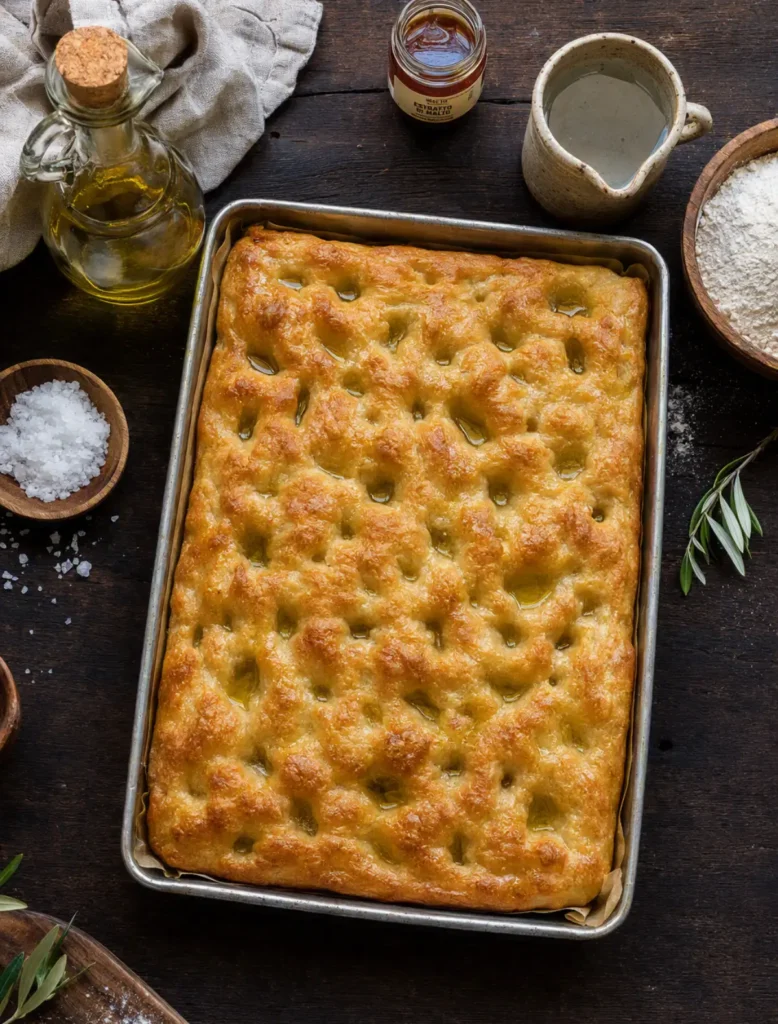
Pan. The quantities in this recipe are designed for a 30 × 40 cm (approximately 12 × 16 in) rectangular baking pan. Using a significantly different pan size will change the thickness of the focaccia and may also affect the baking time and final result.
Storage. Focaccia Genovese is at its best when freshly baked, but it can be kept at room temperature for about 2 days. Allow it to cool completely, then store it in an airtight container or wrap it well to prevent it from drying out.
Freezing and reheating. For longer storage, freeze the focaccia after it has been baked and cooled completely, preferably cut into portions and placed in freezer-safe bags. Allow it to thaw at room temperature, then reheat it for about 3–5 minutes in a preheated oven at 200 °C (390 °F) before serving. The dry heat helps restore the texture of the surface and bottom. Avoid the microwave, as it tends to soften the focaccia and can make it rubbery.
Keywords:
Focaccia Genovese, Ligurian focaccia, fügassa, homemade focaccia, traditional Genoese focaccia
Focaccia Genovese: the History and Origins of Fügassa
Fügassa has been part of Genoese life for centuries, although its history does not begin with a precise recipe resembling the one we know today. Flat doughs made from flour and water and cooked close to a fire belong to a much older tradition found throughout the Mediterranean. The word focaccia itself is linked to the Latin focus, meaning hearth or fireplace.
To find a concrete reference in Genoa, we have to go back to the Middle Ages. In 1392, an inventory belonging to a baker included the words “pala una magna pro fugacis”: a large peel used for focaccias. We cannot know how closely those focaccias resembled modern fügassa, but the document shows that they were already part of the work of Genoese bakers by the end of the fourteenth century.
A Focaccia Shaped by Centuries of Change
Focaccia also appears in accounts of Genoese social life. During the Middle Ages, it was eaten on important occasions, including religious ceremonies, weddings and funerals. According to historical accounts, the custom became intrusive enough for Bishop Matteo Gambaro to prohibit its consumption in church during services.
The fügassa we recognise today would develop much later. Baking methods, available ingredients and eating habits changed over the centuries, and focaccia changed with them. By the nineteenth century, descriptions begin to show preparations closer to the modern version.
Its history is therefore better understood as a series of changes rather than something that began on a particular date or with a single inventor. Focaccia remained on Genoese tables long enough to evolve alongside the city itself.
From the Bakery to the Streets of the Port
It is difficult to separate the history of fügassa from the history of the Port of Genoa. This was a place where inexpensive food that could be eaten quickly made practical sense during long working days.
Among the narrow streets near the port were bakeries and sciamadde, popular establishments whose name evokes the flame of the oven. Farinata, savoury pies and focaccia came out of these places, which belonged to the everyday food culture of the streets rather than to formal dining.
On the quays worked the camalli, the dock workers who loaded and unloaded goods from ships. A piece of focaccia could be bought and eaten quickly without having to leave work for long. Fügassa therefore became part of the early hours of life around the port as well, providing a substantial breakfast for people whose working day had already begun.
Part of focaccia's connection with Genoa was built in precisely these places: its bakeries, its sciamadde and a working port where focaccia was not something reserved for special occasions but everyday food.
In Genoa, Even with Cappuccino
That morning tradition has not disappeared. Genoese bakeries still sell focaccia early in the day, and some people eat it with coffee, milk or cappuccino.
And yes, some even dip the focaccia directly into their cappuccino. What may seem like an unusual combination elsewhere is simply part of local food culture in Genoa.
Perhaps this small detail says more than anything else about the place fügassa occupies in the city. It is not simply something served at the table: it is everyday food, bought from the bakery and eaten whenever the occasion arises, starting in the morning.
A Tradition That Continues in Genoese Bakeries
Centuries of history have not produced an unchanging recipe. Focaccia has evolved, just as ovens and dough-making methods have changed. Yet Focaccia Genovese has retained an identity strong enough to remain closely associated with Genoa.
The professional baking tradition has also sought to protect its defining characteristics through the Focaccia Genovese collective trademark, created to safeguard and promote fügassa and the knowledge of the bakers who continue to make it.
It is the latest chapter in a history that belongs to more than recipe books. From the focaccia peel recorded in a fourteenth-century inventory to the bakeries of Genoa today, fügassa has remained above all what it has long been for the city: everyday food.