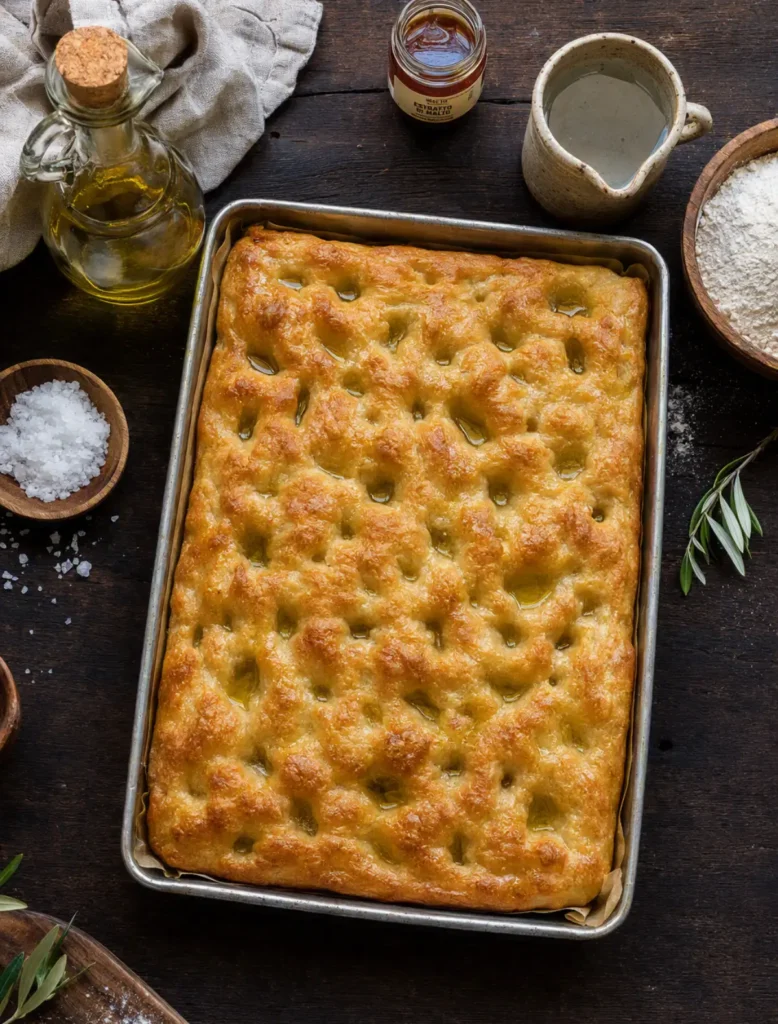
In Genoa, it is called fügassa, and its appearance is unmistakable: a relatively thin focaccia, covered with characteristic dimples and generously seasoned with extra virgin olive oil and salt.
It is deeply rooted in the everyday food culture of the city. Genoese bakeries sell it throughout the day, and it is eaten as a snack, with an aperitivo or even in the morning, sometimes accompanied by coffee or cappuccino.
When making it at home, the important thing is not to rush the stretching. The dough needs time to relax in the pan before being worked with your fingers. This is when the characteristic dimples are formed, ready to hold the oil and brine before the final proof and baking.
This recipe is designed for a 30 × 40 cm (approximately 12 × 16 in) rectangular baking pan and adapts the traditional method to a home kitchen.
Focaccia Genovese: Traditional Genoese Focaccia Recipe
Description
Focaccia Genovese, or fügassa, is a thin, generously seasoned Ligurian focaccia with characteristic dimples that hold extra virgin olive oil and brine before baking. This recipe is designed for a 30 × 40 cm (approximately 12 × 16 in) baking pan and adapted for home preparation.
Ingredients – For a 30 × 40 cm (12 × 16 inch) Baking Pan
For the Dough
For the Pan
For the Surface
Instructions
How to Make Focaccia Genovese
-
Prepare the Dough 🥣
Pour the 236 g water at room temperature into a large bowl. Add the 9 g liquid malt extract and stir with a spoon or small whisk until the malt is evenly dispersed in the water.
Crumble in the 8 g fresh yeast and stir again. Add the 430 g strong Italian type 00 flour and begin mixing with a spatula or directly with your hand.
Once no dry flour remains, add the 9 g fine sea salt and continue working the dough in the bowl.
Transfer the dough to the work surface and knead by hand. It will be fairly rough at first, but as you continue kneading it will gradually become smoother and more elastic.
Add the 21 g extra virgin olive oil a little at a time. The dough may initially become slippery and appear to separate. Continue kneading until all the oil has been absorbed and the dough is once again cohesive, smooth and elastic.
-
Rest and Fold the Dough 🕒
Shape the dough into a ball, cover it with an upturned bowl or a clean kitchen towel and leave it to rest for about 30 minutes. By the end of the rest, it should feel more relaxed and easier to handle.
Gently flatten it with your hands without pressing out too much air. Bring the edges towards the centre one at a time, then turn the dough over so that the seam is underneath.
Cover again and leave to rest for another 30 minutes. It does not need to double in size; look instead for dough that feels more relaxed and soft and has increased slightly in volume.
-
Transfer the Dough to the Pan 🫒
Pour the 15 g extra virgin olive oil into a 30 × 40 cm (approximately 12 × 16 in) rectangular baking pan and use a pastry brush or your fingers to spread it evenly across the bottom and into the corners.
Transfer the dough to the pan and begin gently stretching it with your fingertips. Stop when you feel the dough resisting; do not try to force it all the way into the corners at once.
Cover the pan and leave the dough to rest for about 20–30 minutes. When you return to it, the dough should have relaxed and should stretch much more easily.
-
Finish Stretching the Dough 🤲
Use your fingertips to gently ease the dough towards the edges and corners until it covers the entire pan. Work carefully and try to maintain an even thickness.
If the dough springs back as you stretch it, stop. Cover it and give it another 10 minutes to rest, then continue. Forcing the dough at this stage can cause it to tear.
Once the dough covers the entire pan, cover it and allow it to rest again. It is ready for the next stage when it looks more relaxed and slightly puffy and the surface no longer appears taut from stretching.
-
Add the Olive Oil and Make the Dimples 🖐️
Pour the 30 g extra virgin olive oil over the dough and gently spread it across the surface with your fingers, taking care not to press down on the dough.
Using your index, middle and ring fingers together, hold your fingers at a slight angle and press firmly into the dough without tearing it. Continue across the entire surface, leaving a little space between each set of dimples.
Prepare the brine by pouring the 90 g water at room temperature into a small bowl. Add the 5 g fine sea salt and stir until the salt has completely dissolved.
Pour the brine over the focaccia, allowing it to collect in the dimples together with the olive oil. Do not remove the liquid from the indentations; it should remain on the surface during the final proof.
-
Leave the Focaccia for Its Final Proof 🌡️
Leave the focaccia uncovered in a place protected from draughts.
As a guide, allow approximately 1 hour 30 minutes to 2 hours at 22–24 °C (72–75 °F), but pay attention to the dough rather than relying only on the clock. It should look puffier and more relaxed while the dimples remain clearly visible. Some of the liquid on the surface will also have been absorbed.
If your kitchen is cooler, the dough will need longer; on a warm day it may be ready sooner. There is no need to wait the full 2 hours if the dough already shows these signs.
Meanwhile, preheat the conventional oven thoroughly to 230 °C (450 °F) so that it has reached temperature by the time the focaccia is ready to bake.
-
Bake the Focaccia Genovese 🔥
Place the focaccia in the preheated conventional oven at 230 °C (450 °F), positioning the pan on the first rack from the bottom.
Bake for approximately 18–20 minutes, checking towards the end. The bottom should be properly baked and the surface should be evenly golden, with clearly defined dimples and slightly deeper colour around the edges.
If the bottom is already well baked but the surface needs more colour, move the pan to the centre rack for the final few minutes. If your oven browns the focaccia evenly, there is no need to move it.
Remove the focaccia from the oven and leave it in the pan for a few minutes. Carefully release it from the pan, transfer it to a wire rack and allow it to cool slightly before cutting.
Nutrition Facts
Servings 8
- Amount Per Serving
- Calories 273kcal
- % Daily Value *
- Total Fat 8.8g14%
- Saturated Fat 1.2g6%
- Sodium 690mg29%
- Total Carbohydrate 42.1g15%
- Dietary Fiber 1.5g6%
- Sugars 0.9g
- Protein 5.6g12%
* Percent Daily Values are based on a 2,000 calorie diet. Your daily value may be higher or lower depending on your calorie needs.
Note
Flour. Use a strong Italian type 00 flour suitable for yeasted doughs. Absorption can vary from one flour to another, so pay attention to the consistency of the dough as you work it. Do not add extra flour simply because the dough initially feels soft or slightly sticky; it will develop more structure as you continue kneading.
Proofing. The times given are a guide and may vary depending on the temperature of your kitchen and the activity of the yeast. Watch the dough as well as the clock: before baking, it should look relaxed and slightly puffy while retaining its characteristic dimples.
Pan. The quantities in this recipe are designed for a 30 × 40 cm (approximately 12 × 16 in) rectangular baking pan. Using a significantly different pan size will change the thickness of the focaccia and may also affect the baking time and final result.
Storage. Focaccia Genovese is at its best when freshly baked, but it can be kept at room temperature for about 2 days. Allow it to cool completely, then store it in an airtight container or wrap it well to prevent it from drying out.
Freezing and reheating. For longer storage, freeze the focaccia after it has been baked and cooled completely, preferably cut into portions and placed in freezer-safe bags. Allow it to thaw at room temperature, then reheat it for about 3–5 minutes in a preheated oven at 200 °C (390 °F) before serving. The dry heat helps restore the texture of the surface and bottom. Avoid the microwave, as it tends to soften the focaccia and can make it rubbery.