Note
Choosing the rabbit. Look for a young rabbit with firm, pale-coloured meat. If buying a whole rabbit, ask your butcher to cut it into pieces of similar size. An older rabbit may need longer cooking, so always check the tenderness of the meat before turning off the heat.
Choosing the wine. Pigato is a Ligurian white wine that works particularly well in this recipe. If you can't find it, use a Ligurian Vermentino or another dry white wine, avoiding sweet or strongly aromatic varieties. In western Liguria, some versions are also prepared with Rossese di Dolceacqua, a local red wine.
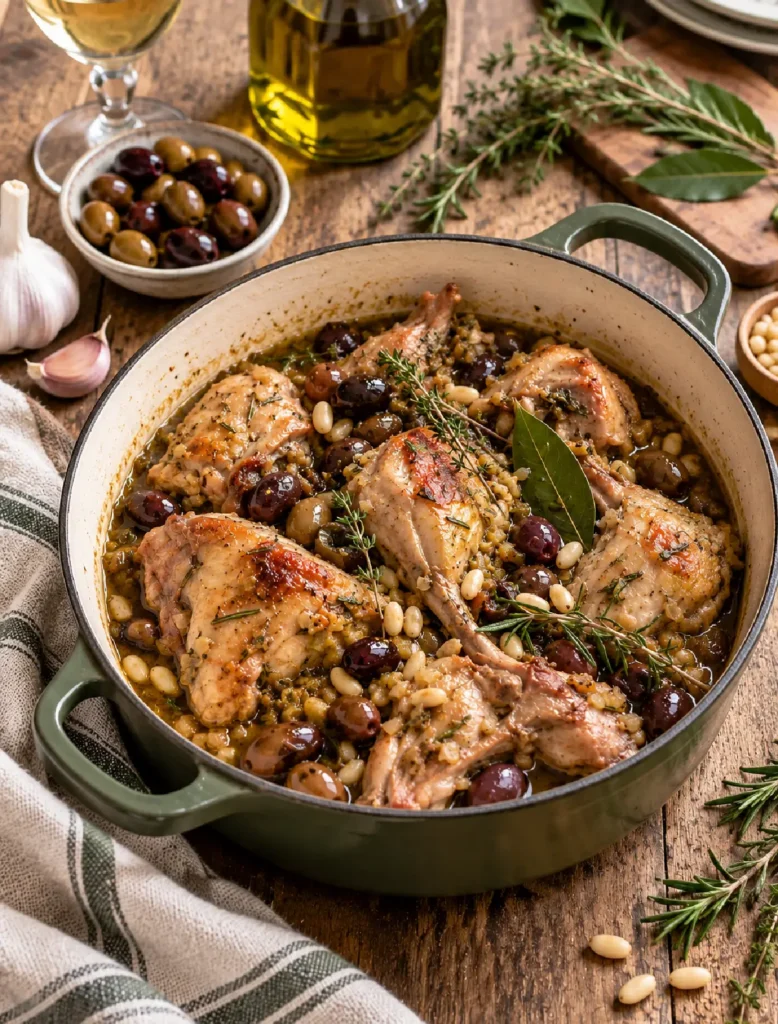
Olives and pine nuts. Pitted Taggiasca olives make the dish easier to eat. If using particularly salty olives preserved in brine, drain them well and rinse briefly if necessary. Add the pine nuts without toasting them beforehand. They absorb some of the cooking juices and retain a pleasant texture.
Storage and reheating. Allow the rabbit to cool briefly, then transfer it to an airtight container with its cooking juices and refrigerate within two hours. Store at 4°C or below and consume within 2–3 days. Reheat gently in a casserole, adding a little water or stock if the sauce has thickened, until thoroughly hot. The dish can also be frozen in individual portions for approximately 2–3 months.
Keywords:
Ligurian braised rabbit, Ligurian rabbit recipe, Coniglio alla ligure, rabbit with olives, rabbit with pine nuts, Italian braised rabbit, rabbit with Pigato wine, Ligurian recipes
The Origins of Coniglio alla ligure
Ligurian cooking is about more than pesto, focaccia and seafood. Inland, away from the coastal villages, everyday meals were shaped for centuries by vegetable gardens and small family farms.
Coniglio alla ligure has particularly deep roots in western Liguria, around Albenga, Imperia and Sanremo. Raising rabbits was once common in the countryside. They needed relatively little space and could be fed with grasses and produce from the garden, without the resources required for larger livestock.
Pinpointing when the recipe first appeared is impossible, as is identifying a single village where it originated. Preparations varied from family to family, and many remained closely associated with the customs of individual towns.
Coniglio alla ligure or Coniglio alla sanremasca?
In Sanremo, the dish has its own name: Coniglio alla sanremasca. It also appears under this name in the recipe collection of the Italian Academy of Cuisine (Accademia Italiana della Cucina).
Food writer and journalist Paolo Lingua made an interesting distinction in an article published in the Academy's magazine Civiltà della Tavola in May 2022. According to Lingua, the name Coniglio alla ligure became widespread largely through restaurants, while Coniglio alla sanremasca is closer to the local name.
Compare recipes from different parts of western Liguria and you'll find variations even between neighbouring villages. Some use white wine, others red. Some follow family recipes, while others reflect the cooking of local trattorias. Today, Coniglio alla ligure is the more widely recognised name, but it hasn't always been the only one.
Rabbit Dishes in the Trattorias of Western Liguria
In 1968, Luigi Veronelli published his Guida della Liguria. Among the establishments listed in the western Albenga area, no fewer than sixteen featured rabbit among their specialities.
This detail was recalled by Roberto Pirino, a member of the Italian Academy of Cuisine, in his essay La terra dei conigli (The Land of Rabbits), published in the Academy's Quaderni series in 2010. Sixteen establishments in a relatively small area was a remarkable number, especially considering how much the preparations differed.
Rabbit could be found stewed, cooked in a casserole, prepared with Pigato or with Rossese. Each trattoria had its own version, often shaped by the customs of its village.
In 1984, Paolo Lingua and Silvio Torre devoted considerable attention to rabbit in their book La cucina del ponente ligure (The Cuisine of Western Liguria). They collected seven rabbit recipes, some quite similar and others noticeably different.
Terraconiglio, an Unusual Place Name near Albenga
In Salea d'Albenga, in the countryside of the province of Savona, there's a locality called Regione Terraconiglio.
Roberto Pirino also mentions the name in his account of rabbit cooking traditions around Albenga. It's a little-known curiosity among the many references to the role of rabbits in the rural life of western Liguria.
We don't know exactly when the place acquired its name or where it came from. Still, it's an unusual name to find on a map of an area where rabbit was such a familiar part of local cooking.