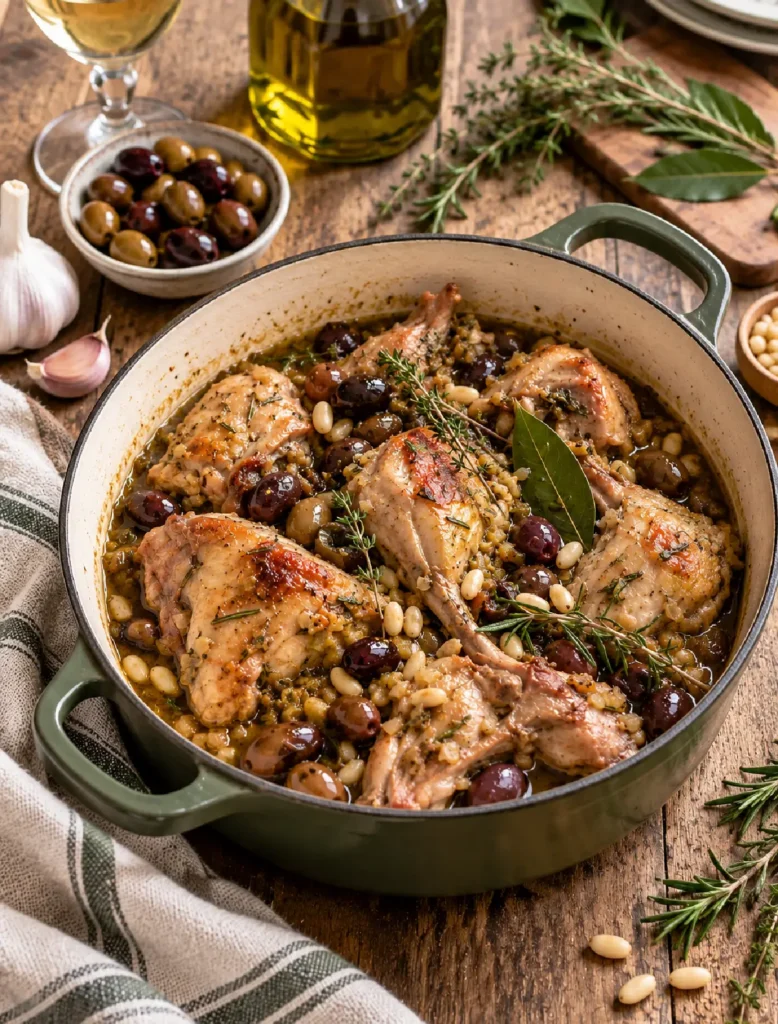
Three ingredients are essential to Ligurian Braised Rabbit, known in Italy as Coniglio alla ligure: Taggiasca olives, pine nuts and aromatic herbs. They give this dish its distinctive character, while the rest of the recipe relies on a handful of ingredients and slow, gentle cooking.
The rabbit goes into a casserole with a soffritto of onion, celery and garlic, followed by Pigato white wine. It cooks slowly, with the olives and pine nuts adding flavour to the cooking juices. There’s no need for tomatoes.
Traditionally, the rabbit’s head and liver were also used to make a stock for cooking the meat. This step still appears in traditional recipes, but it isn’t essential. You can make the dish using a rabbit that has already been cleaned and cut into pieces.
Ligurian Braised Rabbit
Description
A traditional rabbit dish from western Liguria, browned and slowly braised in a casserole with Taggiasca olives, pine nuts and aromatic herbs.
Ingredients
Main Ingredients
For the Traditional Rabbit Stock (Optional, Replaces the Meat Stock)
Instructions
How to Make Ligurian Braised Rabbit
-
Prepare the traditional rabbit stock (optional) 🍲
If you're using the rabbit's head and liver, prepare the stock before starting the main recipe. Place the cleaned head in a saucepan with approximately 600 g of cold water. Bring to a gentle boil, skim off any foam that rises to the surface and simmer for 40–50 minutes. Add the liver during the final 10 minutes, then strain the stock through a fine sieve. For a stronger flavour, you can finely chop the cooked liver and add it to the rabbit's cooking juices later. Reserve 350 g of stock to replace the meat stock listed in the main ingredients. If you're not making the traditional stock, skip this step and use regular meat stock instead.
-
Prepare the ingredients 🔪
Check the rabbit pieces and remove any small bone fragments left from cutting. Pat the meat dry with kitchen paper. Finely chop the onion, celery and garlic. Strip the rosemary leaves from the stem and chop them, leaving the thyme sprigs and bay leaves whole. Heat your chosen stock and keep it ready.
-
Make the soffritto 🧅
Pour 40 g of extra virgin olive oil into a large casserole. Add the onion, celery and garlic and cook over low heat for 5–6 minutes, stirring frequently. The vegetables should soften without browning too much. Transfer the soffritto to a bowl and set aside.
-
Brown the rabbit 🍖
Add the remaining 40 g of olive oil to the same casserole and increase the heat to medium-high. Arrange the rabbit pieces in a single layer and brown them for approximately 5–6 minutes on each side, turning until golden. If the casserole is too small, work in batches. The meat should brown rather than steam in its own juices.
-
Add the herbs and wine 🌿
Return the soffritto to the casserole along with the chopped rosemary, thyme and bay leaves. Stir gently to distribute the herbs, then pour in 350 g of Pigato white wine. Let it bubble over a fairly high heat for a few minutes, until the sharp smell of alcohol has faded and the liquid begins to reduce.
-
Continue cooking in the casserole 🍲
Reduce the heat and add 200 g of hot stock from the 350 g specified in the recipe. Cover with a lid, leaving a small gap, and cook gently for approximately 45 minutes. Turn the rabbit pieces occasionally and check the cooking juices. If they begin to dry out, gradually add some of the remaining 150 g of hot stock, without necessarily using it all. The rabbit should cook gently without being submerged in liquid.
-
Add the Taggiasca olives and pine nuts 🫒
After the first 45 minutes, add the 120 g of pitted Taggiasca olives and 30 g of untoasted pine nuts, distributing them among the rabbit pieces. Stir carefully, replace the lid and continue cooking for another 15–20 minutes, allowing the olives and pine nuts to absorb the flavours of the cooking juices.
-
Check the rabbit and adjust the seasoning 🍽️
Test the rabbit by inserting a fork into the thickest part of a hind leg. The meat should yield easily without becoming dry. If it's still firm, continue cooking for another 10–15 minutes, adding a little more stock if necessary.
Once the rabbit is tender, taste the cooking juices and add salt only if needed, taking into account the saltiness of the olives and stock. If the sauce is too thin, remove the lid and let it reduce over medium-low heat for a few minutes. Remove the bay leaves and thyme stems before serving.
Nutrition Facts
Servings 6
- Amount Per Serving
- Calories 560kcal
- % Daily Value *
- Total Fat 39g60%
- Saturated Fat 7g35%
- Sodium 420mg18%
- Total Carbohydrate 5g2%
- Dietary Fiber 1g4%
- Sugars 2g
- Protein 46g92%
* Percent Daily Values are based on a 2,000 calorie diet. Your daily value may be higher or lower depending on your calorie needs.
Note
Choosing the rabbit. Look for a young rabbit with firm, pale-coloured meat. If buying a whole rabbit, ask your butcher to cut it into pieces of similar size. An older rabbit may need longer cooking, so always check the tenderness of the meat before turning off the heat.
Choosing the wine. Pigato is a Ligurian white wine that works particularly well in this recipe. If you can't find it, use a Ligurian Vermentino or another dry white wine, avoiding sweet or strongly aromatic varieties. In western Liguria, some versions are also prepared with Rossese di Dolceacqua, a local red wine.
Olives and pine nuts. Pitted Taggiasca olives make the dish easier to eat. If using particularly salty olives preserved in brine, drain them well and rinse briefly if necessary. Add the pine nuts without toasting them beforehand. They absorb some of the cooking juices and retain a pleasant texture.
Storage and reheating. Allow the rabbit to cool briefly, then transfer it to an airtight container with its cooking juices and refrigerate within two hours. Store at 4°C or below and consume within 2–3 days. Reheat gently in a casserole, adding a little water or stock if the sauce has thickened, until thoroughly hot. The dish can also be frozen in individual portions for approximately 2–3 months.