Servings 4
- Amount Per Serving
- % Daily Value *
- Total Fat 35g54%
- Saturated Fat 12g60%
- Sodium 430mg18%
- Total Carbohydrate 89g30%
- Dietary Fiber 6g24%
- Sugars 13g
- Protein 44g88%
* Percent Daily Values are based on a 2,000 calorie diet. Your daily value may be higher or lower depending on your calorie needs.
Note
The onions are the most important part of Genovese, and they need enough time to release and slowly lose their water. There is no need to add stock: at the beginning, the onions themselves provide the liquid needed for cooking. Check the casserole from time to time, though, and stir more frequently once the sauce begins to reduce, as this is when it is most likely to catch on the bottom.
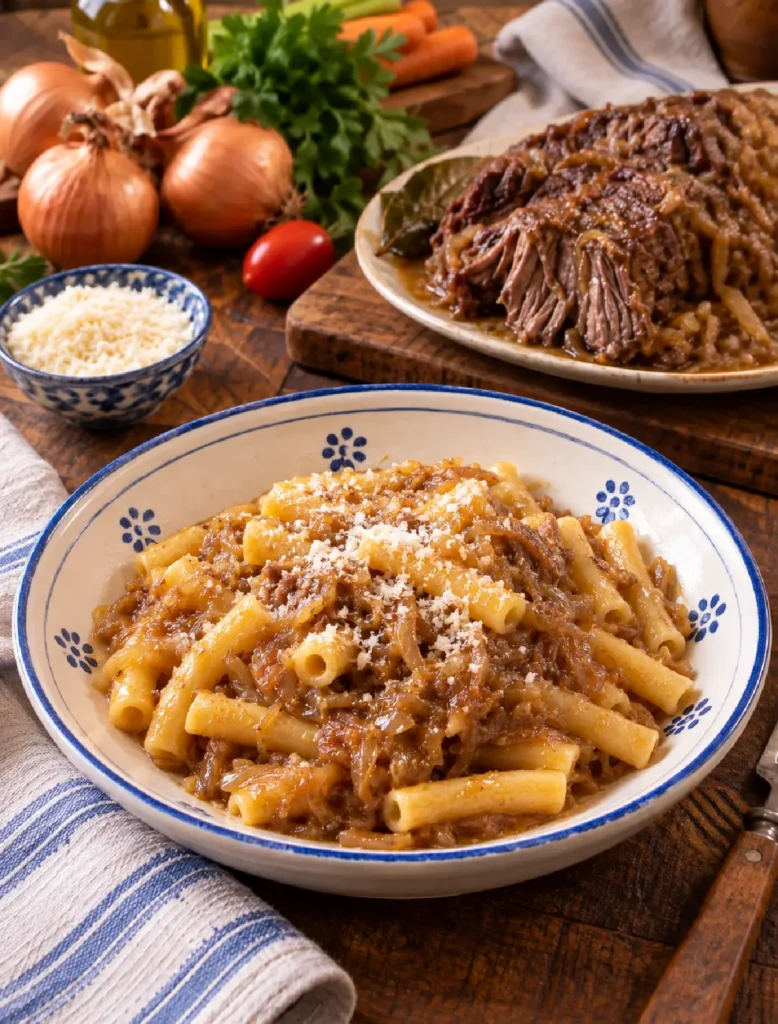
Keep the beef in large pieces and cook it until tender without shredding it into the sauce. Once ready, you can remove it from the casserole and serve it separately as the second course, leaving the onions to dress the ziti.
Do not rush the final stage. Before adding the wine, let the remaining moisture evaporate and allow the beef to brown in the reduced cooking juices. Add the wine in two additions, waiting until the first has almost evaporated before adding the second.
Parmigiano Reggiano is optional. Taste the pasta first: Genovese already has plenty of flavor and can be served without cheese.
Keywords:
pasta alla genovese, Neapolitan genovese, genovese pasta, ziti alla genovese, genovese sauce, beef and onion pasta
Why Is It Called Genovese If It Comes from Naples?
The name still causes confusion, but Genovese is Neapolitan. How it ended up with that name is another matter: there are several stories, but no certain answer.
The best-known one takes us back to fifteenth-century Naples and the Genoese who frequented its port. Sailors, and perhaps cooks, are said to have prepared meat with large quantities of onions.
Naples, in any case, claimed Genovese as its own a long time ago. It belongs to the city's cooking tradition and is now included among Campania's PAT (Prodotti Agroalimentari Tradizionali), or Traditional Agri-Food Products.
An Onion Sauce That Takes Time
What sets Genovese apart is the sheer amount of onion and the long cooking time. The onions are not there simply to accompany the beef: over several hours they lose their structure and become the sauce itself.
Beef and onions are at the heart of the dish, but the base also includes lard, carrot, celery, and parsley, along with olive oil and white wine during cooking. Then there is a less obvious detail: the traditional version recognized in Campania also includes one or two Piennolo tomatoes. It is little more than a touch, certainly not enough to turn Genovese into a tomato sauce.
Pasta and Beef, Two Courses from the Same Pot
There is one detail that says a lot about the kind of cooking this dish comes from. The onion sauce is used to dress the pasta, while the beef that has cooked in it is traditionally served separately.
One preparation therefore gives you both the first and second course. For the pasta, one of the shapes most closely associated with the Neapolitan tradition is broken ziti, which catch the sauce inside as well as out.