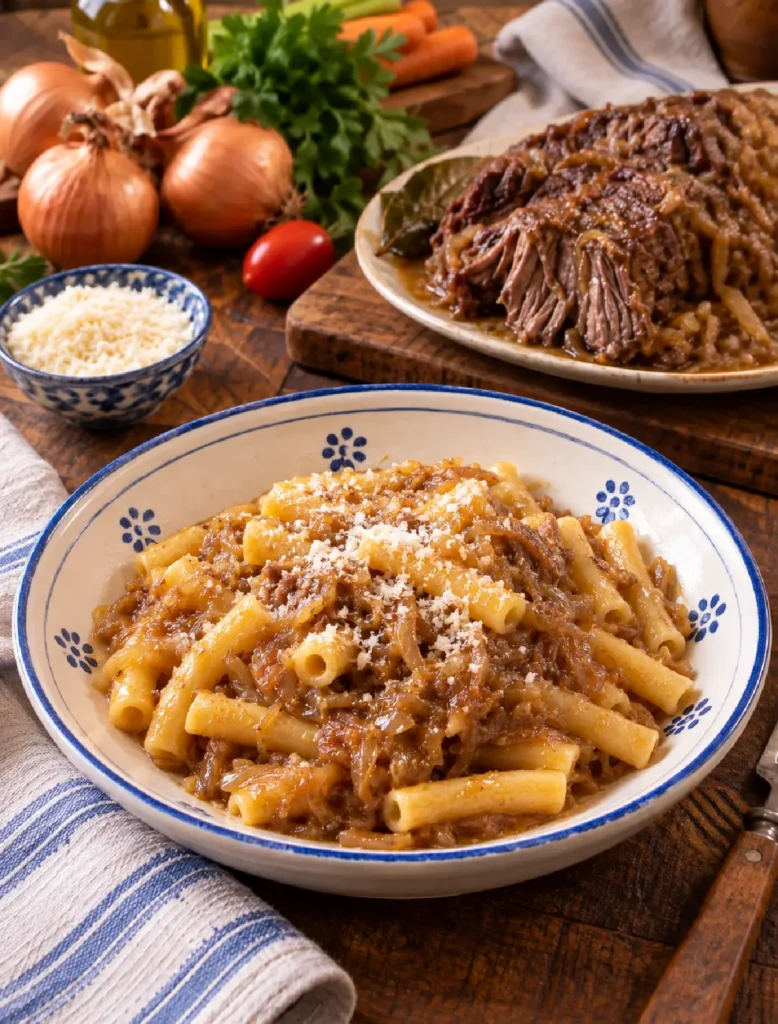
In Neapolitan Pasta alla Genovese, onions are not simply part of the base: they are the sauce. You need plenty of them, and they cook slowly with the beef until they lose their texture and almost disappear.
Time does most of the work here. The onions gradually cook down, picking up the juices released by the beef, until what remains is a hazelnut-brown sauce with no obvious pieces of onion, ready to cling to the pasta.
In Naples, Genovese is traditionally paired with broken ziti, and that is how we are making it. And the beef? It does not necessarily end up in the pasta bowl. Once cooked, it can be served separately as the second course.
Neapolitan Pasta alla Genovese: Traditional Recipe
Description
Neapolitan Pasta alla Genovese is made with broken ziti and a beef and onion sauce cooked slowly for several hours. The onions break down during cooking to become the sauce for the pasta, while the beef can be served separately.
Ingredients
For the Genovese
For the pasta
Instructions
How to Make Neapolitan Pasta alla Genovese
-
Prepare the onions and vegetables 🧅
Peel the onions and slice them thinly. Peel the carrot, then finely chop it with the celery and parsley. Cut the beef into 4–5 large pieces, keeping them roughly the same size.
-
Start the base 🥕
Put the lard in a large casserole and let it melt over low heat with the olive oil. Add the carrot, celery, and parsley and cook for a few minutes without letting them brown too much.
-
Add the onions 🧅
Add all the onions to the casserole, stir, and season with a little salt. Lightly crush the tomato and add it as well, then cover and cook over low heat. The amount of onion will look enormous at first, but it will soon begin to release water and reduce in volume.
-
Add the beef 🥩
Once the onions have started to soften, add the pieces of beef and settle them into the casserole. Cover again and cook over very low heat for at least 2 hours, stirring occasionally and keeping an eye on the bottom of the casserole.
-
Let the Genovese reduce 🥘
Remove the lid and continue cooking slowly. The water released by the onions now needs to evaporate gradually. Stir more frequently as the sauce reduces, making sure the onions do not catch on the bottom.
-
Brown the beef and add the wine 🍷
Once the onions have almost completely broken down and there is no excess water left in the casserole, raise the heat slightly. Let the beef brown in the reduced cooking juices, turning the pieces to color them on different sides. Add the white wine in two additions, allowing the first to almost completely evaporate before pouring in the second.
-
Finish the sauce 🥄
Return the heat to low and continue cooking until the onions have formed a uniform sauce and the beef is tender. Taste and adjust the salt. Remove the beef from the casserole and keep it warm; you can serve it separately.
-
Cook and dress the ziti 🍝
Break the ziti into shorter lengths and cook them in boiling salted water. Drain while still al dente, reserving a little pasta water, then transfer them directly to the casserole with the Genovese. Toss over the heat so the sauce coats the pasta well, adding just a little pasta water only if needed.
-
Serve 🧀
Serve the ziti well coated with the Genovese. If you like, finish with finely grated Parmigiano Reggiano. The beef left from making the sauce can be brought to the table afterwards as the second course.
Nutrition Facts
Servings 4
- Amount Per Serving
- Calories 820kcal
- % Daily Value *
- Total Fat 35g54%
- Saturated Fat 12g60%
- Sodium 430mg18%
- Total Carbohydrate 89g30%
- Dietary Fiber 6g24%
- Sugars 13g
- Protein 44g88%
* Percent Daily Values are based on a 2,000 calorie diet. Your daily value may be higher or lower depending on your calorie needs.
Note
The onions are the most important part of Genovese, and they need enough time to release and slowly lose their water. There is no need to add stock: at the beginning, the onions themselves provide the liquid needed for cooking. Check the casserole from time to time, though, and stir more frequently once the sauce begins to reduce, as this is when it is most likely to catch on the bottom.
Keep the beef in large pieces and cook it until tender without shredding it into the sauce. Once ready, you can remove it from the casserole and serve it separately as the second course, leaving the onions to dress the ziti.
Do not rush the final stage. Before adding the wine, let the remaining moisture evaporate and allow the beef to brown in the reduced cooking juices. Add the wine in two additions, waiting until the first has almost evaporated before adding the second.
Parmigiano Reggiano is optional. Taste the pasta first: Genovese already has plenty of flavor and can be served without cheese.