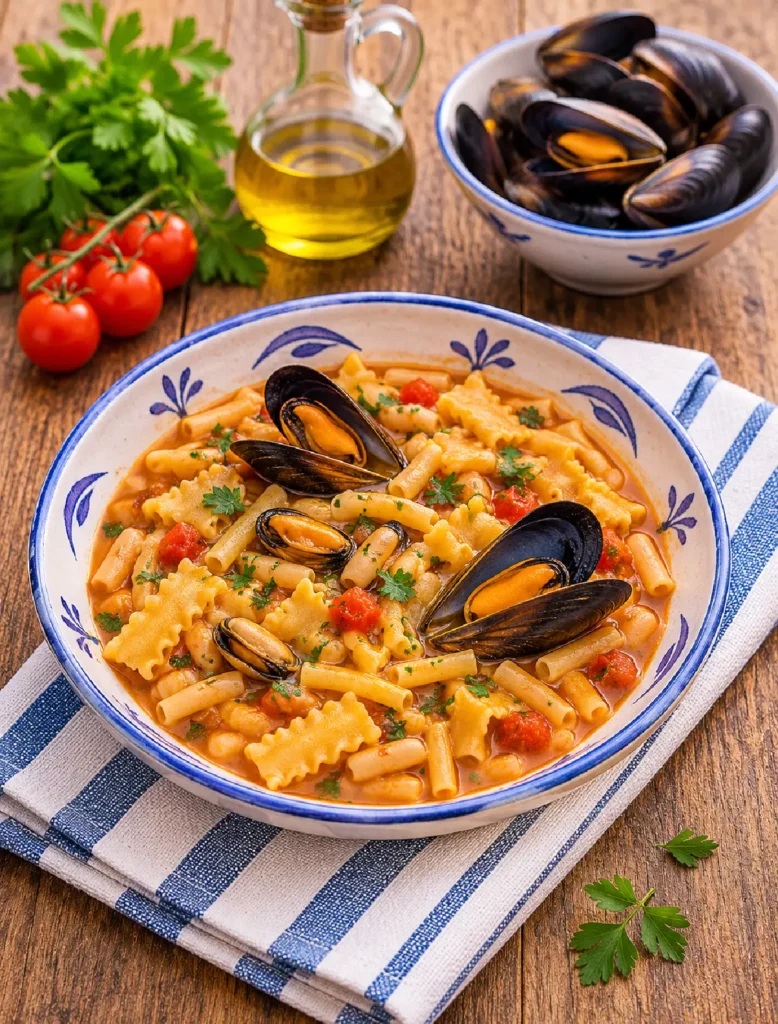
Cook the pasta 🍝
Add the mixed pasta directly to the saucepan with the beans and cook over medium heat, following the cooking times indicated on the packet.
Stir frequently, especially towards the end of cooking, when the sauce becomes thicker and the pasta is more likely to stick to the bottom of the pan. Keep the remaining mussel cooking liquid and a small saucepan of hot water nearby, adding them gradually as needed.
Do not add too much liquid at once: the pasta should absorb it gradually as it cooks, while the starch released during cooking helps thicken the sauce.
Taste before adding any salt, as the mussel cooking liquid may already provide enough seasoning.
7 Add the mussels and finish the dish 🌿
When the pasta has 1-2 minutes of cooking time remaining, add the shelled mussels together with the liquid in which they have been resting. Stir gently and finish cooking, keeping the sauce slightly loose.
Turn off the heat, add the chopped fresh parsley leaves and a drizzle of extra virgin olive oil. Taste and adjust the seasoning only if necessary.
8 Allow to rest and serve 🍽️
Let the pasta with beans and mussels rest for 2-3 minutes before serving. The sauce will continue to thicken as it rests. If it becomes too dry, add a little hot water and stir gently.
Divide between serving bowls and garnish with the mussels reserved in their shells.
Servings 4
- Amount Per Serving
- % Daily Value *
- Total Fat 14g22%
- Saturated Fat 2.2g12%
- Sodium 650mg28%
- Total Carbohydrate 84g29%
- Dietary Fiber 9g36%
- Sugars 4g
- Protein 28g57%
* Percent Daily Values are based on a 2,000 calorie diet. Your daily value may be higher or lower depending on your calorie needs.
Note
Storage
pasta with beans and mussels is best enjoyed freshly prepared. Leftovers can be stored in an airtight container in the refrigerator for up to 24 hours, provided they are cooled quickly. Reheat only once, adding a little water to restore the creamy consistency. Freezing the finished dish is not recommended.
Dried beans
canned cannellini beans can be replaced with approximately 160-180 g (5.6-6.3 oz) of dried cannellini beans. Soak them for 8-12 hours, then drain and cook in fresh water until tender. The final weight may vary depending on the variety of beans and how much water they absorb.
Mixed pasta
if ready-made Italian mixed pasta, known as pasta mista, is unavailable, we can make our own by combining leftover dried pasta shapes, such as broken spaghetti, small pasta tubes, short macaroni and mafaldine. Choose shapes with similar cooking times. Alternatively, ditalini can be used.
Chilli pepper
adjust the amount according to personal preference or leave it out entirely for a milder dish.
Choosing mussels
buy fresh mussels from authorised seafood retailers, checking their labels and origin. Keep them refrigerated until ready to prepare. Straining the cooking liquid removes solid particles but does not eliminate any marine toxins that may be present.
Keywords:
Neapolitan pasta with beans and mussels, pasta with beans and mussels, pasta e fagioli con le cozze, mixed pasta, cannellini beans, fresh mussels, Neapolitan cuisine, traditional Italian recipes, seafood pasta
To understand the origins of pasta with beans and mussels, we need to go back to a time when pasta was still sold loose in Neapolitan grocery shops. Fragments of spaghetti, broken macaroni and remnants of other pasta shapes would accumulate at the bottom of the storage drawers. Grocers collected these pieces and sold them at a lower price. Known as munnezzaglia, this mixture was the predecessor of what we now call pasta mista. With very little money, families could prepare a substantial meal by adding beans, chickpeas or potatoes. We do not know exactly when mussels became part of the recipe, but these relatively inexpensive shellfish were readily available in the city's markets.
The recipe spread along the shores of the Gulf of Naples. In Castellammare di Stabia, it became part of the culinary tradition of the chalet, waterfront establishments serving fish and seafood. Further along the Sorrento Peninsula, in the small village of Schiazzano, we find an account connected with tourism in the 1950s. In 1953, Francesco and Iolanda opened a delicatessen that occasionally doubled as a place to eat. Among the dishes they prepared for Neapolitan holidaymakers was pasta with beans and mussels. That small business would eventually develop into a family-run restaurant.
From family tables and traditional trattorias, the dish even made its way onto wedding menus. In her book Aneddoti e ricette a corte di Federico II nel XXI secolo, Carmela Iovino recalls the custom of serving pasta with beans and mussels at the end of a wedding banquet as a surprise from the chef. A humble dish rooted in the tradition of cucina povera thus found its place among the far more elaborate courses served at wedding receptions.
On 2 June 2022, pasta with beans and mussels was chosen as the signature dish of the 14th International Day of Italian Cuisines. To mark the occasion, chefs belonging to the Virtual Group of Italian Chefs featured one of Naples' most familiar traditional dishes on restaurant menus around the world.