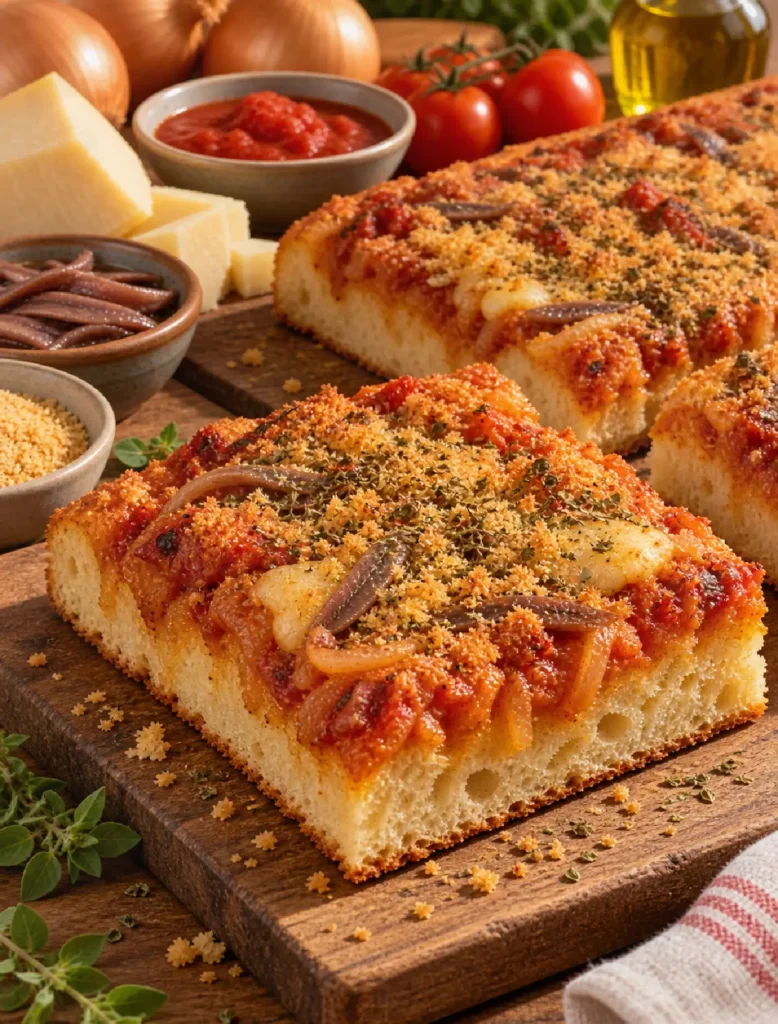
Servings 8
- Amount Per Serving
- % Daily Value *
- Total Fat 22g34%
- Saturated Fat 6g30%
- Sodium 1100mg46%
- Total Carbohydrate 79g27%
- Dietary Fiber 5g20%
- Sugars 9g
- Protein 20g40%
* Percent Daily Values are based on a 2,000 calorie diet. Your daily value may be higher or lower depending on your calorie needs.
Note
Sfincione dough is naturally soft and slightly sticky. Avoid adding extra flour while kneading, as this can make the finished base too dense. Lightly oiling your hands will make it easier to stretch the dough in the baking tray.
The tomato and onion sauce should be thick and completely cool before being spread over the dough. Excess moisture can leave the base soggy and prevent it from baking properly.
Rising times are approximate and depend on room temperature. Pay attention to how much the dough has expanded rather than relying entirely on the clock.
Store leftover sfincione in an airtight container in the refrigerator for up to 2 days. Before serving, warm it in the oven for a few minutes to help restore some of the base's original texture.
Keywords:
Palermo sfincione, sfincione recipe, Sicilian sfincione, sfincione palermitano, Sicilian pizza, Palermo street food
On the streets of Palermo, you don't always need a shop sign to find sfincione. Sometimes all you have to do is listen for the voice of the sfincionaro, the street vendor announcing his arrival with calls in Sicilian dialect, often broadcast through a loudspeaker.
It's a familiar scene for many people in Palermo. Sfincione travels through the city on small three-wheeled vehicles known locally as lape and is sold directly on the street. In the older neighbourhoods, it's not unusual to hear a sfincionaro calling out above the voices of market traders and the noise of traffic.
There was a time when sfincione was mainly prepared for special occasions. Today, it's available throughout the year, in bakeries and from street vendors, and remains something locals buy without needing a particular reason.
One of the best-known stories about its origins takes us to the monastery of San Vito in Palermo. According to local tradition, a group of nuns first prepared sfincione while looking for something different from ordinary bread to serve during the Christmas celebrations. They enriched the dough with ingredients they had available, creating something that would eventually find its way into Palermo's family kitchens.
We don't know how much truth there is in the story, but the connection with Christmas remained part of local customs for a long time. Sfincione was traditionally prepared for Christmas Eve and other important occasions. Another story tells of families serving it when a young man was invited to his future bride's home for the first time.
The name itself may offer another clue to its past. The most common explanation connects it to the Latin word spongia, meaning sponge, although other interpretations point towards Greek, Arabic and the Sicilian word sfincia. All these theories share one idea: something soft and sponge-like.
Then there's Bagheria, just a few kilometres from Palermo, where sfincione developed along a different path. Here, the local version is usually made without tomato sauce, using ingredients such as tuma, ricotta and onions, with variations depending on local customs. It's particularly associated with Christmas and shouldn't be confused with Palermo's red sfincione. They share a name and part of their history, but each has its own identity.