Note
The amount of gelatine is important if you want a panna cotta that holds its shape without becoming too firm. With 7 g of gelatine for 600 g of cream and milk, the result should remain soft, although the setting strength of gelatine can vary slightly between brands.
Do not boil the cream and milk for any length of time. Bring the mixture close to boiling point, then remove the saucepan from the heat before adding the soaked and squeezed gelatine.
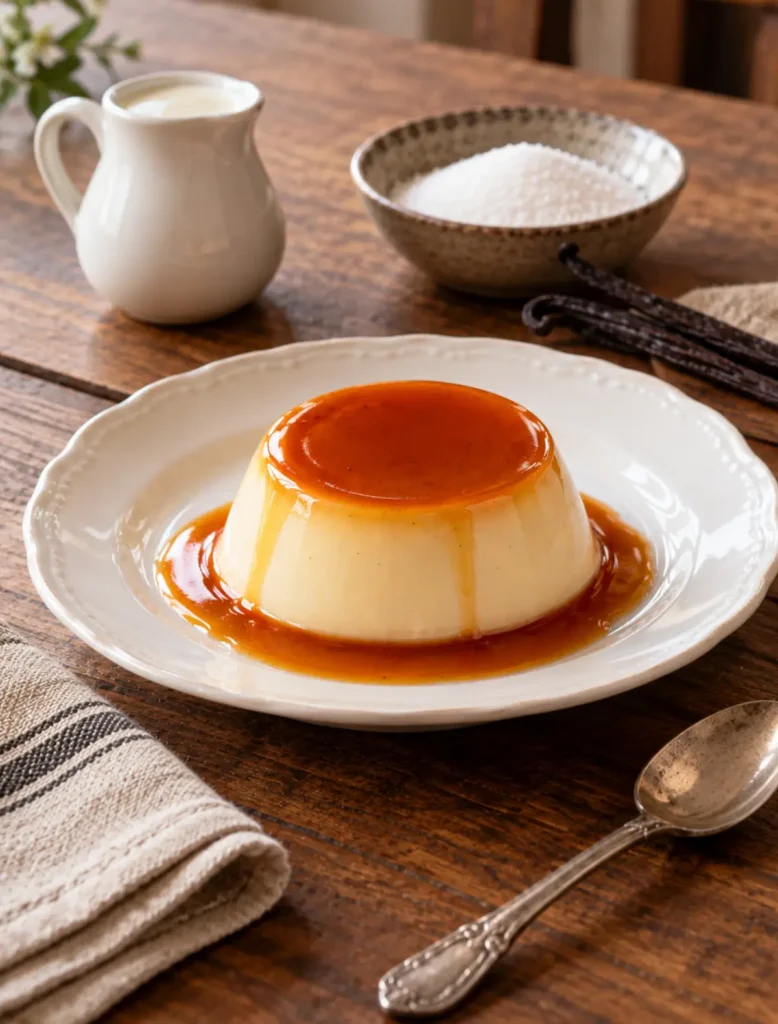
To make the panna cotta easier to release, you can dip the outside of the mould very briefly in hot water, making sure the water does not touch the dessert. Place the serving plate over the mould, then turn them over together.
Panna cotta can be prepared in advance and kept covered in its moulds in the refrigerator. Turn it out only when you are ready to serve.
Keywords:
panna cotta, Italian panna cotta, Piedmontese panna cotta, panna cotta with caramel, Italian dessert, Italian spoon dessert
A Piedmontese Story with a Few Question Marks
Panna cotta is closely associated with Piedmont, but tracing its beginnings is not as straightforward as you might expect. Even the regional documentation does not identify a definite inventor or date of origin.
The best-known story takes us to the Langhe in the early twentieth century. According to tradition, a woman of Hungarian origin prepared a cream-based dessert there which later found a place in Piedmontese cooking. The Piedmont Region still recounts the story today, but with an important qualification: it is said. There is no evidence strong enough to turn the story into established historical fact.
An earlier regional document adds an even more curious detail. In Piedmontese, cream was known as fiore del latte, or "flower of milk", and there was no specific word corresponding to the Italian panna. According to the PAT documentation, this may also suggest that the dessert entered the regional tradition relatively late.
Rather than looking for a precise birthday, we can follow the traces left by similar preparations. Some take us considerably further back in time.
A Name More Recent Than You Might Expect
The name panna cotta is so simple that it feels as though it must have always belonged to Italian cooking, yet finding it in old cookbooks is surprisingly difficult.
Historical sources commonly used to reconstruct its development do not find the name in Italian cookbooks before the second half of the twentieth century. That does not necessarily mean similar desserts did not already exist: cream, milk and setting agents had been used in European cooking long before panna cotta appeared under its modern name.
We can follow the history of the name or the history of the technique. In this case, the two paths do not begin at the same point.
The Curious Giacomo Leopardi Connection
One of the most intriguing episodes takes us away from Piedmont. In 1827, while staying in Bologna, Giacomo Leopardi wrote to his father about a preparation called latte e melle and even recorded its composition: fior di latte or cream, unsalted gelatine and sugar.
Those ingredients sound remarkably similar to panna cotta. It would be a stretch, however, to claim that Leopardi was eating the Piedmontese dessert under another name. What the document does tell us is that desserts made by setting cream and sugar with gelatine were already being prepared in nineteenth-century Italy.
The resemblance is clear. A historical connection with Piedmontese panna cotta remains unproven.
From the Langhe to Menus Across Italy
In the twentieth century, an important name enters the story: Ettore Songia, chef at the I Tre Citroni restaurant in Cuneo. During the 1960s, he is credited with one of the earliest written codifications of the recipe under the name we still use today.
From there, panna cotta began appearing more frequently in Italian restaurants. A few decades later it had become a familiar sight on menus and was even associated with the restaurant cooking of the 1980s.
Behind a dessert that now seems almost timeless lies a surprisingly difficult story to arrange neatly: a legend from the Langhe, strikingly similar nineteenth-century preparations and a name that only emerges clearly during the twentieth century.