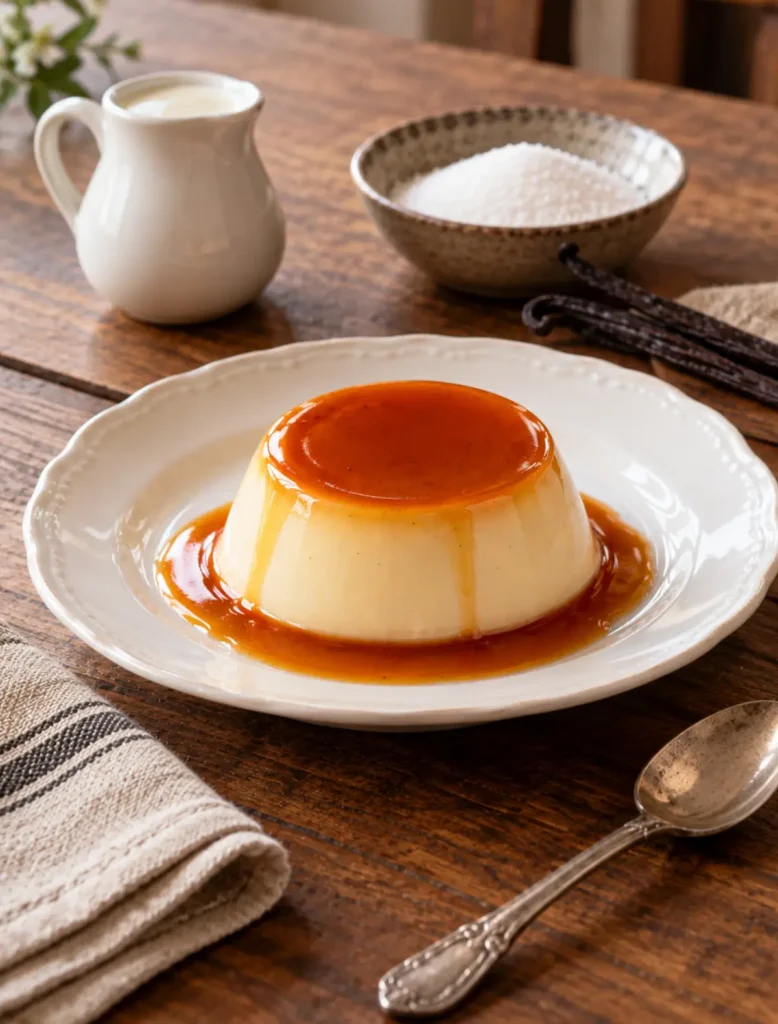
Panna Cotta almost seems to hold itself together by magic. It keeps the shape of its mould on the plate, yet the moment you sink a spoon into it, it should give easily, with a smooth, creamy texture. If it is too firm, something has gone wrong: the gelatine should support it, not turn it into a solid pudding.
It is one of the spoon desserts associated with Piedmontese cuisine and is recognized among the region’s PAT (Traditional Agri-food Products). For our recipe, we use the Piedmontese specification as our reference: liquid cream, whole milk, vanilla sugar and gelatine, with caramel at the bottom of the mould.
There really is not much work involved. The waiting begins when the moulds go into the refrigerator and ends a few hours later, at the most delicate moment: turning them out onto the plates. If everything has gone as it should, the panna cotta slips out whole, gives a slight wobble and the caramel runs from the top down the sides.
Panna Cotta with Caramel: Traditional Piedmontese Recipe
Description
This Piedmontese Panna Cotta is made with cream, milk and vanilla, chilled until set and turned out onto the plate with its caramel. For this recipe, we use the preparation recognized as a PAT of Piedmont as our reference.
Ingredients
For the Caramel
For the Panna Cotta
Instructions
How to Make Panna Cotta
-
Make the caramel 🍮
Put the 100 g of sugar and the water in a small saucepan and place over the heat without stirring. Cook until the sugar turns amber, gently swirling the pan if necessary.
Immediately divide the caramel between 6 moulds, tilting them slightly so that it covers the bottom. Leave it to cool while you prepare the panna cotta.
-
Soak the gelatine 💧
Place the gelatine sheets in a bowl with plenty of cold water and leave them to soften for about 10 minutes.
-
Heat the cream, milk and vanilla 🥛
Pour the cream and milk into a saucepan, then add the 80 g of sugar and the natural vanilla powder. Heat gently, stirring occasionally, until the sugar has dissolved and the mixture is almost at boiling point.
If using a vanilla pod instead of vanilla powder, split it lengthways, scrape out the seeds and add both the seeds and pod to the saucepan. Remove the pod before continuing.
-
Dissolve the gelatine in the hot mixture 🥄
Drain the softened gelatine and gently squeeze out the excess water. Add it immediately to the hot cream and milk and stir until completely dissolved.
Pour the mixture into the moulds over the cooled caramel.
-
Chill the panna cotta until set ❄️
Leave the moulds to cool slightly, then transfer them to the refrigerator and chill the panna cotta for at least 5 hours. You can also prepare it further in advance if convenient.
When you are ready to serve, invert each mould onto a plate and gently release the panna cotta. The caramel left at the bottom of the mould will run over the top and down the sides.
Nutrition Facts
Servings 6
- Amount Per Serving
- Calories 414kcal
- % Daily Value *
- Total Fat 30.6g48%
- Saturated Fat 19.5g98%
- Sodium 32mg2%
- Total Carbohydrate 33.1g12%
- Sugars 33.1g
- Protein 3.3g7%
* Percent Daily Values are based on a 2,000 calorie diet. Your daily value may be higher or lower depending on your calorie needs.
Note
The amount of gelatine is important if you want a panna cotta that holds its shape without becoming too firm. With 7 g of gelatine for 600 g of cream and milk, the result should remain soft, although the setting strength of gelatine can vary slightly between brands.
Do not boil the cream and milk for any length of time. Bring the mixture close to boiling point, then remove the saucepan from the heat before adding the soaked and squeezed gelatine.
To make the panna cotta easier to release, you can dip the outside of the mould very briefly in hot water, making sure the water does not touch the dessert. Place the serving plate over the mould, then turn them over together.
Panna cotta can be prepared in advance and kept covered in its moulds in the refrigerator. Turn it out only when you are ready to serve.