Note
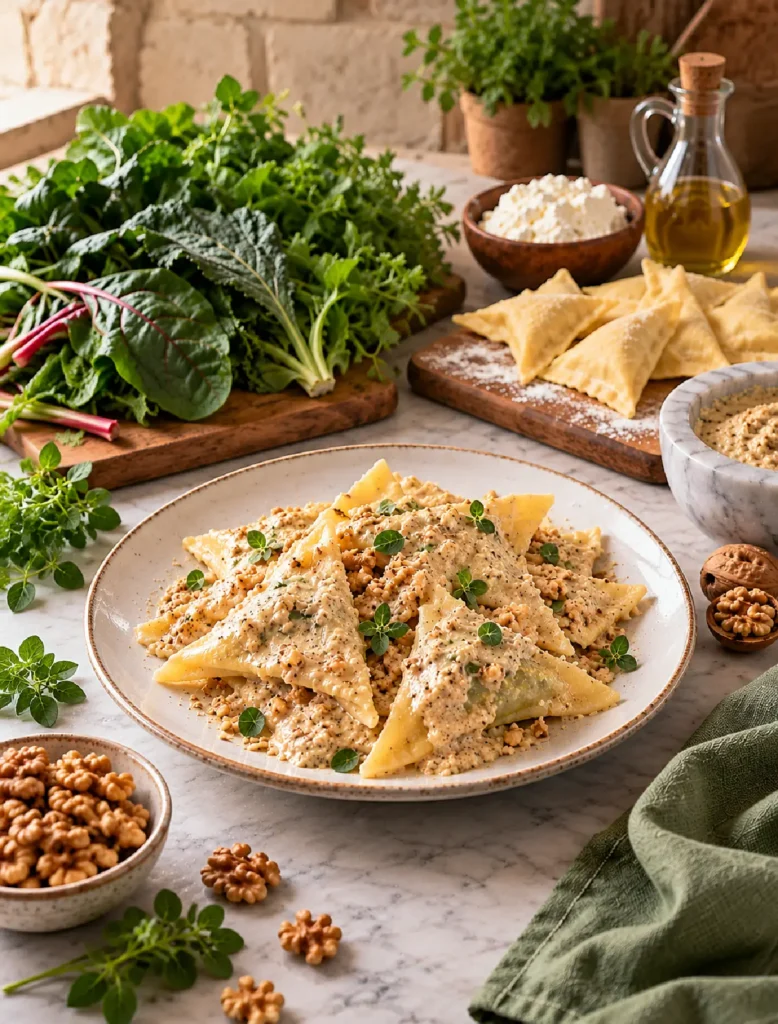
Traditional preboggion consists of several wild greens whose composition changes according to the season and local availability. This recipe uses more accessible vegetables rather than attempting to reproduce the exact mixture of wild Ligurian herbs. If borage is unavailable, replace it with an additional 50 g of Swiss chard.
Prescinseua gives the filling a slightly tangy flavour characteristic of this traditional Ligurian fresh cheese. If using cow's milk ricotta, drain it thoroughly before combining it with the greens.
To prevent the pansoti from opening during cooking, squeeze the greens thoroughly and seal the edges without leaving air around the filling. If preparing the pansoti ahead of time, arrange them on a lightly floured tray, keeping them well separated, and refrigerate for a short period. For longer storage, freeze them individually on a tray before transferring them to a suitable container.
The walnut sauce should remain creamy and should not be cooked in a pan. Add small amounts of pasta cooking water until it is fluid enough to coat the pasta. The quantity listed corresponds to the DishToHub salsa di noci recipe, but you can use less if you prefer a lighter dressing.
Keywords:
pansoti in salsa di noci, Ligurian pansoti, pansotti, Ligurian stuffed pasta, preboggion, prescinseua, walnut sauce, Ligurian recipes, homemade stuffed pasta
The Origins of Ligurian Pansoti
Pansoti belong to the tradition of stuffed pasta from eastern Liguria, particularly the area stretching from Genoa to the Gulf of Tigullio. Unlike many Italian ravioli, their filling contains no meat. Instead, greens provide the distinctive flavour, combined with fresh cheese and other ingredients that vary according to local customs.
The name also offers a clue to their shape. Pansoti, sometimes written pansotti, is linked to the Ligurian word pansa, meaning belly, referring to the rounded, slightly swollen appearance of the filled pasta. There is no single shape shared throughout Liguria: pansoti may be triangular, crescent-shaped or folded in slightly different ways.
Their popularity beyond Liguria is relatively recent compared with the domestic tradition from which they developed. During the twentieth century, particularly in its second half, pansoti with walnut sauce became increasingly common in restaurants, helping introduce Ligurian cooking to diners far beyond the region.
What Is Preboggion?
Preboggion is not a single vegetable but a mixture of wild greens traditionally gathered from fields and hillsides across Liguria. Its composition has never been completely fixed. It depends on which plants are available, the time of year and the knowledge of the people gathering them.
The greens traditionally used include borage, sow thistle, salad burnet, dandelion, nettles and other local plants. Some have a mild, delicate flavour, while others are more aromatic or slightly bitter. Their combination gives the pansoti filling its distinctive character.
Preboggion has its roots in a style of cooking where gathering wild greens was part of everyday life. It was not used exclusively for stuffed pasta: it could also be added to soups, savoury pies and other home-cooked dishes. Today, finding a ready-made mixture is less common, particularly outside Liguria, but preboggion remains one of the most recognisable elements of the region's food culture.
Pansoti and Ravioli: What Is the Difference?
At first glance, pansoti may resemble ravioli, but in Ligurian cooking the main distinction lies in the filling.
Traditional Genoese ravioli generally contain meat, vegetables and cheese, with proportions varying between recipes. Pansoti, on the other hand, are distinguished by their meat-free filling of greens, traditionally centred on preboggion.
The pasta dough also has some distinctive features. Several Ligurian recipes include white wine alongside flour and eggs, sometimes with a little water. This is not a requirement for every version of pansoti, but it appears in numerous regional preparations.
The sauce is another difference. Genoese ravioli are often served with tocco, a traditional meat sauce, whereas the best-known accompaniment for pansoti is salsa di noci.
The Tradition of Pansotti from Rapallo
The connection between pansoti and walnut sauce is particularly strong around Rapallo, on the Gulf of Tigullio.
In 2013, Pansotti con salsa di noci di Rapallo received De.Co. (Denominazione Comunale) recognition, a municipal designation that documents the characteristics of the local preparation.
The specifications include detailed requirements for the filling, such as the use of at least four types of greens, a substantial proportion of borage and limits on the amount of Swiss chard. They also describe certain aspects of the pasta dough and preparation method.
This recognition applies specifically to Rapallo's culinary tradition and does not establish rules for every version of pansoti made throughout Liguria. The recipe presented here follows the broader regional tradition, using a selection of greens that can also be found by cooks living far from Liguria.