In Liguria, walnut sauce is almost inseparable from pansoti. The slightly bitter notes of the herb filling work particularly well with this delicate, creamy sauce, where the flavour of the walnuts remains unmistakable.
Known locally as sarsa de noxe, the sauce owes part of its character to prescinseua, a fresh Ligurian dairy product with a pleasantly tangy flavour. It can also be served with other types of pasta, but its best-known pairing is with pansoti.
To prepare the traditional combination, see our recipe for Pansoti in salsa di noci.
Salsa di Noci, Ligurian Walnut Sauce
Description
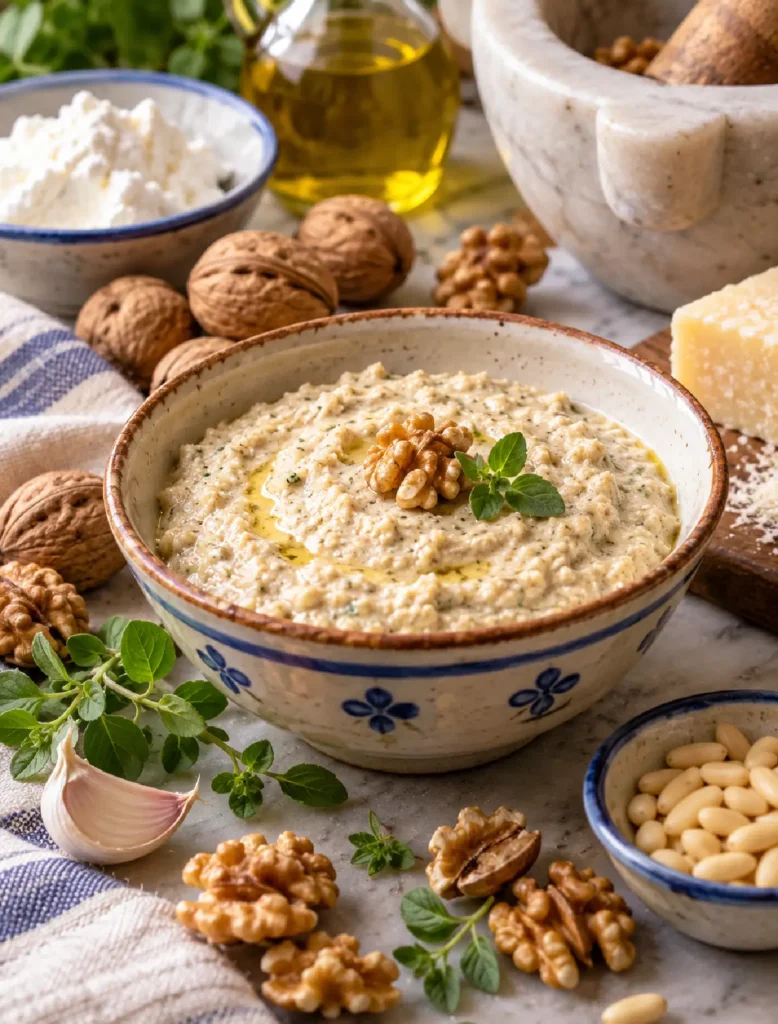
A traditional Ligurian sauce made with walnuts, prescinseua, pine nuts and marjoram. Traditionally prepared with a mortar and pestle, it has a creamy, slightly coarse texture and is particularly well suited to herb-filled pansoti.
Ingredients for approximately 420 g of sauce
Instructions
How to Make Salsa di noci
-
Soften the Bread 🍞
Cut 50 g of white bread crumb into small pieces and place them in a bowl with 70 g of whole milk. Leave to soften for about 5 minutes, then mash with a fork until the mixture is soft. Set aside any milk that has not been absorbed.
-
Prepare the Walnuts 🌰
Bring a small saucepan of water to the boil and add 160 g of walnut kernels. Blanch for about 1 minute, then drain. Once cool enough to handle, remove any dark skins that come away easily. There is no need to peel every walnut completely.
-
Start Crushing the Ingredients 🧄
Place half a garlic clove, with the inner green germ removed, in a mortar together with 20 g of pine nuts and a pinch of salt. Work with the pestle until the mixture becomes fairly fine.
If using a blender or small food processor, add the same ingredients and pulse briefly. Continue adding the remaining ingredients in the order described below, working in short bursts to prevent the sauce from overheating.
-
Crush the Walnuts 🌰
Gradually add the walnuts, crushing them with the pestle until you obtain a soft mixture that still has a slightly coarse texture. If your mortar is small, work in batches and transfer the crushed mixture to a large bowl as you go.
If using a blender, pulse briefly and stop before the walnuts turn into a completely smooth paste.
-
Add the Bread and Marjoram 🌿
Transfer the walnut, garlic and pine nut mixture to a large bowl if you have not already done so. Add the softened bread and 2 g of fresh marjoram leaves, then mix thoroughly.
If the mixture seems too thick, gradually add any milk left over from soaking the bread.
-
Finish the Sauce 🥣
Add 60 g of prescinseua and 30 g of finely grated Parmigiano Reggiano, stirring until well combined. Gradually pour in 35 g of extra virgin olive oil, mixing with a spoon until the sauce becomes creamy while retaining a slightly coarse texture.
Taste and adjust the salt if necessary.
If using a blender, you can also incorporate these ingredients in the container, provided it is large enough. Continue working in short pulses.
-
Prepare the Sauce for Serving 🍝
Salsa di noci is served without cooking it. When the pasta is almost ready, loosen the amount of sauce you need with a little hot pasta cooking water, adding it gradually until it reaches a consistency suitable for coating the pasta.
If using the optional butter, add 10 g of butter together with the hot pasta water and stir until melted. Add the drained pasta and toss gently, without returning the sauce to the heat.
Note
Prescinseua and substitutes: Prescinseua gives the sauce its characteristic slightly tangy flavour. If you cannot find it, use well-drained whole-milk ricotta. The resulting sauce will have a milder taste.
Walnut skins: Briefly blanching the walnuts makes it easier to remove some of their darker skins, which contribute to their slightly bitter flavour. There is no need to remove every trace of skin, as a little bitterness is normal in this sauce.
Consistency: The sauce should be creamy but does not need to be perfectly smooth. If it is too thick, add a little hot pasta cooking water, one tablespoon at a time. Avoid thinning it too much before serving.
Storage: Transfer the freshly prepared sauce to a clean, covered container and refrigerate immediately at 4°C (40°F) or below. For best quality and as a precaution, consume within 24 hours. Do not leave it at room temperature for more than 2 hours. The sauce contains fresh dairy products and is not cooked after preparation.
Serving: This recipe makes approximately enough sauce for four servings of pasta. Do not heat the sauce directly in a pan. Instead, combine it with freshly drained pasta, using a little cooking water to loosen it.