Pansoti in salsa di noci are one of Liguria’s most distinctive pasta dishes. Beneath a thin sheet of fresh pasta is a filling of greens with a delicate, slightly bitter flavour, perfectly complemented by the creamy walnut sauce.
At the heart of the recipe is preboggion, a mixture of wild greens whose composition varies with the season and the part of Liguria where it is prepared. Finding all these herbs outside the region can be difficult, but a similar filling can be made using Swiss chard, spinach, chicory and, when available, borage. The greens are combined with prescinseua, a traditional Ligurian fresh cheese with a slightly tangy flavour. Well-drained cow’s milk ricotta makes a practical alternative, alongside Parmigiano Reggiano and aromatic herbs.
Once cooked, the pansoti are dressed with salsa di noci, a creamy walnut sauce whose delicate flavour complements the greens without overwhelming them.
👉 Discover how to make Salsa di Noci
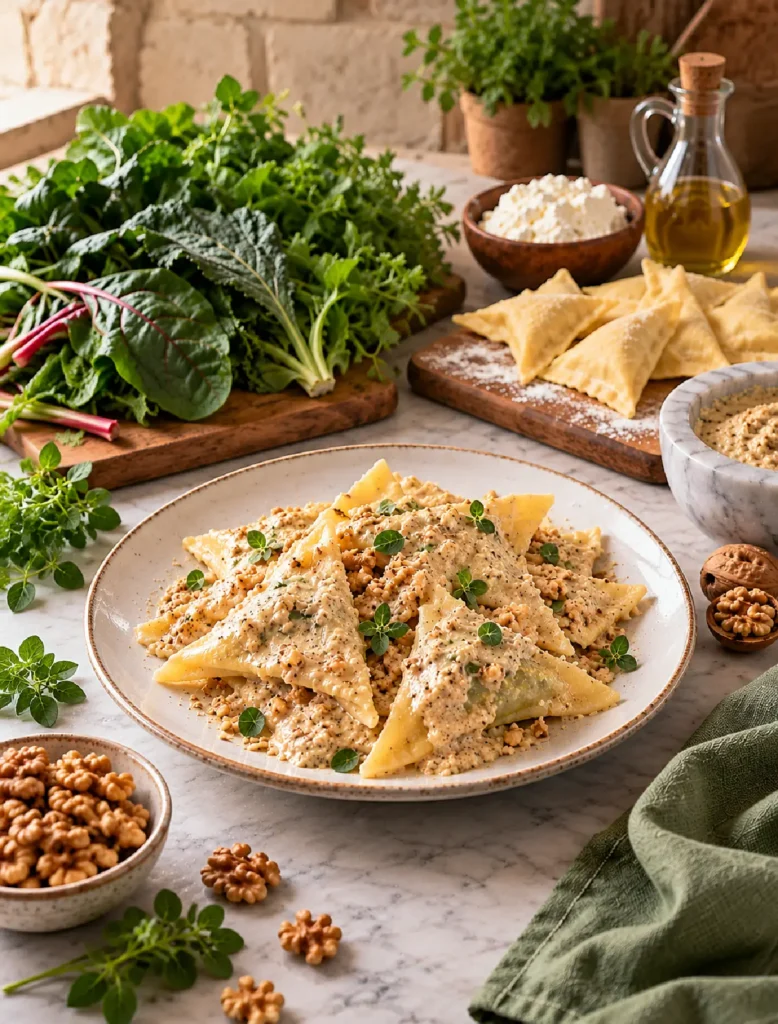
Pansoti in Salsa di Noci, Ligurian Stuffed Pasta with Walnut Sauce
Description
Pansoti are traditional Ligurian stuffed pasta made with a filling of greens, prescinseua or ricotta, and Parmigiano Reggiano. The fresh pasta dough is prepared with eggs and white wine, then rolled thin, filled and folded into triangles. They are traditionally served with a creamy walnut sauce.
Ingredients
For the Pasta Dough
For the Preboggion
For the Filling
For Serving
Instructions
How to Make Pansoti in Salsa di Noci
-
Prepare the Pasta Dough 🥚
Place 350 g all-purpose flour on a work surface and make a well in the centre. Crack 2 medium eggs into the well, add 50 g dry white wine and begin mixing with a fork, gradually incorporating the flour. Continue kneading by hand, adding a little water at a time only if needed. Knead for approximately 8–10 minutes, until the dough is smooth, elastic and fairly firm.
-
Let the Dough Rest ⏱️
Cover the dough with an overturned bowl or wrap it in cling film. Leave it to rest for 30 minutes at room temperature, away from heat. Meanwhile, prepare the greens for the filling.
-
Clean and Cook the Greens 🥬
Thoroughly wash 300 g Swiss chard, 200 g spinach, 150 g chicory greens and 50 g borage leaves, removing any tough stalks. Bring a pot of water to the boil, then add the salt. Add the greens and cook for approximately 5–7 minutes, until tender. If the leaves vary considerably in texture, add the tougher greens first and the more delicate ones later.
-
Squeeze and Chop the Greens 🔪
Drain the greens and leave them until cool enough to handle. Squeeze them thoroughly with your hands to remove as much water as possible. The greens must be well drained, otherwise the filling could make the pasta too soft. Finely chop them with a knife, transfer them to a bowl and leave them to cool completely.
-
Prepare the Filling 🧀
Add 150 g prescinseua to the greens, or the same quantity of well-drained cow's milk ricotta if prescinseua is unavailable. Add 1 medium egg, half a garlic clove, very finely chopped, 40 g grated Parmigiano Reggiano and 2 g finely chopped fresh marjoram leaves. Finish with a little freshly grated nutmeg and salt. Mix until evenly combined. The filling should be soft but firm enough to hold its shape when placed on the pasta.
-
Roll Out the Pasta 🍝
Divide the dough into several portions, keeping those you are not using covered. Roll out one portion at a time with a rolling pin or pasta machine, starting with the widest setting and gradually reducing the thickness. Aim for a thin sheet, approximately 1–1.5 mm thick, without making it so delicate that it tears during filling.
-
Cut and Fill the Pansoti 🥄
Using a pastry wheel, cut the pasta into squares measuring approximately 7–8 cm on each side. Place a small amount of filling, roughly one generous teaspoon, in the centre of each square, leaving enough space around the edges to seal the pasta. Work with a few squares at a time to prevent the dough from drying out before filling.
-
Fold and Seal the Pansoti 🔺
Fold each square diagonally to form a triangle. Gently press around the filling to remove any trapped air, then carefully seal the edges with your fingertips. If the pasta has started to dry out, lightly moisten the edges with a pastry brush and a little water. Arrange the pansoti on a lightly floured tray without overlapping them, and continue until all the ingredients have been used.
-
Prepare the Walnut Sauce 🥣
Prepare 420 g salsa di noci following the DishToHub recipe, or use sauce that you have already made. Transfer it to a large bowl, where you will dress the pansoti after cooking. The sauce should not be fried or brought to the boil.
-
Cook the Pansoti 🍲
Bring a large pot of water to the boil, then add the salt. Gently lower the pansoti into the water, stirring carefully to prevent them from sticking to the bottom. Cook for approximately 3–5 minutes, depending on the thickness of the pasta. Once they float to the surface, taste one to check that the pasta is cooked through, including along the folded edges. Before draining, reserve a cup of the cooking water.
-
Dress and Serve 🍽️
Add a few tablespoons of the reserved cooking water to the walnut sauce, stirring until it becomes smooth and creamy. Lift the pansoti out of the water with a slotted spoon, transfer them to the bowl and toss very gently to avoid breaking them. Add a little more cooking water if needed. Divide among serving plates and serve immediately, garnishing with a few fresh marjoram leaves if desired.
Nutrition Facts
Servings 4
- Amount Per Serving
- Calories 950kcal
- % Daily Value *
- Total Fat 59g91%
- Saturated Fat 13g65%
- Sodium 550mg23%
- Total Carbohydrate 78g26%
- Dietary Fiber 8g32%
- Sugars 8g
- Protein 29g58%
* Percent Daily Values are based on a 2,000 calorie diet. Your daily value may be higher or lower depending on your calorie needs.
Note
Traditional preboggion consists of several wild greens whose composition changes according to the season and local availability. This recipe uses more accessible vegetables rather than attempting to reproduce the exact mixture of wild Ligurian herbs. If borage is unavailable, replace it with an additional 50 g of Swiss chard.
Prescinseua gives the filling a slightly tangy flavour characteristic of this traditional Ligurian fresh cheese. If using cow's milk ricotta, drain it thoroughly before combining it with the greens.
To prevent the pansoti from opening during cooking, squeeze the greens thoroughly and seal the edges without leaving air around the filling. If preparing the pansoti ahead of time, arrange them on a lightly floured tray, keeping them well separated, and refrigerate for a short period. For longer storage, freeze them individually on a tray before transferring them to a suitable container.
The walnut sauce should remain creamy and should not be cooked in a pan. Add small amounts of pasta cooking water until it is fluid enough to coat the pasta. The quantity listed corresponds to the DishToHub salsa di noci recipe, but you can use less if you prefer a lighter dressing.