Servings 4
- Amount Per Serving
- % Daily Value *
- Total Fat 35g54%
- Saturated Fat 11g56%
- Sodium 900mg38%
- Total Carbohydrate 83g28%
- Dietary Fiber 11g44%
- Sugars 15g
- Protein 26g52%
* Percent Daily Values are based on a 2,000 calorie diet. Your daily value may be higher or lower depending on your calorie needs.
Note
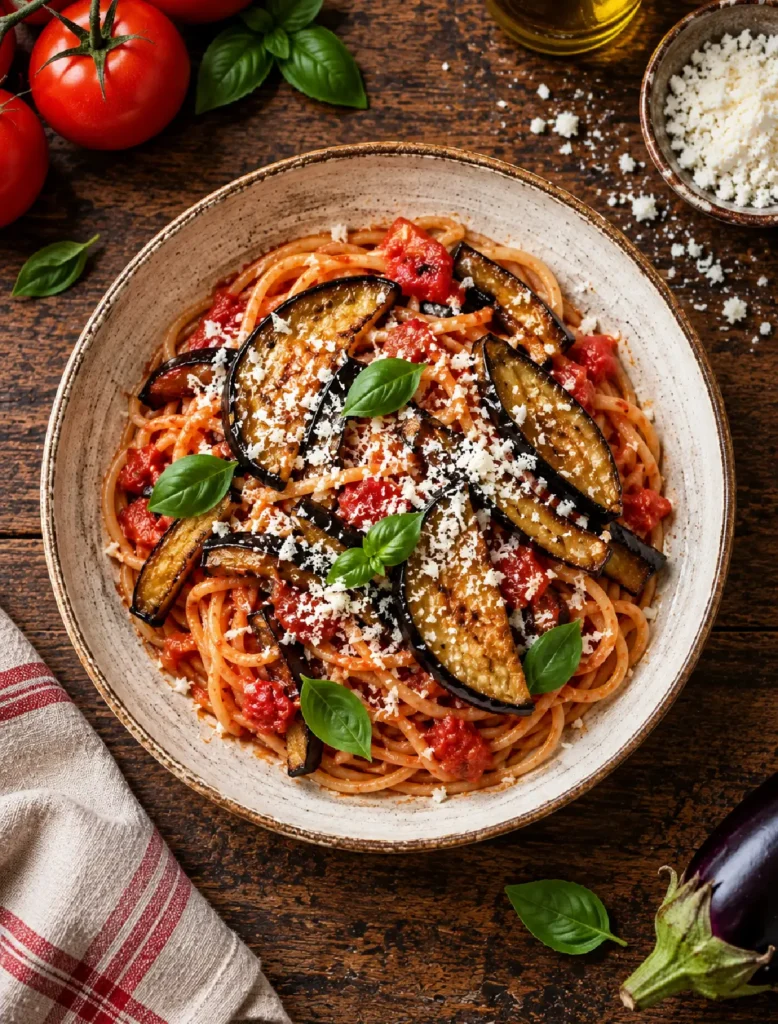
The eggplant: choose firm eggplants with taut skin and compact flesh. After salting, rinse them quickly and dry them particularly well before frying. Any water left on the surface will cause the hot oil to splatter.
Frying: fry only a few slices at a time without overcrowding the pan. This prevents the oil temperature from dropping sharply and helps the eggplant brown without absorbing excessive oil. Drain well on paper towels as soon as the slices come out of the oil.
The tomatoes: when using ripe fresh tomatoes, a food mill separates the skins and seeds from the flesh and produces a smooth sauce without blending it. If the tomatoes are particularly watery, extend the second cooking stage slightly. The sauce should reduce enough to coat the spaghetti without leaving excess liquid at the bottom of the plate.
The ricotta: use salted ricotta for this version. It should be dry and sufficiently aged to grate easily. Do not substitute fresh ricotta, which has a completely different texture, moisture content, and flavor. Baked ricotta (ricotta infornata) is also found in Sicilian tradition and is particularly associated with some products from the eastern part of the island.
Making it ahead: you can prepare the tomato sauce and fry the eggplant separately a few hours in advance. Keep the eggplant separate and add it to the tomato sauce only when preparing the pasta, reserving a few slices for serving.
Storage: Pasta alla Norma is best served immediately. Store leftovers in a sealed container in the refrigerator and eat within 1–2 days. Any reserved fried eggplant slices will inevitably lose some of their texture during storage.
Keywords:
Pasta alla Norma, Sicilian pasta, eggplant pasta, Sicilian recipes, salted ricotta
Why Is It Called Pasta alla Norma?
The name Pasta alla Norma inevitably leads back to Vincenzo Bellini, who was born in Catania in 1801. His opera Norma, with a libretto by Felice Romani, premiered at La Scala in Milan in 1831 and became one of the composer's most celebrated works.
According to the best-known story, the connection between the opera and the pasta came from Nino Martoglio, a Catania-born poet, writer, and man of the theatre. Tradition holds that after tasting the dish, Martoglio praised it by invoking Bellini's Norma. That exclamation is said to have given the recipe the name by which it is still known today.
The story has become firmly established in accounts of Catania's culinary history, but it should be treated for what it is: a tradition passed down over time rather than an episode supported by definitive historical evidence. The dating of the story to around the 1920s, often associated with the anecdote, also comes from later accounts.
The reference to Bellini, however, is not accidental. In Catania, Norma also came to be used as a way of describing something particularly well made. Opera, composer, and recipe have therefore become part of the same cultural landscape, making it difficult to tell the story of this dish without also telling a little of the story of its city.