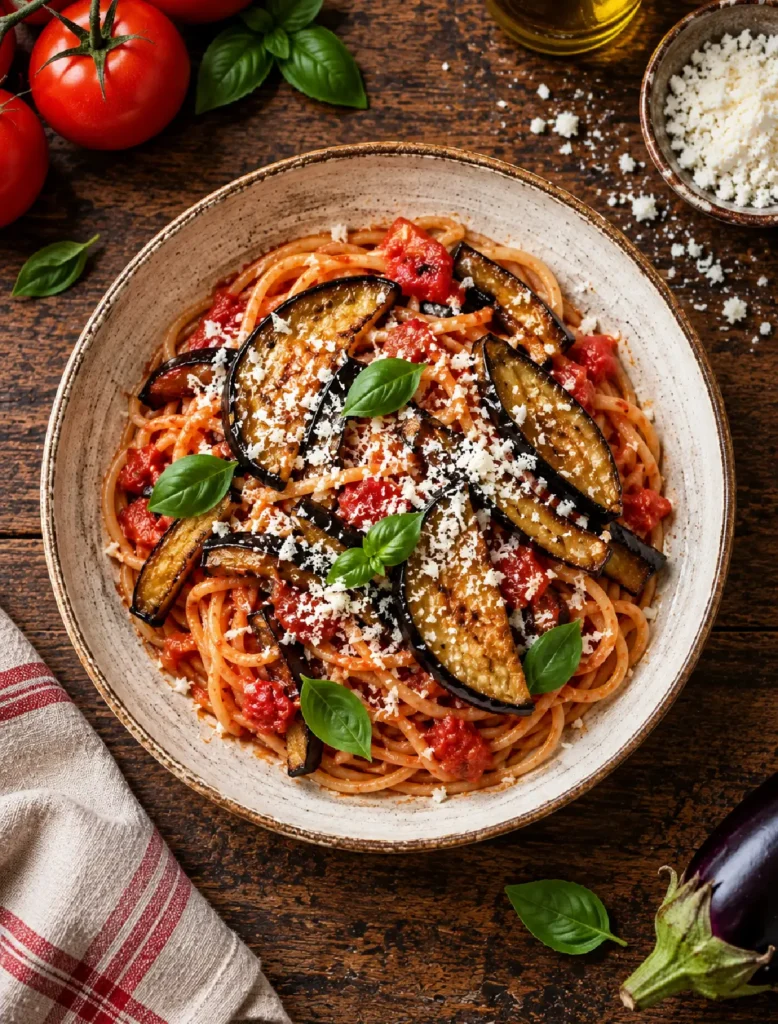
In Catania, Pasta alla Norma brings together some of the most recognizable ingredients of the Sicilian summer: ripe tomatoes, eggplant, basil, and salted ricotta. The eggplant is sliced and fried until tender, with lightly golden edges; some goes into the sauce, while the remaining slices are added to the pasta just before serving.
The tomato sauce coats the spaghetti, the pasta shape traditionally used in Catania, while the salted ricotta is grated directly over the finished dish. Its savory flavor meets the sweetness of the tomatoes and fried eggplant, with basil added at the end to preserve its fresh aroma.
Today, Pasta alla Norma is also commonly made with rigatoni, macaroni, and other short pasta shapes, a practice now widespread in Sicily as well.
Pasta alla Norma: Traditional Sicilian Pasta Recipe
Description
Spaghetti with fresh tomato sauce, fried eggplant, basil, and salted ricotta, prepared in the Catania tradition.
Ingredients
Instructions
How to Make Pasta alla Norma
-
Cook the Tomatoes 🍅
Wash the tomatoes, roughly chop them, and place them in a saucepan with the onion. Add a few basil leaves, season with salt and black pepper, and cook over low heat for about 40 minutes, until the tomatoes are soft and have released their juices.
-
Pass and Reduce the Sauce 🌿
Pass the tomatoes and onion through a food mill, collecting the sauce back in the saucepan. Add the garlic clove, a drizzle of extra virgin olive oil, and a few more basil leaves. Return to low heat and simmer gently for about 20 minutes, until the sauce is smooth and thick enough to coat the pasta. Remove the garlic before adding the spaghetti.
-
Salt and Fry the Eggplant 🍆
Wash the eggplants, trim the ends, and slice them lengthwise about 4–5 mm (0.2 in) thick. Arrange the slices in layers in a colander, sprinkling each layer with a little salt. Place a plate and a weight on top and leave them to drain for about 1 hour.
Quickly rinse the slices to remove excess salt, then dry them very thoroughly with paper towels. Heat plenty of extra virgin olive oil and fry a few slices at a time, turning them until tender and lightly golden. Drain well on paper towels.
-
Add Some of the Eggplant to the Sauce 🍆
Set aside a few slices to finish the individual servings, cutting them in half if they are very large. Cut the remaining slices into strips and add them to the tomato sauce. Stir gently and let them cook together over low heat for a few minutes.
-
Cook the Spaghetti 🍝
Bring a large pot of water to a boil, season with salt, and cook the spaghetti until al dente. Drain and transfer them to the sauce with the eggplant. Toss briefly, just until the sauce evenly coats the pasta.
-
Finish the Pasta alla Norma 🧀
Divide the spaghetti among the plates and finish with the reserved eggplant slices, a generous grating of salted ricotta, and a few fresh basil leaves. Serve immediately.
Nutrition Facts
Servings 4
- Amount Per Serving
- Calories 730kcal
- % Daily Value *
- Total Fat 35g54%
- Saturated Fat 11g56%
- Sodium 900mg38%
- Total Carbohydrate 83g28%
- Dietary Fiber 11g44%
- Sugars 15g
- Protein 26g52%
* Percent Daily Values are based on a 2,000 calorie diet. Your daily value may be higher or lower depending on your calorie needs.
Note
The eggplant: choose firm eggplants with taut skin and compact flesh. After salting, rinse them quickly and dry them particularly well before frying. Any water left on the surface will cause the hot oil to splatter.
Frying: fry only a few slices at a time without overcrowding the pan. This prevents the oil temperature from dropping sharply and helps the eggplant brown without absorbing excessive oil. Drain well on paper towels as soon as the slices come out of the oil.
The tomatoes: when using ripe fresh tomatoes, a food mill separates the skins and seeds from the flesh and produces a smooth sauce without blending it. If the tomatoes are particularly watery, extend the second cooking stage slightly. The sauce should reduce enough to coat the spaghetti without leaving excess liquid at the bottom of the plate.
The ricotta: use salted ricotta for this version. It should be dry and sufficiently aged to grate easily. Do not substitute fresh ricotta, which has a completely different texture, moisture content, and flavor. Baked ricotta (ricotta infornata) is also found in Sicilian tradition and is particularly associated with some products from the eastern part of the island.
Making it ahead: you can prepare the tomato sauce and fry the eggplant separately a few hours in advance. Keep the eggplant separate and add it to the tomato sauce only when preparing the pasta, reserving a few slices for serving.
Storage: Pasta alla Norma is best served immediately. Store leftovers in a sealed container in the refrigerator and eat within 1–2 days. Any reserved fried eggplant slices will inevitably lose some of their texture during storage.