Servings 4
- Amount Per Serving
- % Daily Value *
- Total Fat 24g37%
- Saturated Fat 10g50%
- Sodium 175mg8%
- Total Carbohydrate 95g32%
- Dietary Fiber 7g29%
- Sugars 6g
- Protein 18g36%
* Percent Daily Values are based on a 2,000 calorie diet. Your daily value may be higher or lower depending on your calorie needs.
Note
The amount of water can vary slightly depending on the type of potato, the pasta you use, and the width of your saucepan. Once the pasta has been added, pour in extra water a little at a time. It is much easier to add more than to fix Pasta e Patate that has become too soupy.
Stir frequently after adding the pasta, particularly during the last few minutes. Some of the potatoes will naturally break down while the starch released by the pasta remains in the saucepan, creating the characteristic creamy consistency.
Always taste before adding salt. The lard and especially the Parmesan rind can already provide plenty of seasoning, and the amount needed will vary considerably depending on the rind.
The Parmesan rind should be thoroughly scraped and cleaned before use. It will soften during cooking and add flavor to the dish; if it becomes tender enough, you can serve it together with the Pasta e Patate.
If you want to make the version with provola, add it in small cubes after turning off the heat and stir until melted and stringy. Leave the Pasta e Patate slightly looser before adding it, as the cheese will thicken it further.
Keywords:
pasta and potatoes, Neapolitan pasta and potatoes, pasta e patate, mixed pasta, creamy pasta and potatoes, Neapolitan cuisine
Where Does Pasta e Patate Come From?
Looking for the inventor of Pasta e Patate alla Napoletana does not get us very far. There is no registered recipe and no date we can confidently point to. 1773 and the name Vincenzo Corrado are often mentioned, but the sources do not agree enough for us to say that this is where the story began.
It is much easier to imagine how the dish found its way into people's homes. Potatoes were inexpensive, pasta was filling, and leftovers were not something to waste. Lard, onion, sometimes a little tomato: not much else was needed.
The pasta itself tells part of the story. What we now buy ready-made as mixed pasta could once simply be the remains of several different pasta shapes gathered together. In Naples this mixture was known as munnezzaglia: large pieces, small pieces, broken shapes, whatever was left. Everything went into the same pot.
Then there was the cheese rind. That still had something to give before being thrown away. Cooked together with everything else, it became one of those small details that can still be found in many versions of Pasta e Patate today.
The Pasta e Patate Neapolitans Call “Azzeccata”
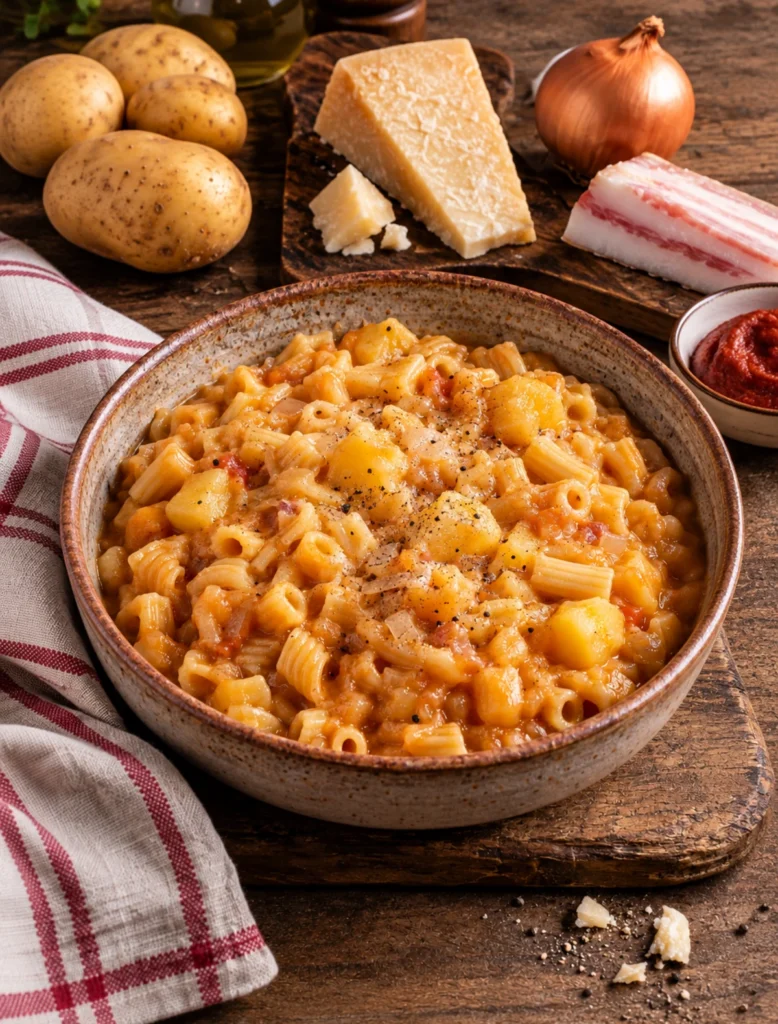
Anyone expecting soup may be surprised. Neapolitan Pasta e Patate can be so thick that it barely moves on the plate. It is “azzeccata” — literally, stuck or clinging — and that is exactly how many Neapolitans like it.
That happens because the pasta and potatoes do not take separate paths only to meet at the end. They cook together and gradually bind into one dish. The consistency is so distinctive that one look at the plate is enough to see how far it is from a brothy pasta and potato soup.
Provola, on the other hand, can divide families. Today the version with melted, stringy cheese is hugely popular both in Naples and elsewhere, to the point that for many people Pasta e Patate automatically means pasta, potatoes, and provola.
But it was not always that way, and it certainly is not the only Neapolitan Pasta e Patate. We have kept ours simpler, without provola. Not because the version with provola is any less Neapolitan, but because we wanted to start with the dish before someone decided to make it even richer.