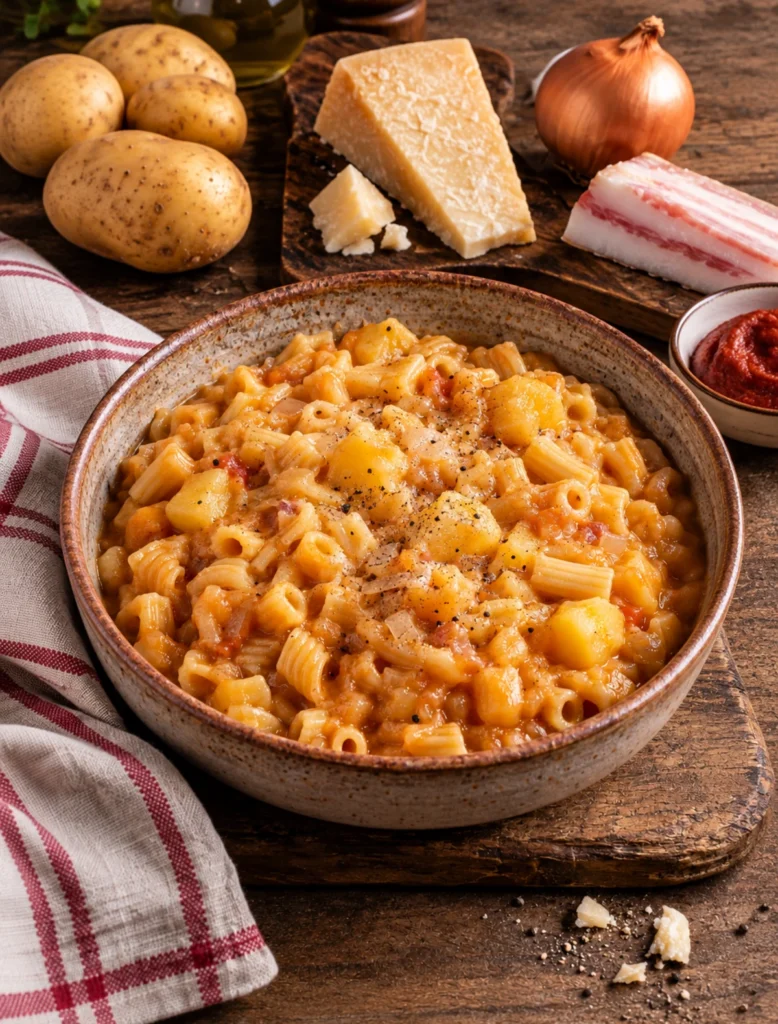
Pasta e Patate alla Napoletana should arrive at the table creamy and almost thick enough to hold its shape. In Naples, they call it “azzeccata”: the pasta and potatoes should cling together, with no broth left at the bottom and neither one taking over the dish.
The potatoes cook slowly with lard, onion, and a little tomato. Once they are tender, the pasta goes straight into the same pot, and from that point you need to keep an eye on it, adding only as much water as necessary and stirring every so often. Some of the potato pieces break down, the pasta releases its starch, and little by little that creamy base comes together.
Mixed pasta makes perfect sense here. The munnezzaglia was made from whatever remained of different pasta shapes, combined rather than thrown away. The Parmesan rind would go into the pot too, cleaned and left to soften as everything cooked. It is hard to think of two ingredients that tell the story behind this dish any better.
Then there is provola. Today, pasta, potatoes, and provola is one of the best-known Neapolitan versions, but it is not the only way to make the dish. We are leaving it out and making a simpler Pasta e Patate, with that dense consistency that almost makes you want to chase the last spoonful around the plate.
Pasta e Patate: Neapolitan Pasta and Potatoes
Description
A creamy, almost dry Neapolitan Pasta and Potatoes, made with mixed pasta, potatoes, lard, a little tomato paste and Parmigiano rind. Cooking the pasta and potatoes together in the same pot creates a thick, creamy consistency that brings everything together.
Ingredienti
Instructions
How to Make Pasta e Patate
-
Prepare the Ingredients 🔪
Peel the potatoes and cut them into cubes about 1.5–2 cm in size. Finely chop the onion and cut the lard into very small pieces. Scrape the outside of the Parmesan rind thoroughly and cut it into 3–4 pieces.
-
Render the Lard and Add the Onion 🥓
Place the lard in a large saucepan and cook over low heat for 3–4 minutes, stirring occasionally. Once it begins to turn translucent and release its fat, add the onion and cook for another 2–3 minutes, until softened but not browned.
-
Add the Potatoes and Tomato 🥔
Add the potatoes and cook them in the rendered fat for 2–3 minutes, stirring gently. Add the tomato paste and stir until evenly distributed.
Pour in 800 g of water, add the Parmesan rind, and bring to a gentle boil.
-
Cook the Potatoes 🍲
Reduce the heat, cover with the lid slightly ajar, and cook for about 25–30 minutes. The potatoes should be tender but not completely falling apart.
Meanwhile, keep some hot water nearby to finish cooking the pasta.
-
Cook the Pasta with the Potatoes 🍝
Once the potatoes are tender, add the mixed pasta directly to the saucepan. Stir and cook over medium-low heat for the time indicated on the package.
Add hot water a little at a time and only as needed, stirring often. As the pasta cooks, some of the potato cubes will naturally break down and the starch released by the pasta will thicken the cooking liquid.
The pasta should finish al dente, creamy, and almost dry, rather than soupy.
-
Rest and Serve 🍽️
Turn off the heat, add some freshly ground black pepper, and stir. Leave the Pasta e Patate to rest in the saucepan for 2–3 minutes, then serve hot.
Nutrition Facts
Servings 4
- Amount Per Serving
- Calories 670kcal
- % Daily Value *
- Total Fat 24g37%
- Saturated Fat 10g50%
- Sodium 175mg8%
- Total Carbohydrate 95g32%
- Dietary Fiber 7g29%
- Sugars 6g
- Protein 18g36%
* Percent Daily Values are based on a 2,000 calorie diet. Your daily value may be higher or lower depending on your calorie needs.
Note
The amount of water can vary slightly depending on the type of potato, the pasta you use, and the width of your saucepan. Once the pasta has been added, pour in extra water a little at a time. It is much easier to add more than to fix Pasta e Patate that has become too soupy.
Stir frequently after adding the pasta, particularly during the last few minutes. Some of the potatoes will naturally break down while the starch released by the pasta remains in the saucepan, creating the characteristic creamy consistency.
Always taste before adding salt. The lard and especially the Parmesan rind can already provide plenty of seasoning, and the amount needed will vary considerably depending on the rind.
The Parmesan rind should be thoroughly scraped and cleaned before use. It will soften during cooking and add flavor to the dish; if it becomes tender enough, you can serve it together with the Pasta e Patate.
If you want to make the version with provola, add it in small cubes after turning off the heat and stir until melted and stringy. Leave the Pasta e Patate slightly looser before adding it, as the cheese will thicken it further.