The Rice That Reached the Rialto Market
During the 16th century, rice fields became increasingly common in the countryside around Verona. Families of Lombard origin helped spread rice cultivation, taking advantage of the waterways and land suitable for flooding. Part of the harvest also entered Venice's trading network, reaching the Rialto market.
Growing rice required considerable work. Farmers needed canals to control the water supply and rice mills, known as pile, to remove the outer husks from the grains. In 1545, the Venetian Senate established the Provveditori sopra i Beni Inculti, a magistracy responsible for matters including water management and the improvement of agricultural land.
Behind the rice sold at Rialto stood a network of landowners, farmers, millers and merchants. The countryside of the Venetian mainland supplied a city that, despite being surrounded by water, depended heavily on agricultural produce from inland territories.
When Rice Fields Were Feared
Flooded fields soon began to concern the Venetian authorities. In areas where rice cultivation was expanding, residents feared the diseases associated with marshes and stagnant water. The role of mosquitoes in transmitting malaria was still unknown. At the time, many illnesses were believed to be caused by unhealthy vapours rising from wetlands.
In 1574, the Venetian Republic introduced restrictions on the expansion of rice fields. Landowners had an economic interest in increasing production, while local communities had to live with the health risks associated with flooded land.
Rice cultivation had already reached several parts of the Vicenza area. At Bagnolo, now part of Lonigo, records document a rice field established in 1560 and associated with the Venetian Pisani family. Such evidence helps illustrate how the agricultural landscape of Veneto was changing throughout the century.
The Doge's Twenty-Six Silver Bowls
Official banquets in the Venetian Republic followed an elaborate set of rules. The scalco maggiore, the chief steward, coordinated the staff, organised the courses and supervised the tableware used for ceremonies at the Doge's Palace.
Food historian Roberto Zottar, referring to accounts of 18th-century Venetian banquets preserved in the State Archives of Venice, recounts an episode associated with the Feast of St Mark. Twenty-six silver bowls were reportedly prepared for the occasion: thirteen containing rice and another thirteen holding bisi col persutto, peas with ham.
The bowls were collected from the Venetian Mint, where part of the silverware used for official occasions was kept. The chief steward was responsible for collecting them and arranging their return.
Rice and peas therefore appeared as two separate preparations. The accounts described in these historical reconstructions do not establish whether the ingredients were combined before serving or mixed by the guests themselves. The presence of ham is also notable, as it appears in this 18th-century account but is absent from the traditional recipe registered in Scorzè.
The episode offers a glimpse into the dining customs of the Venetian Republic.
The Peas of Strunjan and the Connection with Istria
In Strunjan, on the Istrian coast of present-day Slovenia, the fields near the sea were known for producing early-season vegetables. The village, also famous for its salt pans, preserves a tradition associated with peas.
According to local accounts, the first harvests of the season were particularly sought after, and some of the finest peas were sent to Venice. The coastal location and mild climate encouraged earlier production than in many inland areas.
Istrian chef Tomaž Bevčič has recalled this custom when discussing the food traditions of Strunjan. His restaurant is called Rizi e Bizi, a name with an unmistakable connection to the Venetian dish.
For centuries, the two shores of the Adriatic were connected by trade routes and territories belonging to the Republic of Venice. Food traditions travelled alongside goods and people. The relationship between these preparations survives in their names and culinary traditions, although the exact place where the dish originated remains uncertain.
One Hundred Grains of Rice and One Hundred Peas
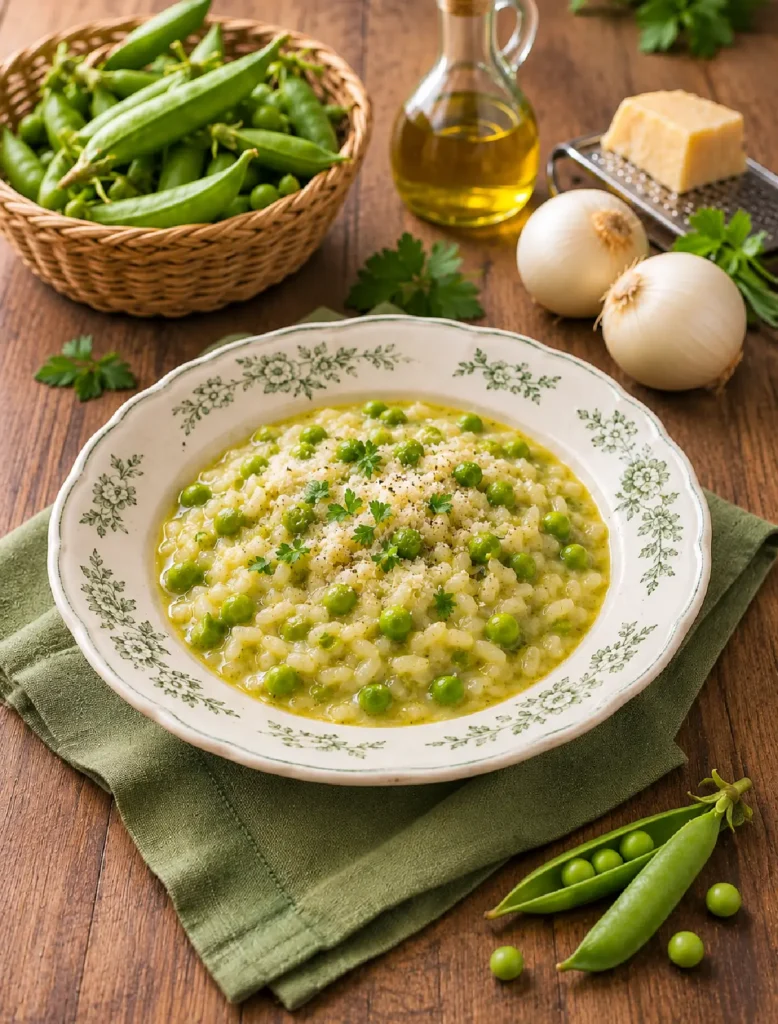
Cento risi e cento bisi is a traditional Venetian expression suggesting a dish in which every grain of rice is matched by a pea. The image places the two ingredients on equal footing.
In Stra, along the Brenta Riviera, the expression has been revived in the name SentorisiSentobisi, an event dedicated to local food and traditions.
The Brenta Riviera has a particularly close connection with Venetian history. Along the waterway, wealthy Venetian families built villas surrounded by gardens, vegetable plots and farmland. Its proximity to the lagoon encouraged trade with the city, while the surrounding countryside supplied many of the ingredients that reached Venetian tables.
The event in Stra has brought the traditional dialect name back into local food culture, involving restaurants and businesses in celebrating the dish.