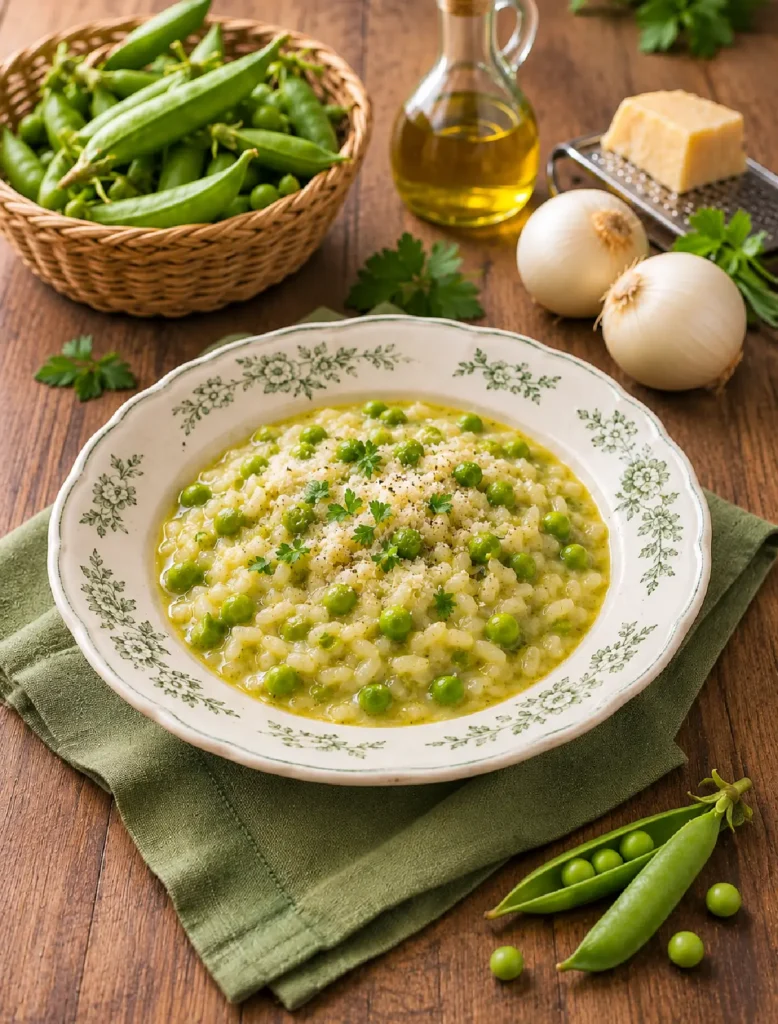
In risi e bisi, the rice and peas are eaten together with a spoon, accompanied by a slightly thickened broth. The grains of Vialone Nano rice remain distinct, while the peas, tender but still whole, bring a gentle sweetness to every mouthful. Parmesan and butter, added at the end, give the dish a creamier texture without overwhelming the delicate flavour of the peas. Its consistency changes even as we eat it: freshly served, it is more fluid, but the rice gradually absorbs the broth and the mixture becomes thicker.
The generous quantity of peas is one of its defining features. In the traditional recipe, peas and rice are used in equal weights, so the peas are far more than a supporting ingredient. When freshly shelled, they have a sweetness that also carries through into the broth. White onions and parsley round out the flavour, while black pepper adds a slightly pungent note. The finished dish is soft and spoonable, with ivory-coloured rice and bright green peas, rather than the compact surface of a thick risotto.
This is primarily a springtime dish. In the Venetian countryside, fresh peas were eagerly awaited as the warmer weather arrived, and those grown around Peseggia, near Scorzè, became particularly associated with this preparation. Its best-known celebration is the Feast of St Mark on 25 April. According to tradition, risi e bisi was served to the Doge of Venice on this occasion, when the first fresh peas of the season were considered a delicacy.
In 2013, the Pro Loco association of Scorzè, with contributions from the Italian Academy of Cuisine, promoted the recovery of the traditional recipe and its registration with the Venice Chamber of Commerce. Since 2024, risi e bisi has also been recognised as a Traditional Agri-Food Product (PAT) of the Veneto region.
Risi e Bisi Venetian Rice and Peas
Description
A traditional Venetian dish made with Vialone Nano rice, fresh peas and broth flavoured with pea pods. Soft and slightly brothy, it is finished with butter and Parmigiano Reggiano.
Ingredients
For the broth
For the rice and peas
Instructions
How to Make Risi e Bisi
-
Prepare the Pea Pod Broth 🍲
Shell the peas, keeping the pods. Wash the pods thoroughly under running water and place them in a large saucepan with the chicken, celery, carrot, onion, garlic and a little salt. Add approximately 2 litres (67.6 US fl oz) of cold water, slowly bring to the boil and simmer gently for about 60 minutes, skimming off any foam that rises to the surface. The broth can also be prepared the day before.
-
Extract the Pea Pod Pulp 🫛
When the broth is ready, remove the pea pods and pass them through a food mill to extract their tender pulp, leaving behind the tough fibres and strings. Stir the resulting purée into the strained broth and keep it warm over a low heat.
-
Cook the Onions and Peas 🧅
Finely slice the fresh white onions. Heat the olive oil in a large, heavy-bottomed saucepan, then add the onions, chopped parsley and shelled peas. Pour in 100 ml (3.4 US fl oz) of water and cook gently for 10–15 minutes, stirring occasionally. The onions should soften without browning, and the peas should remain whole. Season lightly with salt.
-
Add the Rice and Broth 🍚
Add the Vialone Nano rice directly to the saucepan with the peas, without toasting it separately. Stir gently and pour in a few ladles of hot broth. Continue cooking over a moderate heat for approximately 15–20 minutes, checking the cooking time indicated on the rice packaging.
Add more broth as the liquid is absorbed, stirring frequently to prevent the rice from sticking to the bottom of the saucepan. The mixture should remain soft and sufficiently moist throughout cooking.
-
Finish with Butter and Parmesan 🧈
When the rice is cooked but still slightly firm in the centre, turn off the heat. Add the butter, grated Parmigiano Reggiano and freshly ground black pepper. Stir gently until everything is combined, adding a little more hot broth if necessary.
-
Serve with the Right Consistency 🥄
Risi e bisi should have an all'onda consistency, somewhere between a loose risotto and a thick rice soup. When you gently move the saucepan, the rice should flow rather than form a compact mass. Taste, adjust the salt if necessary and serve immediately while hot.
Nutrition Facts
Servings 6
- Amount Per Serving
- Calories 580kcal
- % Daily Value *
- Total Fat 19g30%
- Saturated Fat 7g35%
- Sodium 380mg16%
- Total Carbohydrate 86g29%
- Dietary Fiber 6g24%
- Sugars 8g
- Protein 17g34%
* Percent Daily Values are based on a 2,000 calorie diet. Your daily value may be higher or lower depending on your calorie needs.
Note
Choosing the rice
Vialone Nano is the traditional variety used for risi e bisi. If it is unavailable, Carnaroli is a good alternative and is generally easier to find outside Italy. Check the cooking time and adjust the quantity of broth, as the two varieties absorb liquid differently.
Choosing the peas
Fresh peas are ideal, particularly in spring. Outside the season, you can use frozen peas, preferably small and tender ones. Since frozen peas do not come with pods, replace the pea pod broth with a light chicken broth.
Preparing the broth in advance
The broth can be made the day before. Cool it quickly, refrigerate it and bring it back to the boil before using. If you run out of broth while cooking the rice, add a little hot water to maintain the desired consistency.
Getting the right texture
Risi e bisi thickens quickly after cooking. Keep some hot broth aside and add a little just before serving if necessary. The finished dish should be looser than a typical risotto.
Storage
Risi e bisi is best eaten immediately after cooking. Cool any leftovers quickly and refrigerate them in a sealed container for no longer than 24 hours. Reheat thoroughly only once, adding a little broth or water if needed. Do not leave cooked rice at room temperature for extended periods.